Holding up half the sky on India’s farms Premium
The Hindu
Women now constitute about one-half of the agricultural workforce in India
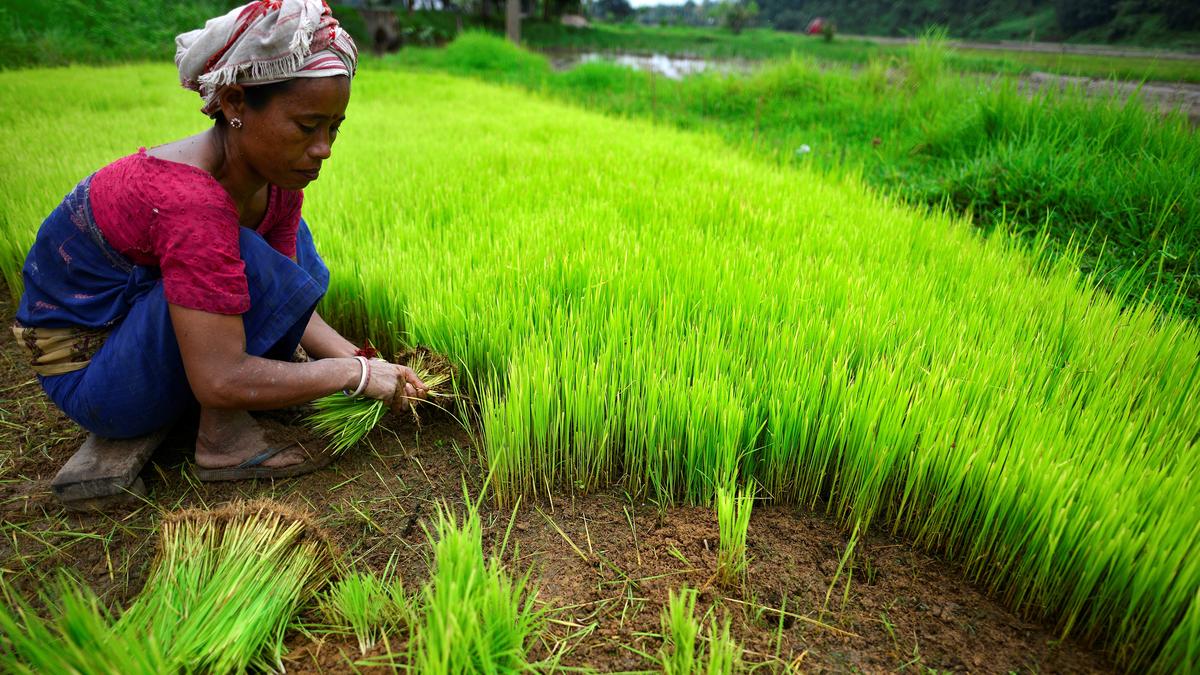
As we celebrated Women’s Day on March 8 this year, we also celebrated the International Year of the Woman Farmer (announced by the United Nations Food and Agriculture Organization). It was an opportunity to recognise the contribution of working women to India’s agricultural economy. As official statistics do not give a complete picture of the scale of participation, type of work, and economic contribution of women, it is field data that we must turn to. It tells us that while women’s labour is central to crop and livestock production, the remuneration to women workers is extremely low and stagnating.
First and foremost, we lack accurate information on how many women are actually engaged in agriculture, livestock rearing, fisheries and other allied activities. Large-scale labour force surveys (such as the Periodic Labour Force Surveys) are unable to capture women workers accurately because in a largely informal agrarian economy, women’s work is often home- or farm-based, unpaid, seasonal, intermittent (even over the course of a single day), and intermingled with care work. For example, a woman respondent may not report herself as a “worker” if her day involves multiple tasks of child care interspersed with animal rearing.
What official labour force surveys tell us is that women’s work participation in rural India has risen sharply in recent years. Among rural girls and women aged 15 years and above, 46.5% were in the workforce in 2023-24 as compared to 35% in 2011-12. This still remains lower than the rest of the world: according to the International Labour Office, women’s work participation was in the range 57%-63% in a majority of countries.
Hidden behind this statistic that shows a rise in rural women workers lies a less happy reality, namely, that the rise is largely in the count of ‘self-employed’ women, reflecting a lack of wage employment opportunities. In 2011-12, 60% of rural women workers were classified as self-employed; the proportion rose to 73 per cent in 2023–24. In the same period, the share of women employed as regular and casual wage workers fell. Further, the share of self-employed women working in the agricultural sector rose from 48% to 62%, and, of the total number of self-employed workers in agriculture, women comprised almost one-half (47.2%in 2023-24).
Put together, in 2023-24, there were at least 117.6 million women working in agriculture (of whom 21.7 million were hired workers, 95.1 million were self-employed and 0.8 million were regular workers). The estimated male workforce in agriculture was 127.5 million.
The first sector we consider is crop production. Official statistics cannot tell us the share of women workers in total labour deployed in crop cultivation as gender-disaggregated data on family labour are not collected. We provide an answer with data from village-level surveys conducted by the PARI project of the Foundation for Agrarian Studies (www.fas.org.in/pari). From this unique database of 27 villages, we draw on two villages, Palakurichi and Venmani, from Nagapattinam district of Tamil Nadu (studied in 2019) and two villages (Harveli and Mahatwar) from western and eastern Uttar Pradesh (studied in 2023).


Parliament is set to introduce a Bill to codify CAPF functions, responding to a Supreme Court ruling on IPS deputation.

BDA seeks court approval to invite applications for residential site allotments in Shivaram Karanth Layout, mired in litigation since 2017.

PM Modi criticizes DMK's governance in Tamil Nadu, alleging corruption and unfulfilled promises during a Tiruchi rally.

IPL's first phase schedule revealed, disappointing Vizag fans as no matches are set for the coastal city this season.

Uthandi residents express environmental concerns as a flood escape channel from Buckingham Canal awaits CRZ clearance in Chennai.

The BJP said on Wednesday that it will stage a protest in Udupi on Saturday, against Chief Minister Siddaramaiah for completely ignoring Udupi district while presenting 2026-27 Budget proposals.

Political controversy erupts as Kerala's PWD Minister is excluded from PM Modi's event, prompting CPI(M) to hold a parallel inauguration.

In an attempt to keep their kitchens running, many restaurants in Bengaluru have turned to alternatives such as kerosene stoves, induction cooktops.

SSLC exams begin in districts

Kremlin accuses Britain of aiding Ukraine's missile strike on Bryansk, resulting in civilian casualties and escalating tensions.

Raichur's bandh for internal quota for SCs garners strong support, disrupting businesses and transport as protesters demand government action.

Karimnagar's decades-old dumping yard will be relocated within a year, addressing community health and environmental concerns, says Minister Ponnam Prabhakar.

PM Modi assures confidence in overcoming the energy crisis from the West Asia conflict, urging calm and unity among citizens.