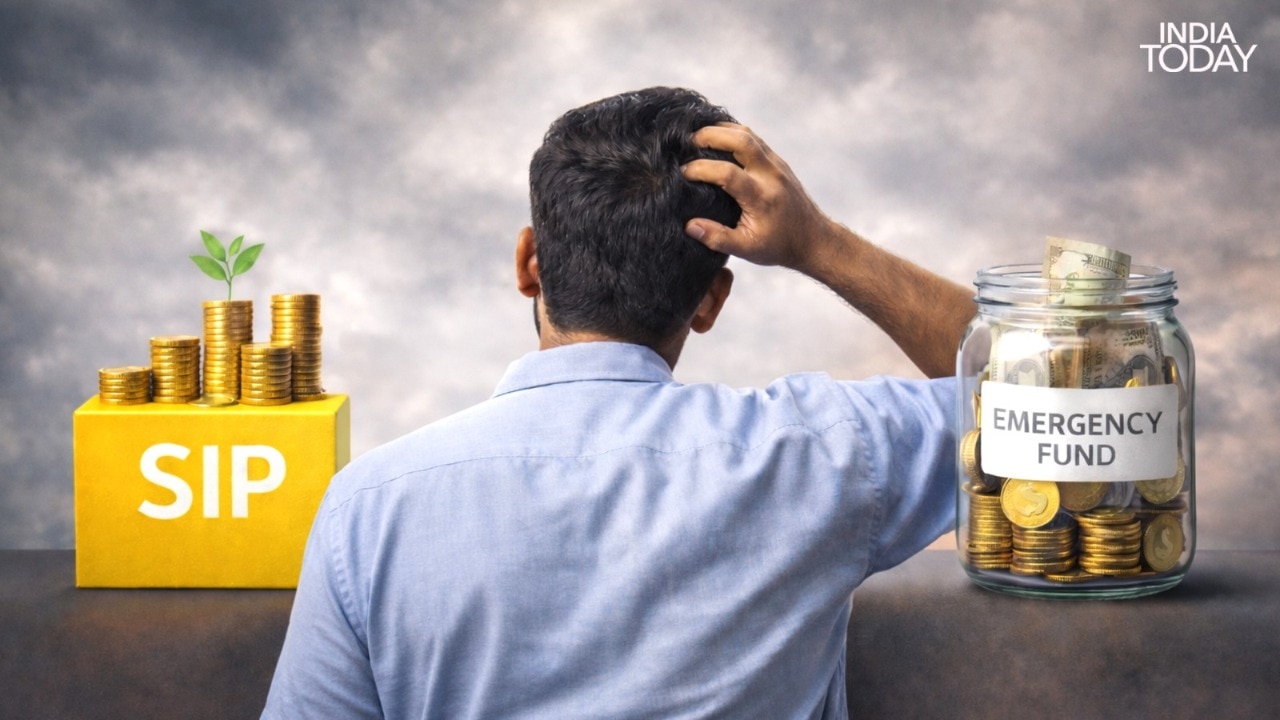
Have Rs 5,000? Here's why an emergency fund should come before your SIP
India Today
You've heard the advice, i.e., "Start a SIP immediately." But is that the smartest first move with Rs 5,000? The choice might surprise you.
Imagine this: You just received your first salary and feel on top of the world. Everyone around you is talking about mutual funds and wealth creation, so you decide to start a Rs 5,000 SIP (Systematic Investment Plan) immediately. The excitement is real, you check your portfolio daily, imagining the wealth you would accumulate over the years.
But life, as it often does, had other plans. A sudden accident, a medical emergency, or an urgent expense hits. With no emergency fund to rely on, that SIP you were so proud of has to be broken at a loss. The joy of investing evaporates, replaced by frustration, and a shaken confidence in the very idea of growing your wealth.
IndiaToday.in spoke to Ritesh Sabharwal, certified financial planner and personal finance expert; Gaurav Makhijani, Tax Head at Makhijani Gera and Associates; and Mayank Bhatnagar, Co-founder and COO of FinEdge, to understand: if you have Rs 5,000 to spare, what should come first—SIP or emergency fund?
Ritesh Sabharwal explains the key issue, “FOMO-driven investing without a safety net is a common trap. Beginners see friends making money in mutual funds, feel they're ‘missing out,’ and immediately start SIPs, only to break them at a loss when an emergency hits six months later. The investment isn’t the problem—the sequence is.”
The numbers back it up. “70% of people who start SIP without an emergency fund break it within 2 years. Those who prioritise a safety net first—85% stay invested for over five years,” Sabharwal adds.
So how should a first-time investor with only Rs 5,000 spare approach this? Mayank Bhatnagar explains, “An emergency fund is a goal in itself, and a SIP can be one of many tools to achieve it. For individuals with irregular income, dependents, or limited job security, building a basic emergency buffer may take precedence to avoid dipping into investments during unforeseen events.”


For many borrowers under 40, applying for a home loan online is no longer optional, it is the preferred way. Around 72% of borrowers in this age group choose digital applications, and nearly half of borrowers above 60 are also getting comfortable with online processes.

The main trigger for the rally was Infosys announcing a strategic partnership with artificial intelligence firm Anthropic. Investors reacted positively to the news, pushing Infosys shares nearly 3% higher to around Rs 1,407 during the session.

Speaking on the development, Commerce Secretary Rajesh Agrawal said a joint statement outlining the contours of the agreement has already been signed. He said that these contours now need to be converted into a formal legal agreement.

The S&P BSE Sensex rallied 650.39 points to close at 83,277.15, while the NSE Nifty50 added 211.65 points to end at 25,682.75.

The S&P BSE Sensex was down by 47.79 points to 82,578.97, while the NSE Nifty50 lost 7.45 points to 25,464.75 as of 9:48 am.

Describing the Budget for the fiscal year starting April 1 as reflective of his governance approach, PM Modi said the document is a good reflection of our governance style and priorities.

You've heard the advice, i.e., "Start a SIP immediately." But is that the smartest first move with Rs 5,000? The choice might surprise you.

The next market shift may not come from earnings or interest rates. It may come from AI. In this article, we explore how it could reshape your stock and mutual fund investments.

The DGCA has imposed a fine of about Rs 1 crore on Air India for flying an Airbus aircraft eight times without a valid airworthiness permit. The aviation watchdog also said the lapse further eroded public trust in the airline.

The journey of hyper-personalisation in personal loans is going to get more exciting for customers with the increasing adoption of technology refining customer offerings, based on minute details of the customers.

Reliance wins US licence for Venezuelan oil as India wavers on Russia supply

After a stunning rally and an equally sharp fall, silver now sits at a crucial crossroads, leaving investors wondering whether this correction is nearing its end or still gathering momentum.

The data, released by the Ministry of Statistics and Programme Implementation, reflects a major statistical overhaul aimed at making India's inflation measure more representative of current consumption patterns.