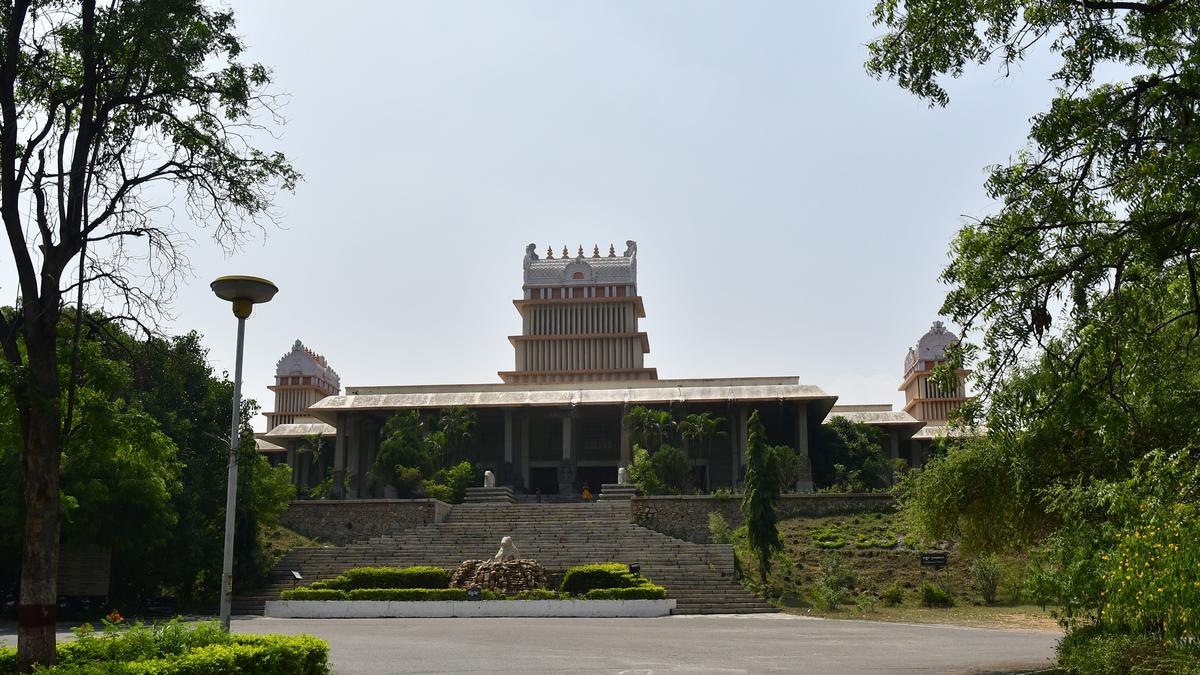
Hampi’s Kannada University finally granted ₹1 crore special grant, but varsity is not able to use it as Karnataka govt. has not approved action plan
The Hindu
The severely cash-strapped and debt-ridden Kannada University, Hampi, was finally given a special grant of ₹1 crore by the State government two months ago. This, though inadequate, should have come as a breather for the university. However, that is not to be, as the government is yet to approve its action plan, though the university submitted the same two months ago.
The severely cash-strapped and debt-ridden Kannada University, Hampi, was finally given a special grant of ₹1 crore by the State government two months ago. This, though inadequate, should have come as a breather for the university. However, that is not to be, as the government is yet to approve its action plan, though the university submitted it two months ago.
The money is part of a special grant of a total of ₹8 crore to seven universities in Karnataka. “Of this, ₹2 crore has been released to Dr. B.R. Ambedkar School of Economics University, Bengaluru, ₹1 crore to Kannada University, Hampi, and the remaining distributed to the University of Mysore, Mangalore University, and others,” said M.C. Sudhakar, Minister for Higher Education. However, the delay in approval of action plans has made this fund a mirage.
Kannada University already has a liability of ₹3.9 crore. While the grant of ₹1 crore is insufficient, the delay in approval of its action plan even two months after submission, has crippled research activities at the university.
“In the action plan, we have given more emphasis on research initiatives. But, since the government has not given approval, research activities have also been hampered. If the grant is used without the action plan being approved, an audit objection will be raised. We have repeatedly requested the government to approve the action plan, but there has been no reply,” said D.V. Paramashivamurthy, Vice-Chancellor.
The State government has been trying to nudge universities into becoming self-sustaining and cutting grants. However, Kannada University is a unique case as it is entirely focused on research and does not give affiliation to colleges owing to which it does not have any revenue sources. During the COVID-19 pandemic, the university was not even able to pay the salaries of contract workers for 18 months as the government did not give funds adequately. “Despite several requests to the State government to pay off the backlog, there has been no response,” Dr. Paramashivamurthy said.
“In the initial years, the government provided an annual grant of ₹25 crore to ₹50 crore to the university. However, this grant which was supposed to increase year-on-year, is decreasing drastically. Earlier, we had 73 faculty members. Now this has come down to 46. About 20 will retire in the next three years. There is only one faculty member in four departments. There are no full-time faculty members in 19 departments. Can the university become self-sustaining in such a situation?” he questioned. “If the government fills the vacant posts and gives an annual grant of ₹6 crore to ₹7 crore, the university will function optimally,” he said.


Abhishek Banerjee challenges BJP's Suvendu Adhikari in Nandigram, pledging community health initiatives if Trinamool Congress wins.

Rising LPG shortages in Karnataka boost firewood demand, reviving an informal market as households and hotels seek alternatives.

Against the backdrop of intense poll activity, a 400-metre stretch of an arterial road in the outskirts of Chennai (technically in Madurapakkam panchayat under Tambaram assembly constituency) presents a salute to the idea of res publica, which underpins India’s system of governance, where citizens have a say, at least before a government is securely ensconced in the seat of power. A Republic Day initiative shines bright every night

Fadnavis claims zero FIR in Ajit Pawar crash is a defamation attempt by Karnataka against Maharashtra's investigation efforts.

Set to unfold as a one-day pop-up on April 5, the Easter Sadya brings together both vegetarian and non-vegetarian menus, offering a peek into the food traditions of the Syrian Christian (Nasrani) community. While the traditional Sadya is often associated with dishes such as sambar, avial, and rice, this version expands to include community-specific festive dishes.

BJP nominates mother of R.G. Kar victim Abhaya to contest from Panihati in West Bengal Assembly elections.

Veteran Malayalam actor-director E.A. Rajendran passes away at 71, leaving behind a rich legacy in the film industry.

Dakshina Kannada Zilla Panchayat has rolled out digital mode of water bill generation and collection in 23 gram panchayats on a pilot basis for the first time in Karnataka. This is set to be extended to the remaining 200 panchayats shortly, according to the Zilla Panchayat Chief Executive Officer Narwade Vinayak Karbhari.

Bengaluru police questioned a man carrying ₹6 lakh for medical expenses at Vidhana Soudha, later releasing him after verification.

BJP accuses Bengaluru's Congress government of corruption in e-Khata issuance, halting infrastructure projects due to financial mismanagement.

Misinformation in Hyderabad sparks panic buying, causing disruptions as residents react to unfounded rumors of an impending lockdown.

Bengaluru Metro extends services until 2 a.m. on March 28 for IPL match, ensuring convenient travel for spectators.

A bus truck-collision in Andhra Pradesh's Markapuram district, killing several. Catch LIVE updates here!