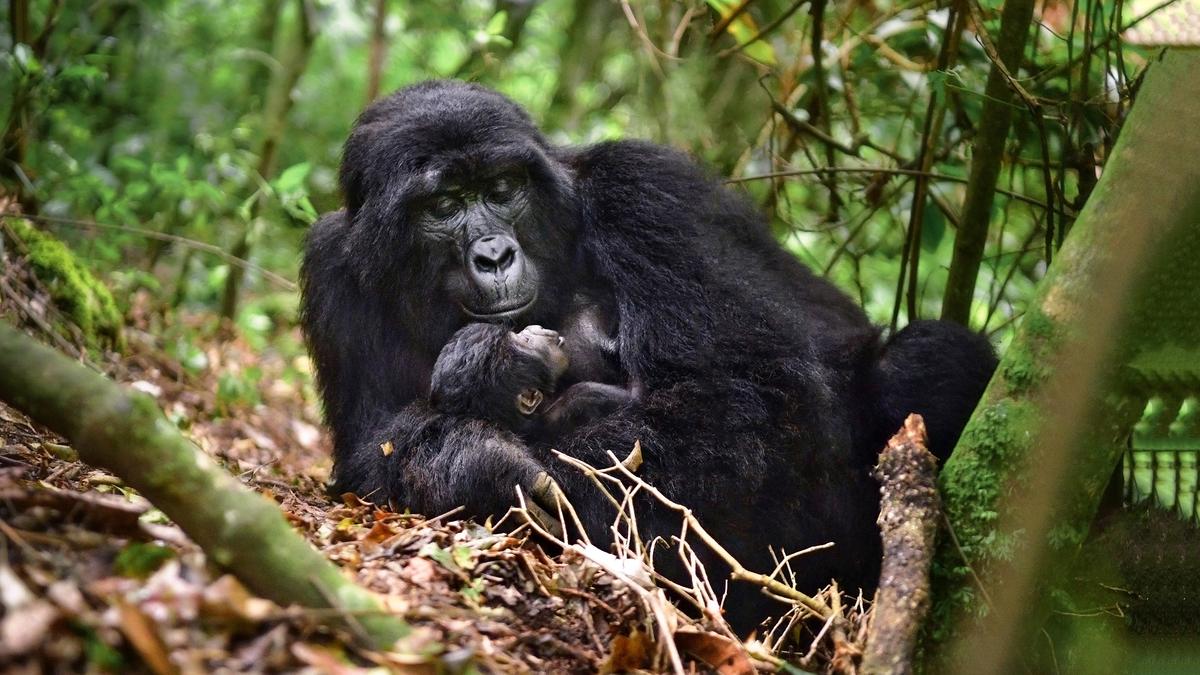
‘Gorillas are what we want to be’: conservation leader Gladys Kalema-Zikusoka Premium
The Hindu
Explore Gladys Kalema-Zikusoka's pivotal role in Uganda's mountain gorilla conservation, intertwining ecology, governance, and community health.
Uganda’s history with mountain gorillas is inseparable from its political turmoil. Mountain gorillas (Gorilla beringei beringei) are restricted to Central Africa and number around a thousand individuals. They inhabit dense volcanic, bamboo, and montane forests at elevations of 2,200-4,300 m.
Yet from Uganda’s independence in 1962 through Milton Obote’s centralisation, Idi Amin’s brutal dictatorship, and Yoweri Museveni’s lengthy rule, poaching and habitat loss have pushed gorillas confined to the Bwindi and the Virunga parks to the brink. And in Uganda’s collective efforts to restore both the species and a sense of national identity, Gladys Kalema-Zikusoka stands out as a defining figure.
Dr. Kalema-Zikusoka, Uganda’s first wildlife veterinarian and one of Africa’s most respected conservationists, has spent more than three decades working during one of the most difficult periods of Ugandan history. She is a globally recognised conservationist and the founder of Conservation Through Public Health (CTPH), where her One Health model has significantly contributed to mountain gorilla conservation. For this work, she received the Whitley and Rolex Awards and the UN Environment Programme’s Champion of the Earth Award.
Like India, Uganda is a postcolonial democracy where wildlife conservation has unfolded alongside political instability and debates about who should bear the cost of protecting nature. The fate of Uganda’s mountain gorillas, much like India’s tigers or elephants, has been shaped by governance, public health, and community relations as well as ecology. And Dr. Kalema-Zikusoka’s work must be understood within this intersection.
Being born and raised in Amin’s time on Ugandan soil and in a politically influential family wasn’t easy.
“When I was just two years old in the 1970s, my father was abducted and murdered by Idi Amin’s men,” Dr. Kalema-Zikusoka said. Much like the rest of Uganda, her life was severely affected by the regime, which destroyed institutions, communities, and wildlife.


Witness the blood moon during the lunar eclipse day in India and other countries, through pictures here.

Discover the fascinating world of hydroxyl megamasers, powerful cosmic lasers revealing secrets of distant galaxies and the universe's evolution.

Discover how India's unique resources could lead to groundbreaking advancements in global cancer care and research.

Discover groundbreaking research on Mars lightning, innovative smart materials, and a universal ageing marker in just one minute.

A launch vehicle’s ascent battles gravity to gain orbital velocity, while re-entry is a controlled struggle against the atmosphere to systematically shed that immense kinetic energy through aerobraking, thermal protection and precise guidance within the re-entry corridor. Operating as a semi-ballistic body, the crew module performs a deorbit burn, manages communication blackout, and deploys a three-stage parachute system to ensure a safe splashdown.

The Nissan Gravite is a budget-friendly seven-seater MPV designed for practical family use in India. Sharing its platform with the Renault Triber, it offers flexible 2-to-7 seating, a removable third row, generous boot space, and a fuel-efficient 1.0-litre petrol engine delivering around 19 km/l. With features such as a floating touchscreen, wireless connectivity, digital instrument cluster, and six airbags as standard, the Gravite blends affordability, safety and everyday usability in a compact footprint tailored to urban and small-family needs.

Discover the dedication of Tamil Nadu's teenage cyclists competing at the Track Asia Cup, balancing sport and academics.

Explore how Salar de Pajonales in Chile serves as a vital Mars analogue for studying microbial life and ancient fossils.

NASA revamps its Artemis lunar program to address delays and ensure a Moon landing by 2028.