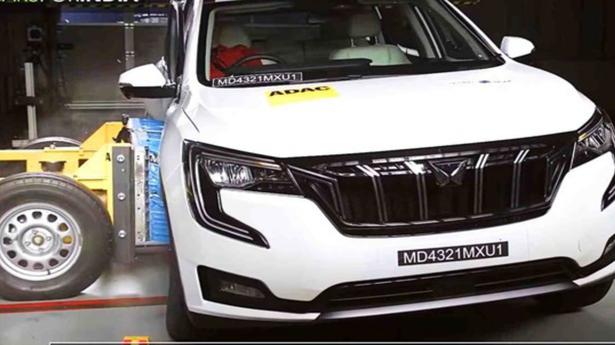
GNCAP 5-star rating to get tougher
The Hindu
Automotive safety watchdog Global NCAP has now introduced an enhanced testing protocol. In order to
Automotive safety watchdog Global NCAP has now introduced an enhanced testing protocol. In order to get a 5-star safety rating, all cars need to be fitted with ESC as standard, and will also be subjected to side impact protection tests. Additionally, the cars will also have to comply with pedestrian protection measures as per UN requirements.
For cars tested under GNCAP’s Safer Cars for India programme, scoring a full 5-star safety rating will now be even tougher. So far, models tested by GNCAP were subjected to a side-impact test either after scoring a 5-star rating in the frontal offset crash test or at the behest of the manufacturer. Now, the side-impact test will be mandatory for all cars and will be crucial for achieving a 5-star safety rating.
Additionally, the new norms state that even if a car scores multiple stars, but the dummy reading shows poor protection for a vital body part, it will only get one star, regardless of the overall points scored. Further, ESC and pedestrian protection equipment, as per UN requirements, will have to be standard fitment on all variants of the car for a 5-star safety rating.
The last model to be tested under GNCAP’s outgoing testing protocol was the Kia Carens which got a 3-star safety rating.
The upgraded testing protocol was originally set to be introduced in 2021, but were delayed due to the COVID-19 pandemic.
Meanwhile,India-specific crash tests will be conducted under Bharat NCAP, which will roll out from April 1, 2023. Last month, Union Minister for Road Transport & Highways Nitin Gadkari approved the draft notification to introduce Bharat New Car Assessment Program (BNCAP). Automobiles in India will be accorded star ratings based on their performance in crash tests factoring in the existing Indian regulations and driving conditions.
The Bharat NCAP program was first announced in 2016.


Discover efficient pressure cooking techniques to save up to 50% on fuel. OPOS B Ramakrishnan tells you how

Mercedes-Benz CLA 250+ with EQ Technology review: design, performance, range and features explained. Discover how the new electric CLA combines advanced AI, long range, fast charging and futuristic styling for the next generation of luxury EVs.

Pi Day is celebrated every year on March 14, honouring the significance of the mathematical constant π and its applications in mathematics.

Discover how sculptural interior design transforms modern spaces, blending creativity and functionality to evoke emotion and identity.

A study reveals that certain antibiotics can cause long-lasting changes in gut microbiome diversity for up to eight years.

Indian scientists and international experts are divided over a study questioning the viability of a nuclear reactor fuel called HALEU-thorium; while critics cite safety risks, proponents argue the technology is vital to achieve national energy goals.

ISRO and AIIMS partner to enhance space medicine research, focusing on human health during long-duration space missions.

A practical guide to induction setups for students, families, and home food businesses as India’s LPG supply faces its biggest disruption in years

Explore the electrifying Oscars 2026 race, featuring standout films, baffling nominations, and memorable performances amid a cinematic transition.

Zai and Rom Whitaker’s latest book for young readers, The Book of Indian Snakes, tackles common misconceptions surrounding snakes, highlighting their utility to humans

Discover PC Mahalanobis's pivotal role in India's statistical revolution and his lasting influence on modern statistics in this episode.

Explore why nothing can exceed light speed and the paradoxes that arise if it were possible.

Scientists have engineered bacteria to produce designer proteins by smuggling artificial amino acids, enabling precise drug delivery and multifunctional applications.