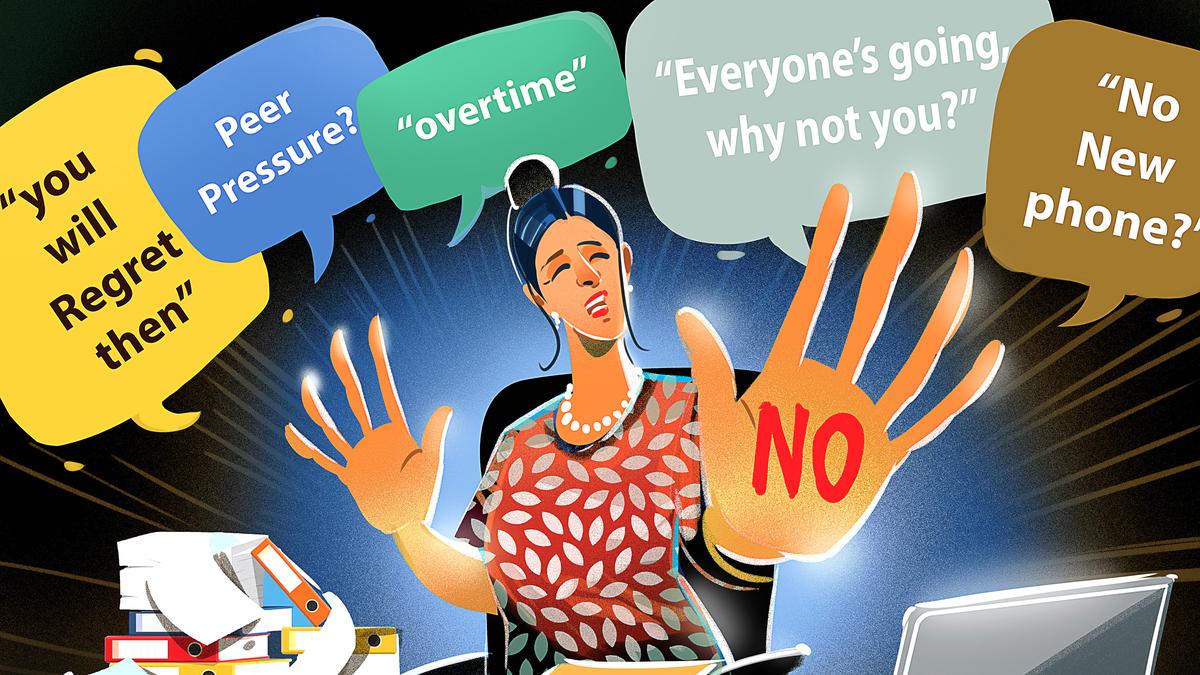
Gen Z, setting the boundaries, and the art of saying ‘No’
The Hindu
Gen Z in Chennai navigating boundaries at work, home, and social circles, prioritizing mental health and self-awareness.
It is hard to miss all the chatter about Gen Z on social media, and one thing that keeps coming up is how this generation is comfortable with saying ‘No’, whether at work, in social circles, and even at home. But how true is this for the younger crowd in Chennai? Are they actually pros at setting boundaries, or does saying ‘No’ still feel like opening up a Pandora’s box?
For many, being vocal about boundaries is not about entitlement; it is often protecting their mental health from burnout and setting limits on things that simply do not serve them.
“If my plate is full and more work is coming my way, I am upfront about it and back it up with data. Saying ‘No’ has been easy for me,” says Padmashree, a corporate employee in her mid-20s. “And it is not just work. Even with friends or family, if I decline something which is upsetting them and they pursue even further, that shows they are not thinking about the best for me,” she says.
According to World Economic Forum, Gen Z will make up 27% of the work force in 2025. Srividya Lakshmi Chandran, a 25-year-old counselling psychologist, explains why they are more comfortable setting boundaries than the other generations, “I think the knowledge that there are other ways of being, other kinds of lifestyles to have, other things to do, which empowers you to say — Hey, you know what? This is my line.”
Of course, this confidence to prioritise oneself does not always come naturally. For some, it is a steep learning curve in self-care, often following burnout. “I used to feel like I had to say ‘Yes’ to everything, neglecting my own me-time. Especially since Gen Z already got a bad rap about not caring, ghosting at work, I felt this pressure to prove something,” says Ajith Paul, 25, who works in finance. “But that led to my being exhausted all the time. Now, I know better.” In unison, most of them agree learning when to tap out, when to take up space, and when to say, “That’s not for me,” is the approach to self-awareness.
The boundary-setting is not rebellion but finding the balance for Kripa Saatvika, 21, working in a non-governmental organisation. She says that even when it comes to boundaries with family and friendships, she has learned to communicate them, though it is not always smooth-sailing. “Even something as simple as stepping out of a conversation when I find it hard, it took me a while to establish that, but it feels much easier now,” she says.
Peer pressure and the missing out of things quotient still get in the way for some sections, though. You find yourself saying ‘Yes’ to things that you would rather skip, to avoid feeling left out or to keep the peace. But Ms. Srividya points out, saying ‘No’ is more like a muscle memory which you practise and build over time.


Abhishek Banerjee challenges BJP's Suvendu Adhikari in Nandigram, pledging community health initiatives if Trinamool Congress wins.

Rising LPG shortages in Karnataka boost firewood demand, reviving an informal market as households and hotels seek alternatives.

Against the backdrop of intense poll activity, a 400-metre stretch of an arterial road in the outskirts of Chennai (technically in Madurapakkam panchayat under Tambaram assembly constituency) presents a salute to the idea of res publica, which underpins India’s system of governance, where citizens have a say, at least before a government is securely ensconced in the seat of power. A Republic Day initiative shines bright every night

Fadnavis claims zero FIR in Ajit Pawar crash is a defamation attempt by Karnataka against Maharashtra's investigation efforts.

Set to unfold as a one-day pop-up on April 5, the Easter Sadya brings together both vegetarian and non-vegetarian menus, offering a peek into the food traditions of the Syrian Christian (Nasrani) community. While the traditional Sadya is often associated with dishes such as sambar, avial, and rice, this version expands to include community-specific festive dishes.

BJP nominates mother of R.G. Kar victim Abhaya to contest from Panihati in West Bengal Assembly elections.

Veteran Malayalam actor-director E.A. Rajendran passes away at 71, leaving behind a rich legacy in the film industry.

Dakshina Kannada Zilla Panchayat has rolled out digital mode of water bill generation and collection in 23 gram panchayats on a pilot basis for the first time in Karnataka. This is set to be extended to the remaining 200 panchayats shortly, according to the Zilla Panchayat Chief Executive Officer Narwade Vinayak Karbhari.

Bengaluru police questioned a man carrying ₹6 lakh for medical expenses at Vidhana Soudha, later releasing him after verification.

BJP accuses Bengaluru's Congress government of corruption in e-Khata issuance, halting infrastructure projects due to financial mismanagement.

Misinformation in Hyderabad sparks panic buying, causing disruptions as residents react to unfounded rumors of an impending lockdown.

Bengaluru Metro extends services until 2 a.m. on March 28 for IPL match, ensuring convenient travel for spectators.

A bus truck-collision in Andhra Pradesh's Markapuram district, killing several. Catch LIVE updates here!