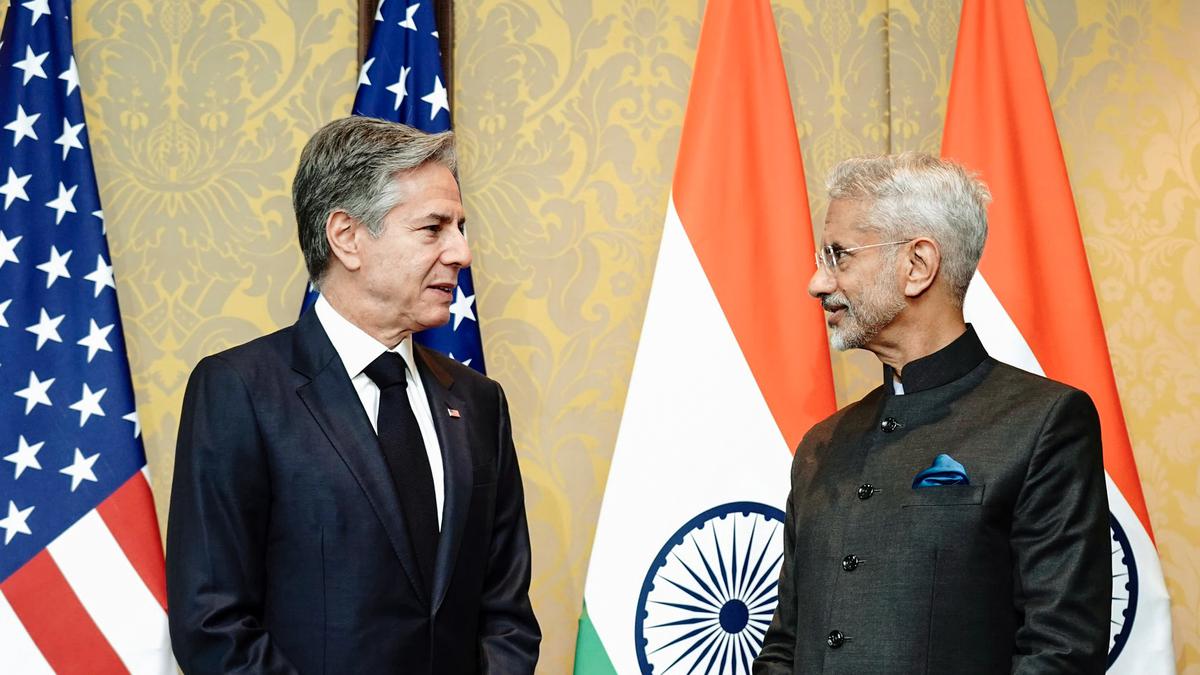
Gaza crisis | India bats for two-state solution during talks with U.S.
The Hindu
India reiterated the need for a two-state solution to end the current Israel-Palestinian crisis, during India-United States 2+2 Ministerial meeting
India reiterated the need for a two-state solution to end the current Israel-Palestinian crisis, during a ministerial meeting between India and the United States on November 10. The Foreign and Defence Ministers of both countries focussed on the October 7 Hamas attack on Israel and called for the “immediate release” of those being held hostage in the Gaza Strip. There was no mention of a ceasefire; instead, India and the U.S. called for “humanitarian pauses” in the conflict
“Noting horrific terrorist attacks against Israel, the Ministers reiterated that India and the United States stand with Israel against terrorism and called for adherence to international humanitarian law, including with regard to the protection of civilians. They called for the immediate release of all remaining hostages,” read a joint statement issued after the ‘2+2’ ministerial meeting.
Foreign Secretary Vinay Mohan Kwatra added that India had proposed the “two-state solution and early resumption of dialogue” as a way forward in dealing with the crisis.
U.S. Secretary of State Antony Blinken’s interactions in Delhi were a continuation of his diplomacy on the Israel-Palestinian crisis which has taken a heavy humanitarian toll due to the continued Israeli bombardment of the Gaza Strip. The joint statement reflected Mr. Blinken’s recent arguments made during a meeting with Arab Foreign Ministers in Amman on November 4, where the U.S. had refused to call for a ceasefire in Gaza.
“They expressed support for humanitarian pauses and committed to continue close diplomatic coordination, including with key partners in the region,” the joint statement said.
The ‘2+2’ meeting was led by External Affairs Minister S. Jaishankar and Defence Minister Rajnath Singh on the Indian side, and Mr. Blinken and U.S. Secretary of Defence Lloyd Austin on the American side. A broad range of issues were discussed, including the India-Canada spat over Khalistani groups, the upcoming election in Bangladesh, and the Indo-Pacific situation.
India-Canada ties nose-dived in September, when Canadian Prime Minister Justin Trudeau claimed that Indian agents were involved in the June 18 murder of Khalistan Tiger Force leader Hardeep Singh Nijjar. The U.S. had earlier come out in support of Canada, after India expelled 41 Canadian diplomats on the grounds of “parity” in diplomatic representation.


TGSRTC plans to cut CO2 emissions by 1,200 tons daily through the adoption of electric buses, enhancing sustainable public transport.

Parliamentary panel urges a review of EPF pensions, highlighting ₹1,000 is insufficient amid rising living costs.

ECI reshuffles 19 senior police officers in West Bengal ahead of upcoming Assembly elections, ensuring transparent and fair polls.

Rajasthan’s employment offices report no government job placements in five years, with over 22 lakh registered job seekers.

In a post shared in his X account, the actor also wrote about his emotional attachment to the State

NIA charges six in Puducherry BJP leader Senthil Kumaran's murder case for attempting to sabotage trial by threatening witnesses.

Bollywood star Hrithik Roshan’s HRX Films has teamed up with Prime Video for ‘Mess’ after the thriller series ‘Storm’. The latest series is directed by Rajesh A Krishnan

Bengaluru NGO PfA Wildlife Hospital replenishes water sources in Turahalli forest to protect urban wildlife from dehydration and human-animal conflict.

Bengaluru NGO PfA Wildlife Hospital replenishes water sources in Turahalli forest to protect urban wildlife from dehydration and human-animal conflict.

Andhra Pradesh Upa Lokayukta orders ₹50.24 lakh payment of EPF and ESI dues to KGBV outsourcing staff in Srikakulam.

Former Puducherry Congress MLA V. Vizeaveny joins BJP

Bajaj Electricals acquires Morphy Richards brand rights in India and South Asia, enhancing innovation and market strategy.

CPI(M) insists on contesting more seats in the 2026 Tamil Nadu Assembly elections amid ongoing seat-sharing negotiations with DMK.