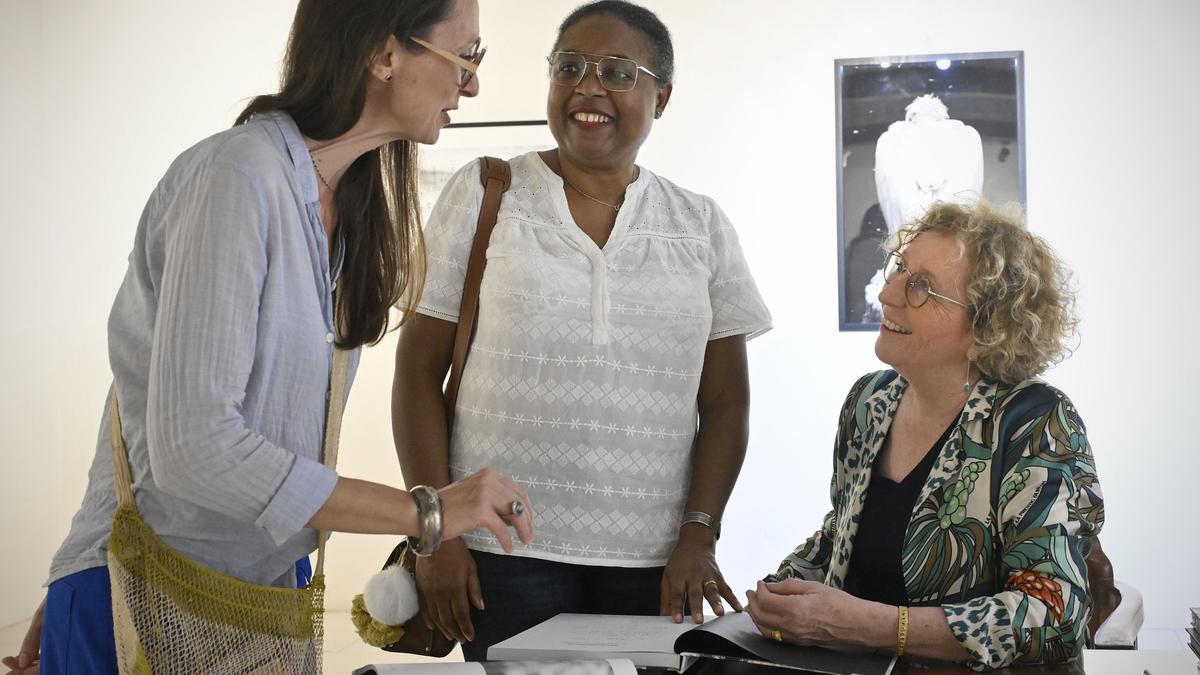
French photographer-artist calls the craft a universal language
The Hindu
French photographer Muriel Pénicaud's black-and-white images leave interpretation open, showcasing urban landscapes, trees, and women's freedom.
French photographer-artist Muriel Pénicaud prefers her images to not impose an idea or thought; rather leave them open-ended. The black-and-white frames, for her, are “an open door to poetry”, and left to the interpretation and imagination of the viewer.
The former French Minister of Labour in the government of Prime Minister Édouard Philippe under President Emmanuel Macron (2017-2020) was recently in the city to host two exhibitions of her works.
The ‘Wind into the Roots’ show being held from January 17 to February 28 at The Spot showcases two major series on urban landscapes and trees, while the ‘Deep Heights’ expo (January 17-February 23) at Kalinka Art Gallery features an allegory of women’s freedom and spiritual elevation through poetic images of birds, trees and altitudes.
For the artist, who has exhibited her work, including many award-winning prints, at top art galleries across Paris, Beijing and Tokyo, this was her first show here. The Kalinka expo also featured the launch of ‘Matrix of Worlds’, her first photography book released in 2024 — a monograph showcasing 150 of her prints from a trilogy of her first three exhibitions themed on women, trees and birds and how they link back to mythological roots of life on earth.
Ms. Pénicaud says she loves photography as it is a uniquely universal and accessible language. “It is a huge gift for humanity for people who differ in land, language and culture to be able to share similar emotions in front of a photo,” she adds.
She prefers to work in black and white photography to “extract the light from the dark” and because the duality goes right to the essential. “You just have light and structure...nothing fancy or superfluous”. In its depiction of reality, the black-and-white photograph adds a certain depth and creates a space to the viewer to assign imagination and emotion, she says.
“I am a photographer in black and white...and red”, she remarked in jest, about her rare use of colour in her series, “Life is red” as a signifier of suffering and alienation, women’s freedom and empowerment. This is best illustrated in an image of a single red sandal in a heap of shoes — her way of memorialising the Auschwitz horrors — or another frame showing a line of faceless women in scarlet apron taken in Vietnam.


Abhishek Banerjee challenges BJP's Suvendu Adhikari in Nandigram, pledging community health initiatives if Trinamool Congress wins.

Rising LPG shortages in Karnataka boost firewood demand, reviving an informal market as households and hotels seek alternatives.

Against the backdrop of intense poll activity, a 400-metre stretch of an arterial road in the outskirts of Chennai (technically in Madurapakkam panchayat under Tambaram assembly constituency) presents a salute to the idea of res publica, which underpins India’s system of governance, where citizens have a say, at least before a government is securely ensconced in the seat of power. A Republic Day initiative shines bright every night

Fadnavis claims zero FIR in Ajit Pawar crash is a defamation attempt by Karnataka against Maharashtra's investigation efforts.

Set to unfold as a one-day pop-up on April 5, the Easter Sadya brings together both vegetarian and non-vegetarian menus, offering a peek into the food traditions of the Syrian Christian (Nasrani) community. While the traditional Sadya is often associated with dishes such as sambar, avial, and rice, this version expands to include community-specific festive dishes.

BJP nominates mother of R.G. Kar victim Abhaya to contest from Panihati in West Bengal Assembly elections.

Veteran Malayalam actor-director E.A. Rajendran passes away at 71, leaving behind a rich legacy in the film industry.

Dakshina Kannada Zilla Panchayat has rolled out digital mode of water bill generation and collection in 23 gram panchayats on a pilot basis for the first time in Karnataka. This is set to be extended to the remaining 200 panchayats shortly, according to the Zilla Panchayat Chief Executive Officer Narwade Vinayak Karbhari.

Bengaluru police questioned a man carrying ₹6 lakh for medical expenses at Vidhana Soudha, later releasing him after verification.

BJP accuses Bengaluru's Congress government of corruption in e-Khata issuance, halting infrastructure projects due to financial mismanagement.

Misinformation in Hyderabad sparks panic buying, causing disruptions as residents react to unfounded rumors of an impending lockdown.

Bengaluru Metro extends services until 2 a.m. on March 28 for IPL match, ensuring convenient travel for spectators.

A bus truck-collision in Andhra Pradesh's Markapuram district, killing several. Catch LIVE updates here!