Fossils suggest even smaller ‘hobbits’ roamed an Indonesian island 700,000 years ago
The Hindu
Study reveals hobbit ancestors were even shorter than previously thought, shedding light on human evolution mystery.
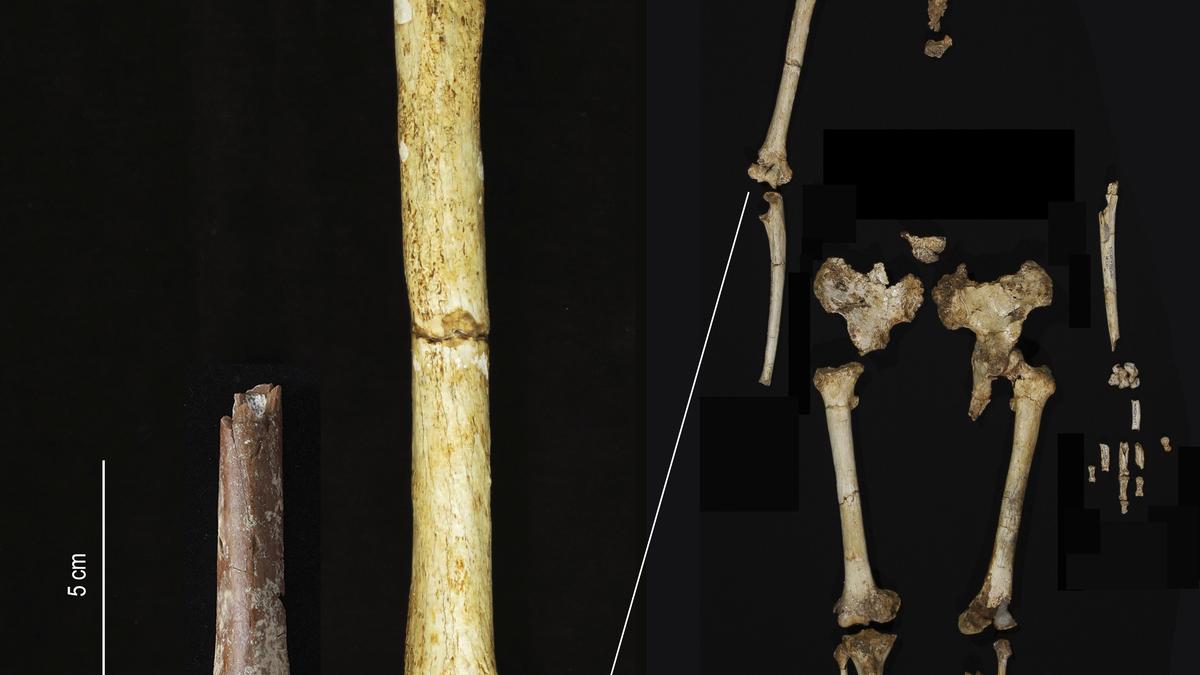
Twenty years ago on an Indonesian island, scientists discovered fossils of an early human species that stood at about 1.07 meters tall — earning them the nickname “hobbits”. Now a new study suggests ancestors of the hobbits were even slightly shorter.
“We did not expect that we would find smaller individuals from such an old site,” study co-author Yousuke Kaifu of the University of Tokyo said in an email.
The original hobbit fossils date back to between 60,000 and 100,000 years ago. The new fossils were excavated at a site called Mata Menge, about 45 miles from the cave where the first hobbit remains were uncovered.
In 2016, researchers suspected the earlier relatives could be shorter than the hobbits after studying jawbone and teeth collected from the new site. Further analysis of an tiny arm bone fragment and teeth suggests the ancestors were a mere 2.4 inches (6 centimeters) shorter and existed 700,000 years ago.
“They’ve convincingly shown that these were very small individuals,” said Dean Falk, an evolutionary anthropologist at Florida State University who was not involved with the research.
The findings were published on Tuesday (August 6, 2024) in the journal Nature Communications.
Researchers have debated how the hobbits – named Homo floresiensis after the remote Indonesian island of Flores – evolved to be so small and where they fall in the human evolutionary story. They're thought to be among the last early human species to go extinct.


Discover the inspiring legacy of Bibha Chowdhuri, a pioneering woman in physics and a trailblazer in STEM history.

Ashdeen’s Spring 2026 collection features saris inspired by the designer’s Parsi gara archive

Red ochre burials, ritual markings and myths across cultures show that red repeatedly marks liminal thresholds such as puberty, sacrifice and death; anthropologists argue that the colour functions as a technology of collective ritual and value, binding communities through shared symbolic acts

India approves 23 institutions for quantum labs under the National Quantum Mission, aiming to advance quantum technology and research.

India approves 23 institutions for quantum labs under the National Quantum Mission, aiming to advance quantum technology and research.

The Gaza conflict exacerbates environmental damage, emitting millions of tonnes of CO2 and threatening climate stability in West Asia.

Chefs and cookery experts share smart kitchen hacks, hybrid cooking methods and appliance tips to help households reduce LPG use without compromising on food

Discover groundbreaking research on Titan's lakes, bat vaccinations, and the unique aroma of ripening bananas in just one minute.

IRSO's NavIC system faces challenges as the last atomic clock fails, reducing operational satellites for navigation services.

Discover efficient pressure cooking techniques to save up to 50% on fuel. OPOS B Ramakrishnan tells you how

Mercedes-Benz CLA 250+ with EQ Technology review: design, performance, range and features explained. Discover how the new electric CLA combines advanced AI, long range, fast charging and futuristic styling for the next generation of luxury EVs.

Pi Day is celebrated every year on March 14, honouring the significance of the mathematical constant π and its applications in mathematics.

Discover how sculptural interior design transforms modern spaces, blending creativity and functionality to evoke emotion and identity.