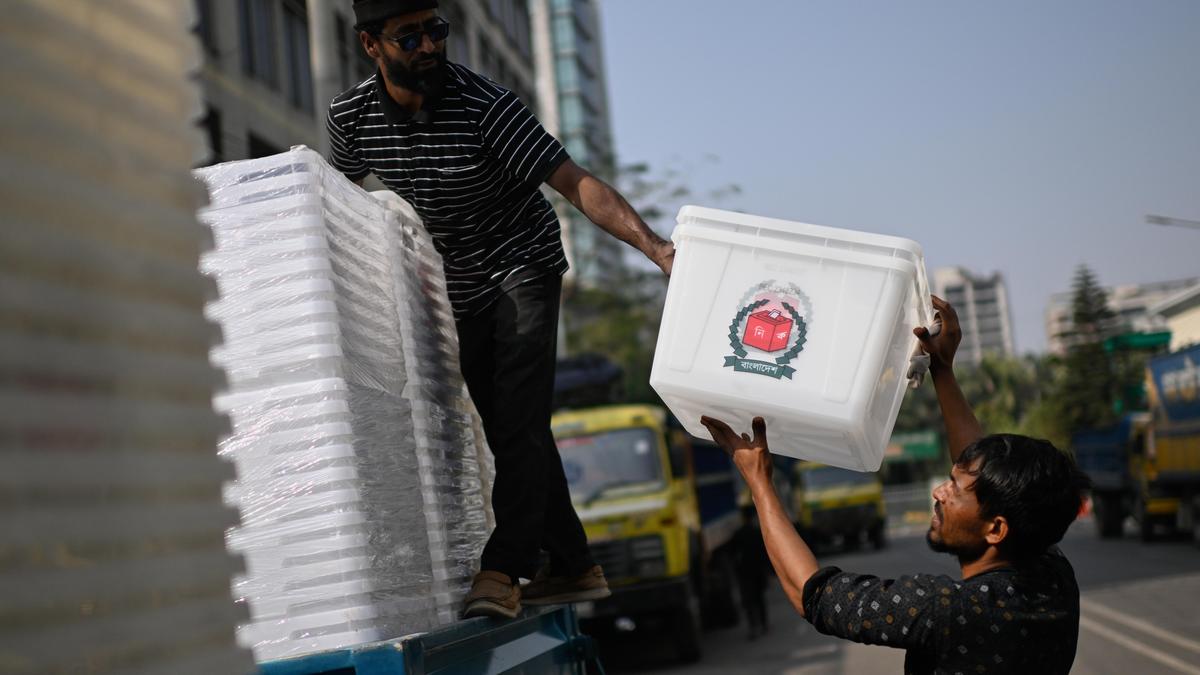
For minorities, Bangladesh’s election is a litmus test of security
The Hindu
Bangladesh's upcoming election highlights minorities' urgent demand for security amid rising violence and political tensions.
‘Pranto Das Gupta, a 22-year-old from Bangladesh’s minority Hindu community, is preparing to cast his first vote in the upcoming national elections. Living in Dhaka, around 300 km from his ancestral village in Satkania, Chattogram, Mr. Gupta plans to travel home to vote with his family on February 12, as the country heads into its first election since the dramatic fall of Sheikh Hasina in an uprising in August 2024.
For the first-time voter, the lofty promises in party manifestos from trillion-dollar economies to constitutional reform ring hollow against the lived reality of arson, vandalism and intimidation.
“We don’t want clashes. We don’t want promises. All we ask for is safety,” Mr. Gupta said. “People in my village will go to the polling centres and vote for whoever they think can ensure their safety.”
This plea for basic security has emerged as the overwhelming, non-partisan demand of religious minorities, who make up roughly 10% of the population, as campaign rallies intensify and polling day draws closer.
According to a recent report by the Human Rights Support Society (HRSS), at least 56 targeted attacks on minority communities were recorded in the 17 months leading up to the election. These incidents included the desecration of temples, vandalism of homes, and physical assaults, leaving one person dead and 27 injured. Transparency International Bangladesh reported more than 50 such attacks in 2025, while Ain-e-Salish Kendra documented 42 incidents.
The Chief Adviser’s Office, however, has offered a different assessment. It said that of the 645 incidents involving minority community members recorded in 2025, only 71 were communal in nature, while the remaining cases were linked to general criminal activity.


Nepal's March 5 election aims to restore democracy amid recent protests and regional geopolitical tensions.

Russia accuses Ukraine of using sea drones to attack and sink a tanker carrying liquefied natural gas in the Mediterranean.

Nepal deploys over 300,000 security personnel for the March 5 polls, ensuring safety and minimal invalid ballots through voter education.

U.S. military strikes Iranian warship off Sri Lanka, prompting rescue operations for sailors amid escalating tensions.

Explore the escalating Iran-Israel conflict, detailing key events and retaliatory actions over the first five days of war.

Thailand's election commission certifies results, paving the way for a new parliament and government formation.

The U.K. charters a repatriation flight for stranded nationals amid West Asia conflict, enhancing security with a Royal Navy deployment.

Iran seeks to quickly appoint a new Supreme Leader following Khamenei's death, amid threats from Israel regarding potential assassinations.

Israel escalates air strikes in Lebanon, killing 11 and targeting Hezbollah amidst ongoing conflict and civilian evacuations.

Spain's Prime Minister Sanchez defends anti-war stance on Iran amid Trump's trade threats, emphasizing global responsibility and values.

In the present-day context, when both regional and global order is being reshaped, Iran’s growing confrontation with the United States and Israel continues to shape the current regional security narrative.

Iran's judiciary chief threatens those who say or do anything' in support of U.S.-Israeli airstrikes
Iran's judiciary chief threatens severe penalties, including death, for supporting U.S.-Israeli airstrikes amid rising tensions.

U.N. experts express deep concern over child deaths in escalating Israel-Iran conflict, highlighting a school bombing in Iran.