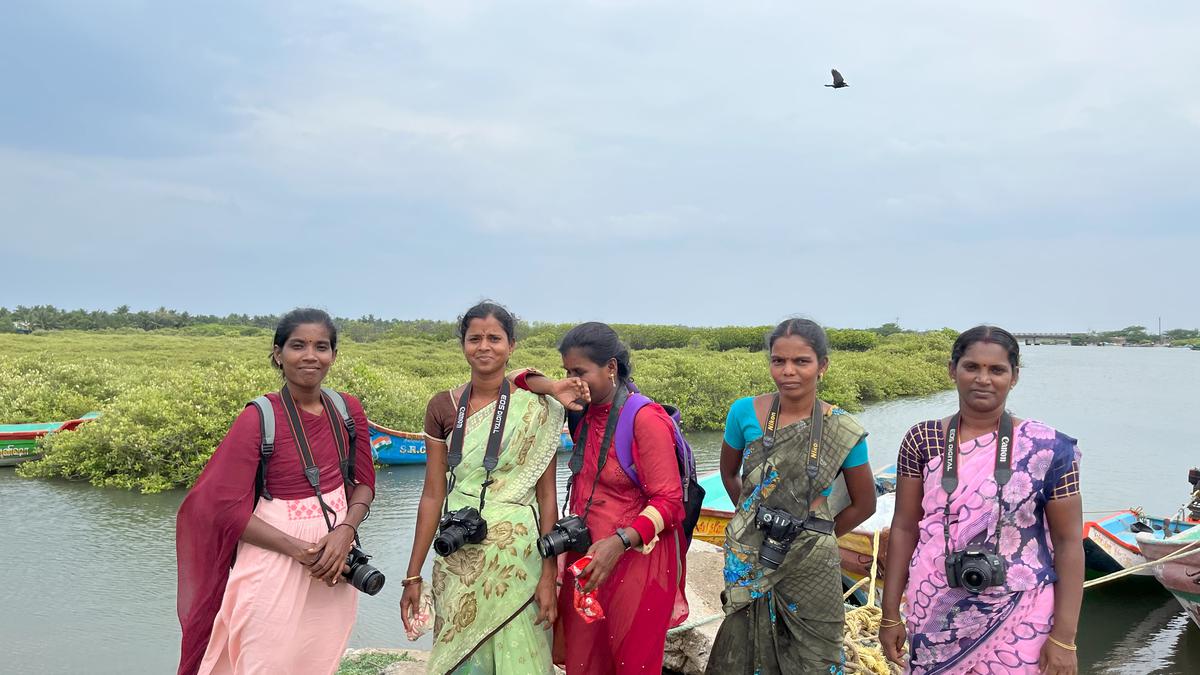
Fisherwomen from Nagapattinam turn documentary photographers
The Hindu
Photographer Palanikumar trained 13 women in TN & Odisha, giving them the confidence to document their own stories.
Fisherwoman P Poonkodi will never forget the looks she got from people in her village when they first saw her with a DSLR camera.
“I felt uncomfortable,” recalls the 34-year-old, who is from Seruthur in Nagapattinam. “They asked lots of intrusive questions, but I eventually learned to ignore them,” she adds.
Poonkodi is among the 13 women photographers M Palanikumar trained as part of a three-month workshop organised by the NGO Dakshin Foundation. The first thing he told the fisherwomen when he handed them DSLR cameras was to simply feel the equipment. “It was important that they felt they could handle the camera,” says the Chennai-based independent photographer.
In February last year, boys and girls from North Chennai, whom Palanikumar trained, displayed their photos at an exhibition titled REFRAMED in the city. The exhibition that was the result of a six-month long workshop, paved the way for a similar workshop with the fisherwomen of Nagapattinam in Tamil Nadu, and Ganjam in Odisha.
“Dakshin Foundation, a non-profit organisation reached out to me with the idea,” says the 32-year-old, who contributes to People’s Archive of Rural India (PARI). What followed was a week-long session at Nagapattinam, followed by another one at Ganjam.
“We first met at the seaside on a particularly hot day,” Palanikumar recalls, adding that the idea was to train the women in their own environment. In Nagapattinam, he trained seven women: A Mahalakshmi, M Lakshmi, P Poonkodi, V Manjamatha, M Suganthi, S Bharathi and Parimala from fishing hamlets such as Keechankuppam and Pazhayar. They worked with DSLR cameras that Palanikumar bought with his own funds, and with contributions from friends.
Palanikumar does not believe in rigorous, structured training when it comes to photography. “When one holds the camera, the device automatically turns political,” he feels. “Apart from documenting what we see around us, we eventually tend to train the lenses on our problems.” This was the case with the fisherwomen as well. “They were chosen from the community for the workshop based on their eagerness to learn and use the camera as a political tool,” he adds.


Test your knowledge with the quiz on Science films at the Oscars through history

Set between the Siwalik hills and the plains, Butwal offers travellers a mix of regional cuisine, pilgrimage trails to Lumbini and the comfort of Hyatt’s new hospitality landmark

Explore 2026's wallpaper trends in India, highlighting botanicals and handmade designs that enhance modern homes with nature-inspired aesthetics.

Mercedes-Benz CLA 250+ with EQ Technology review: design, performance, range and features explained. Discover how the new electric CLA combines advanced AI, long range, fast charging and futuristic styling for the next generation of luxury EVs.

AI tool for sparrow conservation

BTS’s comeback with ‘Arirang’ marks a major global music event. When does the album release, and where can you watch their concert live stream? We have all the details

The 2026 U.S. cholesterol guidelines urge starting screening and treatment at 30 to prevent cardiovascular disease effectively.

Olam Festival 2026 in Thiruvananthapuram returns March 27-29 with 120+ vendors, music, art, and cultural zones.

A few storytellers in Thiruvananthapuram share their journeys, challenges, and evolving methods on World Storytelling Day, inspiring young minds.

76-year-old Kurian Jacob from Kerala triumphs with seven medals, including five golds, at the Open Masters Games in Abu Dhabi.

Explore the nature of the human mind as an emergent property of brain activity and complex neural interactions.

CERN's Large Hadron Collider discovers the Xi-cc-plus particle, enhancing understanding of quantum mechanics and baryon behavior.

Vibha Batra’s latest book, Spotless (Hachette India) is a novel in verse for young adults