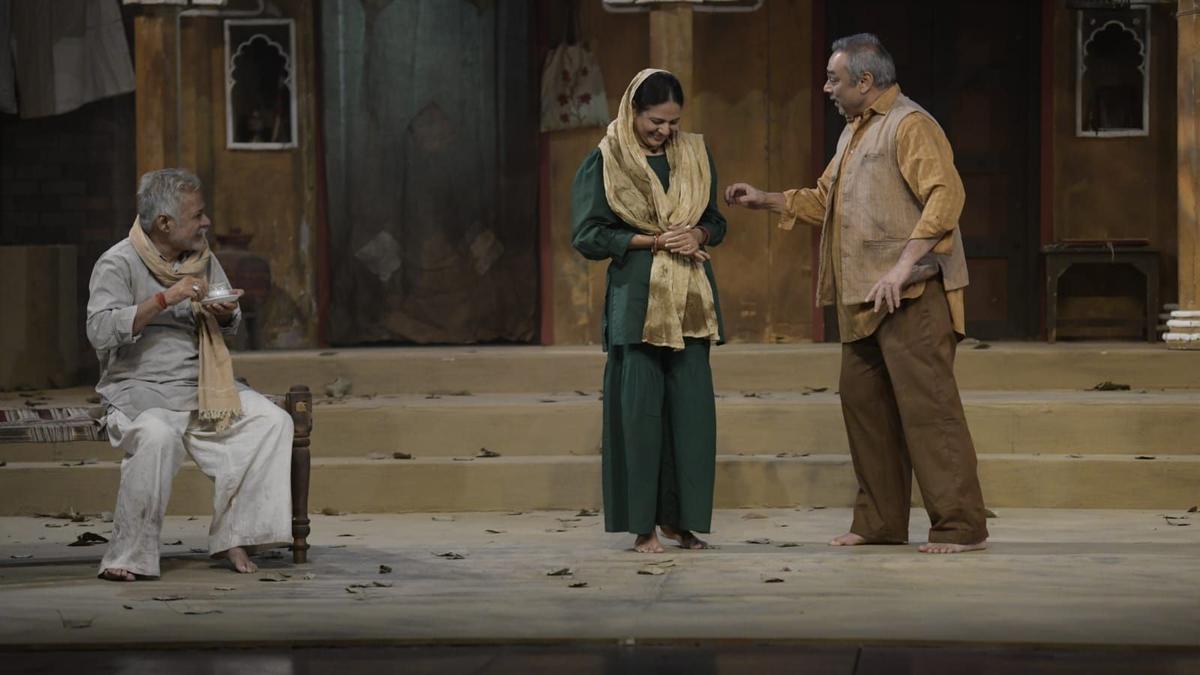
Feroz Abbas Khan’s Hind 1957 revisits the unhealed wounds of Partition
The Hindu
Hind 1957: Reflecting on the questions of religion and belonging
Expressing the unspoken, Feroz Abbas Khan’s Hind 1957 makes us reflect on humanity. Hind 1957, staged at the Bharat Rang Mahotsav, is about a Muslim family that chooses to remain in India post-Partition. It is a sensitive and thoughtful Hindustani adaptation of August Wilson’s Pulitzer Prize-winning play Fences (1985), by Vikas Bahari. The play transposes the 1950s African-American experience in Pittsburgh to the Muslim narrative in post-Partition India.
Spread over two acts, the play explores themes of patriarchy, prejudice, family secrets and the tension between a weary father’s cynicism and the optimisim of his sons for a better future. The poignant story makes you realise that classics don’t age.
The central character, Tabrez Ansari (evocatively portrayed by Sachin Khedekar), is a poet who participated in the freedom movement. He is wrongfully imprisoned after his father migrates to Pakistan. He is tired of being repeatedly interrogated by the police, and works in a bidi factory to keep the home fires burning.
Charged as a spy, Tabrez personifies the shattered dreams of a generation, poignantly captured towards the end through Abhishek Shukla’s verse, ‘Main ghar kahoon toh Hindustan samajh samjha jaye....’
Feroz Abbas Khan resists generalising the Muslim peeve or romanticising the laments of progressive writers. Tabrez is flawed in his understanding of society and family, and uses religion opportunistically. His poetry is progressive, but his behaviour within the four walls is far from forward-looking. For him, drinking liquor is being liberal, but when it comes to infidelity, he invokes the Shariat. He uses his brother’s pension to have a roof over his family’s head.
Tabrez tries to pass on his bitterness to his sons, who, in a departure from the traditional depiction of Muslim families, embrace India with all its imperfections. They are not chained by their father’s fears. Latif takes to his father’s poetic legacy while Kaif wears his love for the nation in his army uniform. They believe their father will get justice under the Indian Constitution, and the writer rewards their patience and optimism.


Jeevan Reddy leads a rally for maize farmers in Jagtial amid speculation of leaving Congress for BRS.

BJP and AINRC likely to maintain 2021 seat-sharing formula for Puducherry's 2026 Assembly elections, confirms party president.

BJP reveals 144 candidates for Bengal Assembly polls, featuring Suvendu Adhikari contesting against Mamata Banerjee in Bhabanipur.

Anna University partners with Ramco Systems to create an advanced ERP lab for enhanced industrial engineering education.

NDA announces candidates for 12 Kozhikode seats in Kerala Assembly polls 2026 as UDF and LDF ramp up campaigning.

As India formulates its next steps in the Israel-U.S.-Iran war, it is necessary to consider not only what it will mean for the whole region but also its own ties with each neighbour

CITU criticizes the Centre's privatization efforts for VSP, alleging employee removal over production increase and financial mismanagement.

Visakhapatnam Customs House's short film "Right Turn" wins Honourable Jury Mention at the 10th Indian World Film Festival.

Economist Arvind Subramanian advises CM Revanth Reddy on strengthening Telangana's finances during a meeting in Hyderabad.

Supreme Court emphasizes stakeholder consultation for legal education reforms, hesitant to change five-year law course duration.

Authorities in Andhra Pradesh are set to tranquillise a roaming tiger near Annavaram temple for safety and conservation.

MEA criticizes USCIRF for bias, urging focus on vandalism of Hindu temples in the U.S. over selective criticism of India.

Bengaluru's Urban Development aims to beautify underutilized flyover spaces, enhancing city aesthetics and improving green cover initiatives.