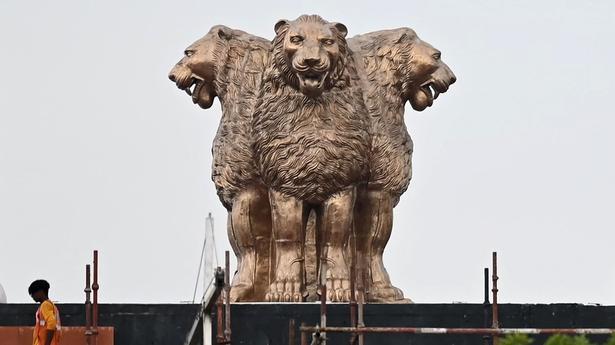
Explained| Why is there outrage over the new ‘National Emblem’?
The Hindu
What are the various allegations raised against the revised sculpture atop the new Parliament House?
The story so far: Prime Minister Narendra Modi recently gave the nation a first glimpse of the national emblem atop the new Parliament House coming up as part of the Central Vista Project. The first look at the new 6.5 metre bronze emblem designed by Sunil Deore and Romiel Moses disappointed many with its alleged inaccuracies in depiction. The Opposition, cutting across party ranks, found the lions on the new 9,500 kg emblem ‘angry’, with their fangs visible, as opposed to the grace and glory of the original. Others found them a distortion of the actual emblem. The Congress Party has called it a “deviation” from the original. The new emblem is placed at the top of the Central Foyer of the new Parliament building which the government estimates will be ready in time for the winter session this year.
Four Asiatic lions are part of the national emblem with three lions being visible to the naked eye and the fourth one always hidden from general view. They are taken from the Sarnath Lion Capital of the Mauryan emperor Asoka. The seven feet tall sculpture made of polished sandstone represented courage, power and pride. Built in 250 BC to commemorate the first sermon of Gautama Buddha, where he is said to have shared the Four Noble Truths of life, it was mounted on a base of a frieze of smaller sculptures, including a horse (under fire in the new replica for its tail supposedly resembling that of a dog), a lion, a bull and an elephant moving in a clockwise direction. The four animals are said to be guardians of the four directions — north, south, east and west. They are separated by a wheel, representing the Dharmachakra of Buddhism, on all four sides. Each chakra or wheel has 24 spokes. The chakra was later adopted as part of the national flag. This abacus was mounted on an inverted lotus which is a symbol of Buddhism. Chinese traveller Hiuen Tsang has left a detailed account of Asoka’s lion pillar in his writings.
The pillar was part of Asoka’s plan to spread Buddha’s teachings. After the large-scale massacre in the Battle of Kalinga, Asoka was shaken and embraced Buddhism with its emphasis on ahimsa. He decided to propagate his principles throughout his empire through the Major and Minor Edicts.
As India won independence, the Constituent Assembly decided on the Sarnath pillar as the national emblem. It was felt that the pillar epitomised the power, courage and confidence of the free nation. The emblem depicts a two-dimensional sculpture with the words Satyameva Jayate (truth alone triumphs) written below it, taken from the Mundaka Upanishad, written in Devanagari script.
On January 26, 1950, the Lion Capital of Asoka at Sarnath officially became the national emblem of India. The emblem represents the seal of the Republic of India. Five students of renowned artist Nandalal Bose created the emblem. Among them were Jagdish Mittal, Kripal Singh Shekhawat, Gauri Bhanja and Dinanath Bhargava who was a young man in his 20s then. He was advised by Bose to visit the Kolkata zoo to observe the lions closely so as to get the exact expression of the majestic animal. He is said to have travelled 200 kilometres to observe the lions from close quarters. Incidentally, Bhargava has also designed the first 30 pages of the Constitution.
The latest replica by Deore and Moses has a steel pillar support of 6,500 kgs. The lions, many alleged, looked “too aggressive”, which amounted to tampering with the original in a hurry to meet the deadline of the Central Vista Project. “The concept sketch and process of casting the national emblem on the roof of the new Parliament building have gone through eight stages of preparation, from clay modelling and computer graphics to bronze casting and polishing,” the PMO responded in a statement to emphasise the thoroughness of the process.
However, it failed to douse criticism. The All India Congress Committee General Secretary Jairam Ramesh said, “To completely change the character and nature of the lions on Ashoka's pillar at Sarnath is nothing but a brazen insult to national symbol”. The Rashtriya Janata Dal tweeted from the official party handle that, “The original emblem has a mild expression, but those built during Amrit Kaal show a man-eater's tendency to consume everything in the country." Jawhar Sircar, Trinamool Congress MP, questioned the entire process, asking, “We seek to know the details of the process of selecting the artist, the brief given and the cost of the work. Has this contributed in raising the original estimated cost of ₹975 crore to the currently estimated cost of ₹1,200 crore? Did the proposal to install this sculpture receive sanction from the Delhi Urban Art Commission, and the Heritage Conservation Committee, mandated by the Supreme Court order of Jan 6, 2021 regarding the New Parliament Building?”


T.N. Chief Secretary and DGP visit Governor at Lok Bhavan, presenting flowers in courtesy call.

Eight TSPC Maoists arrested in Hazaribag, Jharkhand, with weapons and ammunition seized during a police operation.

Four ambulances of a Jewish community service in London were set ablaze in a suspected antisemitic hate crime.

Gautham Manohar hopes his photographs serve as reminders of the Earth’s delicate beauty

Thousand Lights faces parking chaos and traffic congestion despite its political significance and ongoing development efforts.

Generic semaglutide increases accessibility, but doctors caution against misuse and quality concerns

Haryana Police removes 857 links to Badshah's 'Tateeree' for objectionable content, ensuring a safer digital environment.

Congress criticises Modi for not leveraging the upcoming BRICS+ Summit to address the West Asia crisis amid U.S. tensions.

Nagapattinam faces underdevelopment and resource challenges, impacting its rich heritage and the livelihoods of its fishing community.

One of the best games of 2025 makes it over to the PC, with a harder mode and bristling with new graphic tech

Air Force employee arrested for espionage, allegedly sharing sensitive information with Pakistani handlers since 2023 for money.

Four killed and several injured in a Bengaluru–Mysuru Expressway crash; driver arrested for alleged negligence.

Four injured in SUV collision with a stranded goods carrier on Narsingi ORR, causing significant traffic congestion.