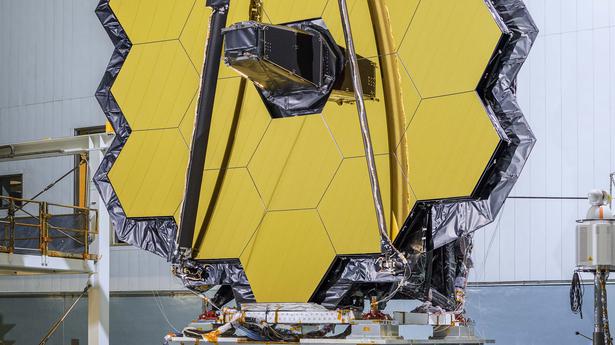
Explained | What is the relevance of the recently released images from the James Webb Space Telescope?
The Hindu
With the release of its first five stunning images, the James Webb Space Telescope has demonstrated an acute observational capacity and revealed aspects of the cosmos hitherto hidden from other telescopes
On November 30, 1609, Galileo turned his telescope towards the night sky. This singular act revolutionised astronomy. Until then, scholars held that celestial objects were without any kind of blemish. Galileo showed that the Moon had craters and mountains. All celestial objects, including stars, were thought to go around the Earth. The telescope, by observing phases of Venus firmly established that planets go around the Sun and not the Earth. The Milky Way, a haze in the dark night teemed with hundreds of stars, established that the cosmos is immense and beyond our imagination. Galileo revolutionised astronomy using a crude telescope which by today's standards is merely a toy.
The first five images released by NASA (National Aeronautics and Space Administration) on July 11, captured by the James Webb Space Telescope (JWST) is no less momentous in the history of astronomy than the day Galileo turned his telescope toward the heavens.
The deep field image of the SMACS 0723 cluster of galaxies has images that date back to times when the first stars were born. The images from Carina Nebula vividly show the birth of new stars. In contrast, the Southern Ring Nebula image details a dying star. In Stephan's quintet, the JWST has captured the cataclysmic cosmic collision of galaxies. By analysing the spectrum of the radiation from WASP-96 b, an exoplanet (a planet orbiting a distant star), the telescope has shown conclusively the presence of water vapour in the atmosphere of this hot, puffy gas giant planet orbiting a distant Sun-like star. With its sharp vision, more light-collecting area and ability to see in the invisible infrared regions, the JWST is sure to expand our understanding of the cosmos.
About 13.8 billion years ago, through the Big Bang, our Universe emerged. The first stars and galaxies were born around 300 million years after the Big Bang. To know more about the formation of these stars and galaxies, we do not need a time machine or time travel. As light travels with a velocity of about 3,00,000 km per second, light from a distant object will take time to reach us on Earth. Hence, when we see a distant stellar object, we see it as if it were far back in time. Powerful telescopes are therefore, like time machines.
However since objects far away are dim, we need giant telescopes to collect more light. Further, light from distant objects is stretched out by the expansion of our Universe, driving the radiation from the visible range into the infrared. Therefore, to look deep back into the early phases of the Universe, we need a giant infrared telescope. JWST is the biggest infrared telescope ever built. With a 6.5-metre primary mirror, the JWST infrared telescope collects more photons than Hubble. It can see even the faintest flicker from the most distant regions of the cosmos.
The SMACS 0723 is a noted cluster of galaxies around 5.12 billion light-years away. Situated in the direction of the southern constellation of Volans, the image is as it appeared 4.6 billion years ago, about the same time when the Sun and the Earth evolved. The cluster has been previously studied by Hubble, Planck and Chandra space telescopes. But the rich details and features of the JWST's Near-Infrared Camera (NIRCam) are unmatched.
With a sharper vision than Hubble, many of the galaxies seen clearly in this image appear as mere blobs in Hubble's telescope. SMACS 0723 galaxy cluster is massive, which, as Einstein's general relativity theory predicts, distorts the fabric of spacetime. Like the refraction of a ray of light passing through a lens, the light from behind bends through the massive cluster. Due to this ''gravitational lensing'' effect, we notice that some galaxies appear distorted in an arc shape, some are split into multiple images, and some are magnified.


Discover the Minor Planet Centre, the key hub for tracking and verifying observations of small solar system bodies.

Discover the Minor Planet Centre, the key hub for tracking and verifying observations of small solar system bodies.

In this week's Science for All newsletter, XX explains

Test your knowledge with the quiz on Science films at the Oscars through history

Set between the Siwalik hills and the plains, Butwal offers travellers a mix of regional cuisine, pilgrimage trails to Lumbini and the comfort of Hyatt’s new hospitality landmark

Explore 2026's wallpaper trends in India, highlighting botanicals and handmade designs that enhance modern homes with nature-inspired aesthetics.

Mercedes-Benz CLA 250+ with EQ Technology review: design, performance, range and features explained. Discover how the new electric CLA combines advanced AI, long range, fast charging and futuristic styling for the next generation of luxury EVs.

AI tool for sparrow conservation

BTS’s comeback with ‘Arirang’ marks a major global music event. When does the album release, and where can you watch their concert live stream? We have all the details

The 2026 U.S. cholesterol guidelines urge starting screening and treatment at 30 to prevent cardiovascular disease effectively.

Olam Festival 2026 in Thiruvananthapuram returns March 27-29 with 120+ vendors, music, art, and cultural zones.

A few storytellers in Thiruvananthapuram share their journeys, challenges, and evolving methods on World Storytelling Day, inspiring young minds.

76-year-old Kurian Jacob from Kerala triumphs with seven medals, including five golds, at the Open Masters Games in Abu Dhabi.