Explained | Ukraine’s counter-offensive
The Hindu
What are the territorial gains made by the Ukrainian forces? How has Kremlin reacted?
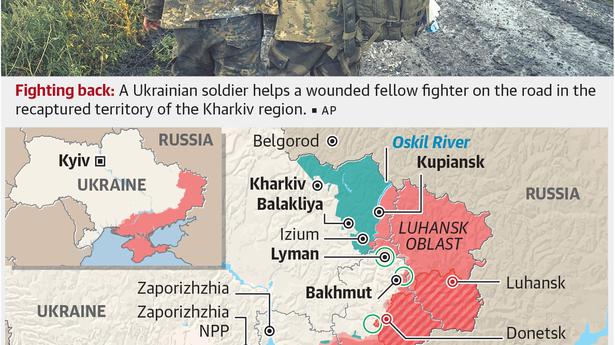
The story so far: Ukraine has launched a lightning counter-offensive in the country’s northeast that saw surprising territorial gains. Its forces have pushed back Russian soldiers from most of Kharkiv Oblast, retaking thousands of square kilometres of territory. Russia has confirmed the retreat, saying it withdrew troops for “regrouping”. Ukraine’s fresh momentum has triggered debates on whether the country, which has lost swathes of territories in the north, east and south since the Russian invasion began on February 24, is finally turning around the war. It has also raised questions on Russia’s battlefield tactics.
Ukraine says it has retaken some 3,500 square miles of territories since its counter-offensive began earlier this year, including Izium and Kupiansk, two strategically important towns in the northeast that served as logistical hubs for the Russian forces. This is a significant battlefield gain for Ukraine because this is the first time, since the war began, that Ukrainian troops have pushed back the Russians through combat. In March, Russia had voluntarily announced withdrawal from the Kyiv area and around Kharkiv, Ukraine’s second largest city, after the Istanbul talks between the two sides. But this week’s withdrawal was different. It looked like the Russians were caught off guard when Ukraine launched the blitz. This provides a much needed morale booster for the Ukrainian troops that suffered a series of defeats in recent months — in Mariupol, Severodonetsk and Lysychansk. Ukraine has now said the fighting would continue till the “liberation” of all lost territories (including Donbas and Crimea), practically ruling out any negotiated settlement. The Russians have also ruled out talks.
Ukraine has been planning for this counter-offensive for months. After capturing Lysychansk in July, which saw the whole of Luhansk province coming under its control, Russia’s battlefield combat came to a halt. By that time, Russia was controlling almost 25% of Ukraine, Europe’s largest country. Russia, which also took huge losses in the battle for Donbas, seemed to have decided to halt the ground offensive as its troops were regrouping and recovering. This opened a window opportunity for Ukraine to move ahead with its counter-offensive plans. This was also the time when Ukraine started receiving advanced mid-range rocket systems such as High Mobility Artillery Rocket Systems (HIMARS) from the U.S. The Biden administration, which has committed military assistance worth more than $14.5 billion to Ukraine, and British and other European governments made sure that Ukraine is replenished despite the military setbacks it suffered. On the other side, the sanctions-hit Russia found it difficult to make sure their supply is intact and had to turn to Iran and North Korea, according to western intelligence, for drones and shells.
American and British intelligence officials were directly involved in planning the Ukrainian counter-offensive, according to a report in the NYT. U.S. intelligence agencies also provided information to Ukraine on the weak links of the Russian defence. Ukraine started attacks in southern Ukraine —including a ground offensive in Kherson, one of Russia’s early gains in the war, and sabotage hits in Crimea, which Russia annexed in 2014. But as it appears now, Ukraine’s main target was not the southern region, but Kharkiv. As Russia, faced with the Ukrainian attacks in the south, bolstered the defences of Kherson and Zaporizhzhia, Ukraine broke into the relatively weaker defence lines in the northeast, pushing the Russians back. Russia had two options — resist the Ukrainian attack with the limited number of soldiers deployed in Kharkiv or retreat and regroup elsewhere. The Russian Generals seem to have opted for the latter.
Russia has stepped up air and missile attacks in Kharkiv and elsewhere in Ukraine. That’s understandable as Russia still possesses the capability to strike anywhere in Ukraine. But the question is whether such attacks would have any meaningful effect on the battlefield. Several defence analysts, including those at the U.S.-based Institute for the Study of War and the London-based Royal United Services Institute, have pointed out that Russia faces several challenges on the battlefield such as manpower crunch and supply disruptions. This explains why the Russian battlefield advances came to a halt after the capture of Luhansk. Russian President Vladimir Putin still hasn’t declared war on Ukraine. His original plan was to meet his military objective with a limited deployment of Russian troops (what he calls “the special military operation”). But the Ukrainian resistance and the current counter-offensive have made it difficult for Mr. Putin to maintain the momentum with the limited deployment.
So unless he changes the current plan of the war and deploys more soldiers, the Russian focus is likely to be on holding the line in the south and east — Kherson, Zaporizhzhia, Luhansk and Donetsk — until the winter (say, November). Once the winter sets in and the conflict gets frozen, Mr. Putin will have more time to prepare his forces for future battles. He can also use the energy card, which he is more than willing to do, to wreak havoc in European economies, which are already battered by high inflation, during winter. On the other side, Ukraine knows that it has a small window of opportunity to make maximum territorial gains before winter sets in, and that’s what Ukraine is trying to achieve. So the coming weeks would be crucial for both sides. While it’s too early to say whether Ukraine has turned around the war, it has clearly pushed Russia to the defensive.
Russia’s retreat from Kharkiv has triggered rare public criticism inside the country of the way the war is conducted. Defence Minister Sergei Shoigu is particularly targeted. Even Ramzan Kadyrov, the strongman of Chechnya and a Putin ally, has said the Defence Ministry has made mistakes. Russian forces’ inability to take a quick, decisive victory in Ukraine had already raised questions about Mr. Putin’s decision to invade the country. But the dominant Russian narrative was that its troops were making incremental advances in Ukraine (which they were) and Russian officials and Generals have made it clear several times that they want to take the whole of Ukraine’s east and south, stretching from Kharkiv to Odesa. But Ukraine has drilled holes in this narrative with its gains in Kharkiv. That leaves Mr. Putin in a spot.


Russia claims to have shot down nearly 400 Ukrainian drones amid escalating aerial attacks, highlighting intensified conflict between Moscow and Kyiv.

Kim Jong Un reaffirms North Korea's unwavering support for Russia amid strengthened ties and military cooperation against Western adversaries.

Rights group warns of a "dystopian" Hong Kong after police arrest bookstore staff for selling allegedly seditious publications.

Iran rejects a U.S. ceasefire proposal, outlining five conditions for peace amid ongoing conflict with Israel.

Gulf states warn the UN of an existential threat from Iran's strikes, calling for condemnation and monitoring of the situation.

Matt Brittin, ex-Google executive, appointed as BBC's new director general amid ongoing $10 billion lawsuit from Trump.

Pakistan's PM Sharif briefs Saudi Crown Prince on mediating U.S.-Iran talks and reaffirms support amid regional tensions.

Iranian military ridicules Trump's ceasefire claims, asserting U.S. negotiations are merely self-deceptions amid strategic failures.

Denmark's recent election results leave Prime Minister Mette Frederiksen's future uncertain amid a fragmented parliamentary landscape.

An explosion at Valero's Port Arthur refinery caused a temporary shutdown but resulted in no reported injuries.

Anduril and Palantir Technologies are working together to develop software for U.S. President Donald Trump’s Golden Dome antimissile shield initiative, a source familiar with the matter said

A federal judge weighing the merits of the Pentagon’s designation of rising Silicon Valley star Anthropic as a security threat repeatedly questioned the government’s reasons for vilifying the company

When the conflict in West Asia, which began with the U.S. and Israel’s attack on Iran on February 28, escalated into a regional war, analysts said that the war would last as long as Iran had missiles or until the Gulf nations ran out of interceptors. However, with “emergency” military sales, piling monetary costs and a strained supply chain, is the U.S. becoming too constrained in its effort to keep the war going — both militarily and monetarily?