Experts from Australia-India to establish roadmap for critical minerals research
The Hindu
Advancing research in critical minerals for sustainable mining and green energy collaboration between India and Australia.
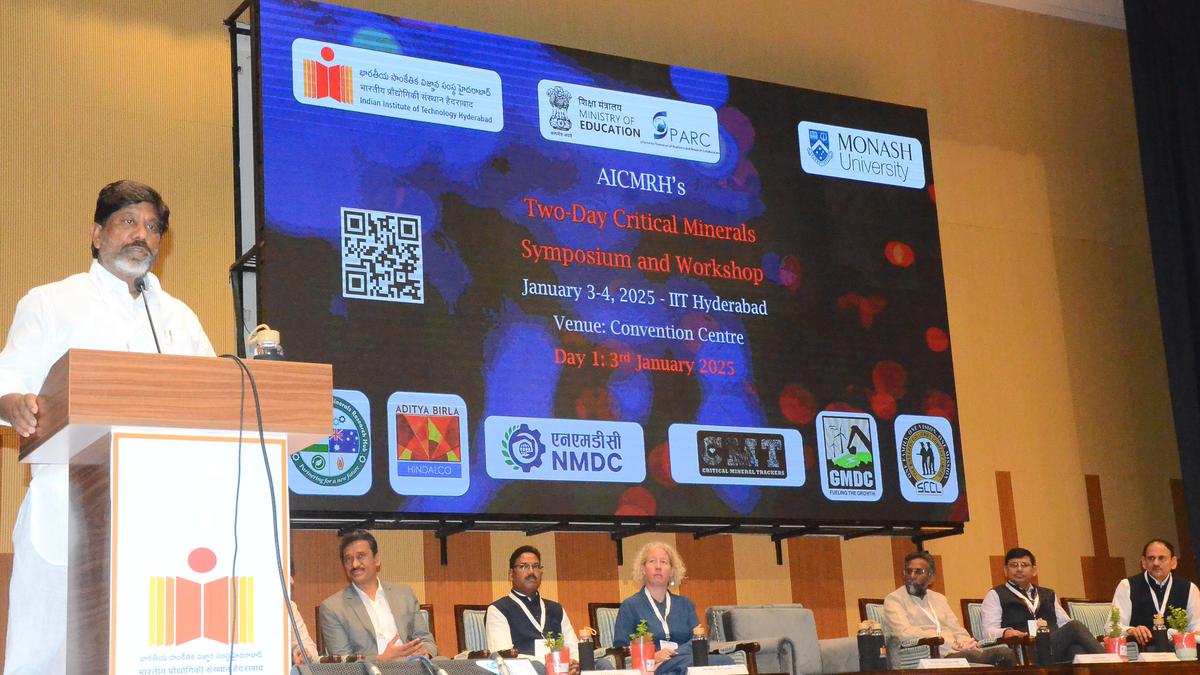
Advancing research and innovation in critical minerals with a focus on sustainable methods for mineral exploration, extraction and recycling as the theme, Indian Institute of Technology, Hyderabad, on Saturday concluded its two-day workshop.
The Australia-India Critical Minerals Research Hub (AICMRH) symposium co-organised by Monash University saw attendance of researchers, academicians, and Industry leaders from across India and Australia.
The first day featured keynote and expert talks and the concluding day, with workshops and deliberations, marked a roadmap for research priorities between Australia and India.
According to Deputy Chief Minister Mallu Bhatti Vikramarka, who was present to share the Telangana government’s commitment, “critical minerals are the building blocks of green energy and sustainable development, and they play a key role in achieving the goals of renewable energy, battery storage, and green Hydrogen.”
He said the government was committed to fostering sustainable mining, green energy and innovation. By advancing green hydrogen technology, the target is to produce 20,000 MW green energy by 2030, he said.
For Consul General Hilary McGeachy (Australia Consulate-General), critical minerals is a key area of Australia-India collaboration. “These initiatives drive commercial links, sustainable practices and supply chain diversification in support of the transition to clean energy,” she said.
The AICMRH is a dedicated centre for research and promoting sustainable mining innovations and was established through a MoU between IIT Hyderabad and Monash University. The Ministry of Education approved $1.1 million as the first instalment under the Scheme for Promotion of Academic and Research Collaboration (SPARC) Scheme for the programme and it serves scholarships, research fellowships, and collaborative visits for Australian scholars to India. The programme also aligns the National Education Policy (NEP-2020) and the Australian Researcher Cooperation Hub (ARCH-India), and aims to unite leading academicians, researchers, and industry leaders from Australia and India to collaborate to harness collective expertise.


Abhishek Banerjee challenges BJP's Suvendu Adhikari in Nandigram, pledging community health initiatives if Trinamool Congress wins.

Rising LPG shortages in Karnataka boost firewood demand, reviving an informal market as households and hotels seek alternatives.

Against the backdrop of intense poll activity, a 400-metre stretch of an arterial road in the outskirts of Chennai (technically in Madurapakkam panchayat under Tambaram assembly constituency) presents a salute to the idea of res publica, which underpins India’s system of governance, where citizens have a say, at least before a government is securely ensconced in the seat of power. A Republic Day initiative shines bright every night

Fadnavis claims zero FIR in Ajit Pawar crash is a defamation attempt by Karnataka against Maharashtra's investigation efforts.

Set to unfold as a one-day pop-up on April 5, the Easter Sadya brings together both vegetarian and non-vegetarian menus, offering a peek into the food traditions of the Syrian Christian (Nasrani) community. While the traditional Sadya is often associated with dishes such as sambar, avial, and rice, this version expands to include community-specific festive dishes.

BJP nominates mother of R.G. Kar victim Abhaya to contest from Panihati in West Bengal Assembly elections.

Veteran Malayalam actor-director E.A. Rajendran passes away at 71, leaving behind a rich legacy in the film industry.

Dakshina Kannada Zilla Panchayat has rolled out digital mode of water bill generation and collection in 23 gram panchayats on a pilot basis for the first time in Karnataka. This is set to be extended to the remaining 200 panchayats shortly, according to the Zilla Panchayat Chief Executive Officer Narwade Vinayak Karbhari.

Bengaluru police questioned a man carrying ₹6 lakh for medical expenses at Vidhana Soudha, later releasing him after verification.

BJP accuses Bengaluru's Congress government of corruption in e-Khata issuance, halting infrastructure projects due to financial mismanagement.

Misinformation in Hyderabad sparks panic buying, causing disruptions as residents react to unfounded rumors of an impending lockdown.

Bengaluru Metro extends services until 2 a.m. on March 28 for IPL match, ensuring convenient travel for spectators.

A bus truck-collision in Andhra Pradesh's Markapuram district, killing several. Catch LIVE updates here!