Digi Yatra plans expansion to international travel with passport-based enrolment
The Hindu
Digi Yatra plans to enhance international travel with passport-based enrolment, ensuring data security and seamless passenger experiences.
The Digi Yatra Foundation is working on extending its decentralised digital identity platform to international air travel, with passport-based enrolment already tested and discussions under way with global aviation bodies, its Chief Executive Officer Suresh Khadakbhavi said at The Hindu Tech Summit 2026 on Thursday (February 12, 2026).
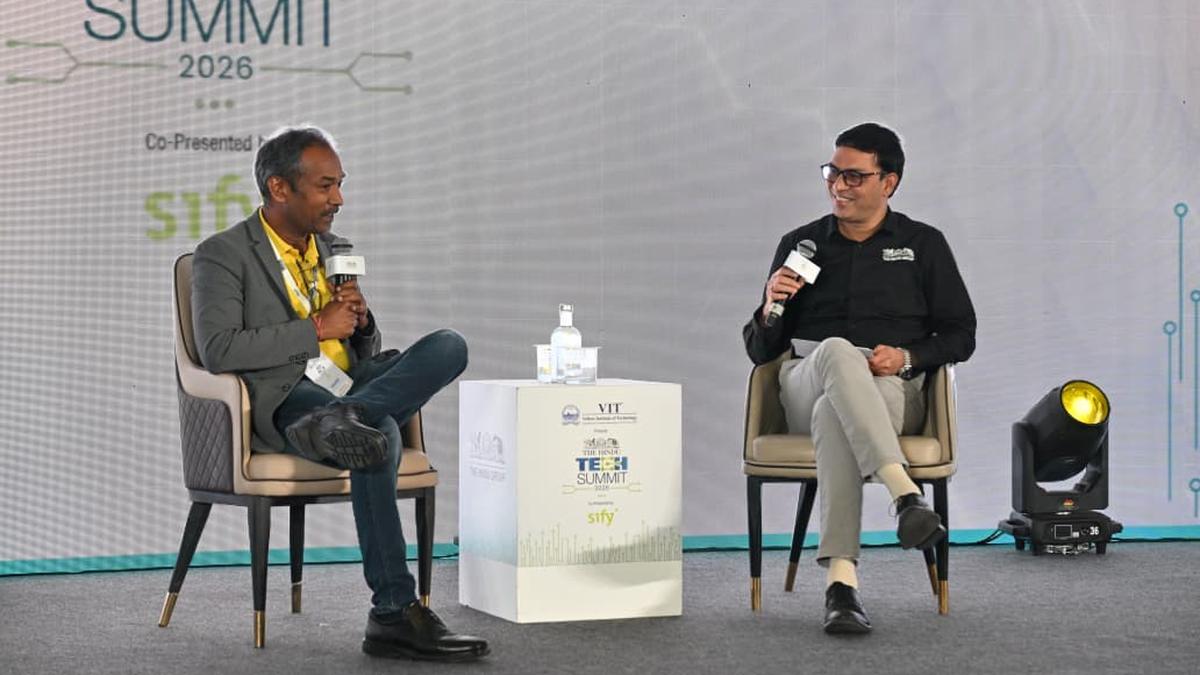
Speaking with L.V. Navaneeth, CEO, The Hindu Group, during a fireside chat on ‘Data Privacy & Security in Biometric Travel Platform’, Mr. Khadakbhavi said the planned feature would allow passengers to share verified digital credentials with both departure and destination airports, enabling seamless travel without repeated identity checks. “If you are travelling from Chennai to London, you can share credentials at Chennai, enjoy a seamless process, and when you reach London, you do not have to stand in two-hour queues again for immigration,” he said.
Explaining the origins of Digi Yatra, Mr. Khadakbhavi said he had earlier been part of an advisory group for One ID, a global seamless air travel initiative, where discussions focused on privacy-preserving technologies and self-sovereign identity. Self-sovereign identity, he said, meant that individuals remained in control of their identity data, which led to the decision to build a decentralised ecosystem rather than a centralised identity platform.
Under the Digi Yatra model, enrolment is a one-time process, using Aadhaar-based verification. Users authenticate via an OTP at the airport verifier, after which limited KYC data — name, date of birth, gender, photograph, and the last four digits of the Aadhaar number — is retrieved. Mr. Khadakbhavi said this was significantly less information than what is routinely shared in other settings, such as hotel check-ins.
To prevent misuse, the platform incorporates liveness detection and facial matching. A live selfie is captured and matched with the KYC photograph, after which the Aadhaar-linked image is discarded for privacy reasons and only the verified selfie is retained. Acknowledging the growing sophistication of deepfake technologies, he said multiple safeguards were built into the system.
Addressing concerns around data security, Mr. Khadakbhavi said Digi Yatra follows a decentralised architecture in which credentials reside on users’ own devices rather than in a central database. As a result, any attempt to breach the system would require compromising individual devices rather than a single repository.


Hyderabad's restored Bam Rukn-ud-Daula Lake and Nalla Cheruvu will be inaugurated on March 6

Multilingual classrooms: Can NEP 2020 bridge the policy-practice gap?

AIADMK's M. Thambi Durai and PMK's Anbumani Ramadoss file nominations for Rajya Sabha elections in Chennai.

Karnataka forms a 28-member Elephant Task Force in Dakshina Kannada to address human-elephant conflict, and enhance safety.

CBI investigates Puducherry counterfeit drugs case, uncovering illegal manufacturing and distribution affecting public health and national security.

Congress renominates Phulo Devi Netam, a senior tribal leader from Bastar, for the Rajya Sabha elections in Chhattisgarh.

Tamil Nadu bans private schools from hosting political or divisive events, ensuring a focus on education and student welfare.

Hyderabad's TIMS Sanathnagar hospital will alleviate surgery wait times by addressing long-pending cases as it opens soon.

Newwave Art Collective in Hyderabad is using art for public dialogue. The group is having their first show at State Art Gallery.

Nvidia CEO Jensen Huang said that the opportunity to invest $100 billion in OpenAI is probably not in the cards

What does it take to design gloves, masks and uniform that factor in the various challenges faced by workers on the waste beat? Indore, Bengaluru and Pune have an answer

Congress nominates Kamarvir Boudh, a SC leader, for Rajya Sabha from Haryana, aiming to balance party dynamics.

Karnataka Speaker U.T. Khader requests UIDAI probe into discarded Aadhaar cards found along Netravati river near Mangaluru.