Despite ban, Bangladesh elections open new political space for Awami League Premium
The Hindu
Bangladesh's elections have reopened Awami League offices, sparking political activity despite the party's ongoing ban.
It was the morning of February 13, a day after Bangladesh’s parliamentary election delivered a landslide victory to the Bangladesh Nationalist Party (BNP). The lock on the closed Chaklahat union office of the Awami League in the northern district of Panchagarh was removed. The office had remained locked for 18 months after the fall of the Awami League Government and the subsequent ban on the party’s activities.
Its reopening took place in the presence of the Panchagarh Sadar upazila BNP President, who stood beside local Awami League leaders and activists. The BNP leader, a former union parishad chairman, said he was unaware that the office had remained locked and claimed he would have opened it earlier had he known.
Similar incidents took place across Bangladesh in the days since the February 12 election. From Faridpur to Patuakhali, Khulna to Rajbari, Naogaon to Dinajpur, Kurigram to Narayanganj, Mymensingh to Shariatpur, and Noakhali, Awami League leaders and activists have reopened closed party offices, hoisted the national flag, displayed portraits of Sheikh Mujibur Rahman and Sheikh Hasina, and chanted “Joy Bangla”. In the capital, a group of Juba Mohila League, the women’s wing of the AL, staged a brief rally on February 20 at the main gate of Sheikh Hasina’s political office in Dhanmondi, a site that had previously been attacked multiple times.
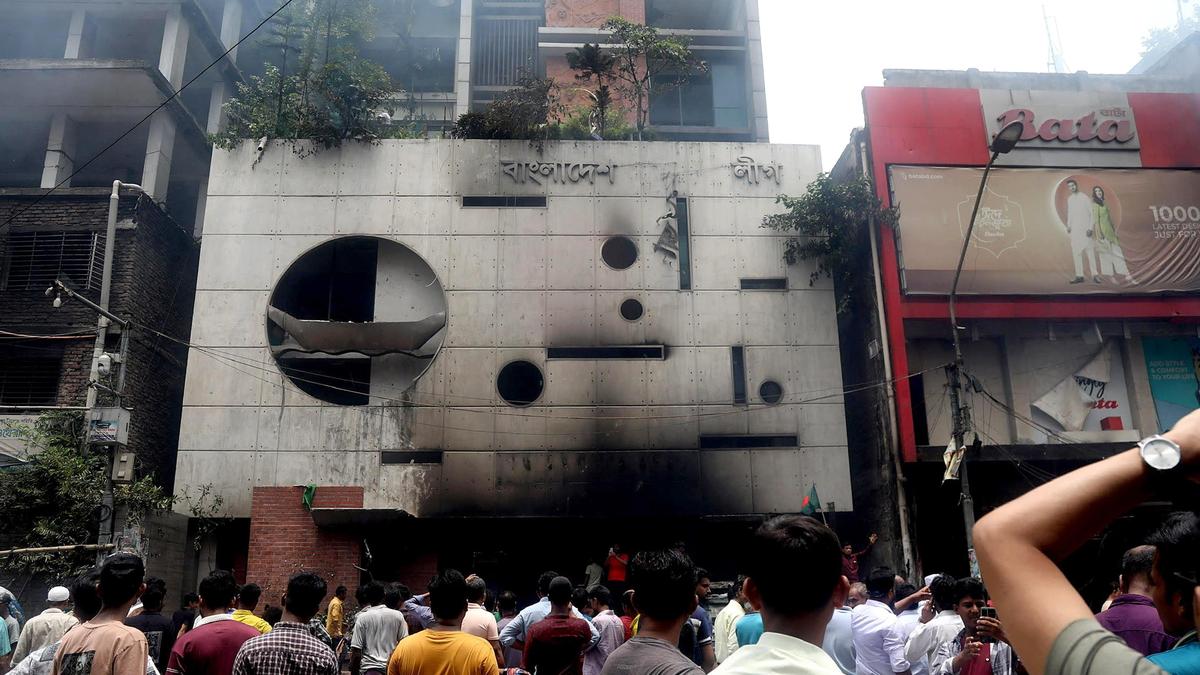
Awami League offices have now been reopened in at least 15 districts. In most cases, leaders and activists arrived early in the morning, raised the flag, chanted slogans, and left within a short time. Several individuals have been arrested by police in connection with these incidents. Leaders of the Awami League and its affiliated bodies were also seen paying tribute at Shaheed Minar on February 21, International Mother Language Day. However, reactions to the reopening of offices have varied. In some areas, AL activists unlocked offices without obstruction; in others, they faced resistance, including BNP affiliates and anti-discrimination student movement activists who tore down banners, vandalised offices, and, in some cases, set them on fire before re-locking the premises.
Despite these local reopenings, AL and its affiliated organisations remain officially banned from political activities. Most party offices, from the central headquarters to ward-level branches, had been closed since the 2024 uprising. Some buildings were partially damaged by fire or looting, and furniture and equipment were stolen, including from the party’s central office.
Political analysts said the timing of these reopenings is significant. Under the interim government, even small gatherings of AL activists often led to immediate arrests. The current wave of activities indicates that activists believe enforcement may be less stringent under the new administration.


Jeevan Reddy leads a rally for maize farmers in Jagtial amid speculation of leaving Congress for BRS.

BJP and AINRC likely to maintain 2021 seat-sharing formula for Puducherry's 2026 Assembly elections, confirms party president.

BJP reveals 144 candidates for Bengal Assembly polls, featuring Suvendu Adhikari contesting against Mamata Banerjee in Bhabanipur.

Anna University partners with Ramco Systems to create an advanced ERP lab for enhanced industrial engineering education.

NDA announces candidates for 12 Kozhikode seats in Kerala Assembly polls 2026 as UDF and LDF ramp up campaigning.

As India formulates its next steps in the Israel-U.S.-Iran war, it is necessary to consider not only what it will mean for the whole region but also its own ties with each neighbour

CITU criticizes the Centre's privatization efforts for VSP, alleging employee removal over production increase and financial mismanagement.

Visakhapatnam Customs House's short film "Right Turn" wins Honourable Jury Mention at the 10th Indian World Film Festival.

Economist Arvind Subramanian advises CM Revanth Reddy on strengthening Telangana's finances during a meeting in Hyderabad.

Supreme Court emphasizes stakeholder consultation for legal education reforms, hesitant to change five-year law course duration.

Authorities in Andhra Pradesh are set to tranquillise a roaming tiger near Annavaram temple for safety and conservation.

MEA criticizes USCIRF for bias, urging focus on vandalism of Hindu temples in the U.S. over selective criticism of India.

Bengaluru's Urban Development aims to beautify underutilized flyover spaces, enhancing city aesthetics and improving green cover initiatives.