Declining areca yield, lack of amenities forcing residents of village surrounded by Kudremukh National Park in Karnataka to move out
The Hindu
Residents of Bhalekadi, Karnataka, face declining areca yields and lack of amenities, prompting demands for rehabilitation from the government.
“I get rice free from the government of Karnataka under the Annabhagya scheme. But, to carry it home, I need to spend ₹600 on an autorickshaw,” says Sunitha, a resident of Bhalekadi, a village in Kere gram panchayat of Sringeri taluk in Chikkamagaluru district. This statement of Sunitha, who is from a tribal community (Gowdlu/Malekudiya), sums up the hardship faced every day by residents of Bhalekadi, which is surrounded by the Kudremukh National Park.
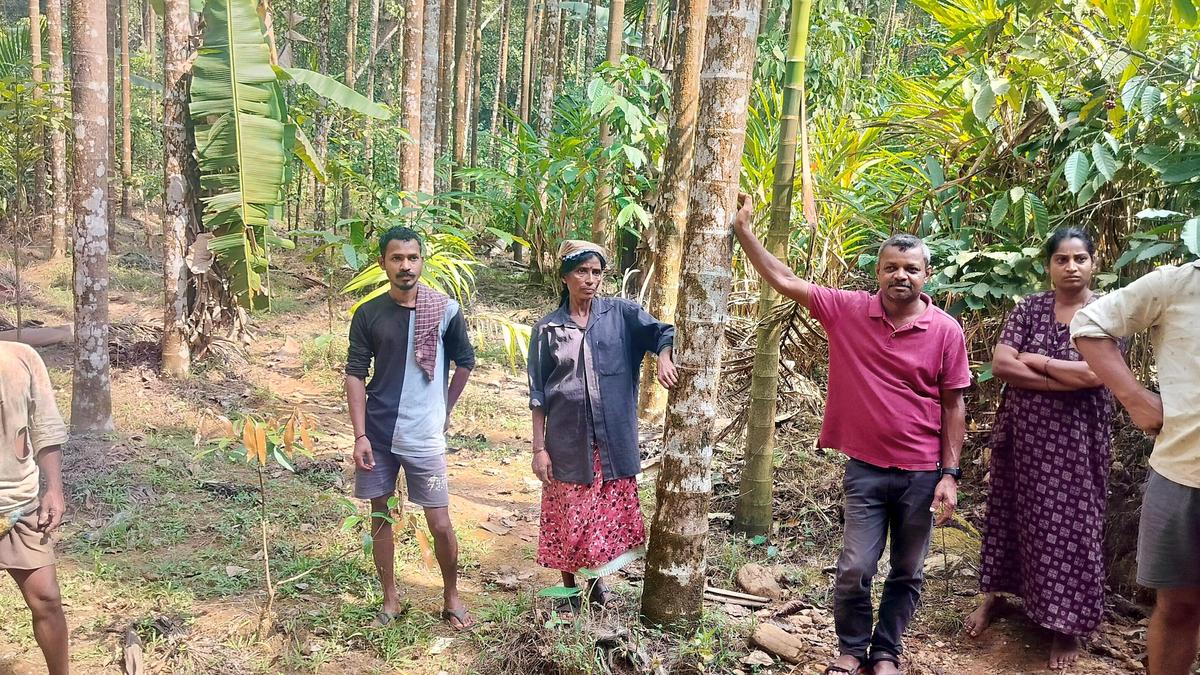
Residents of Bhalekadi village live on the boundaries of Kudremukh National Park in Karnataka. As the village is interspersed with a national park, which is a protected area, the government hardly takes up any development work in the village | Photo Credit: Sathish .G.T
Lack of basic amenities, coupled with diseases bringing down yield in arecanut farms, have prompted the villagers to move out of the region where they have lived for generations. As the village is interspersed with the national park, the government hardly takes up any development work in the village.
“If someone falls sick and needs urgent emergency healthcare, it takes hours to reach the nearest hospital in Sringeri, about 26 km from our village,” explained Rangappa. A couple of months ago his wife, Sunitha, developed chest pain. It took him more than an hour just to arrange for an autorickshaw to take her to the hospital. Later, she was moved to Manipal in neighbouring Udupi district for better treatment.
Bhalekadi is home to about 45 families. They have built houses in revenue land and their own farmland, where they have been cultivating arecanut. In recent years, yellow-leaf disease and leaf-spot diseases has decreased the yield substantially. | Photo Credit: Sathish G.T.
Bhalekadi is home to about 45 families. They have built houses in revenue land and their own farmland, where they have been cultivating arecanut. In recent years, yellow-leaf disease and leaf-spot diseases has decreased the yield substantially.


Bill Gates visits Andhra Pradesh to discuss projects with officials and explore opportunities in agriculture, education, and healthcare.

Learn about umbilical cord complications, including nuchal cord and compression, and ensure timely medical care for expectant parents.

Supreme Court's nine-judge Bench to assess if state functions and activities qualify as 'industry' under the Industrial Disputes Act.

Home Minister Amit Shah predicts an 80% conviction rate following the full implementation of three new criminal laws in India.

Palayamkottai's historic clock, predating Big Ben, is set for restoration to reclaim its long-lost chime.

Kerala Crime Branch interrogates Palakkad MLA Rahul Mamkootathil in a rape and coerced pregnancy case amid allegations of deceit and conspiracy.

Michito Kaneno of Lamp Bar in Japan will be in India for bar takeover

Sri Lankan Navy detains 25 fishermen from Karaikal for allegedly crossing maritime boundaries during fishing activities.

Former Assam Congress chief Bhupen Borah resigns, citing neglect by party leadership ahead of upcoming Assembly polls.

Supreme Court to review Sabarimala women entry case with a nine-judge Bench starting April 7, 2026, after pandemic delay

India AI Impact Summit 2026 LIVE: PM Modi to inaugurate India AI Impact Expo 2026 on February 16, showcasing global AI collaboration and innovation in New Delhi.

Kiren Rijiju claims Rahul Gandhi is uninterested in Parliament, influenced by NGOs, while asserting no further efforts will placate Congress.

Residents of Bhalekadi, Karnataka, face declining areca yields and lack of amenities, prompting demands for rehabilitation from the government.