Could the near-extinct Asiatic cheetah rewild Saudi Arabia? Premium
The Hindu
Could Saudi Arabia rewild the near-extinct Asiatic cheetah using insights from ancient remains found in its caves?
The cheetah is a spotted beast that can burn through savannas like a bolt of lightning to hunt prey vastly bigger than itself. This big cat is the world’s fastest terrestrial mammal, which purrs more than it growls and has been historically tamed and trained by people to hunt game.
Cheetahs once roamed most of Africa and western and southern Asia, from the Arabian Peninsula to India. Today, it has vanished from 91% of its historical global range. In India, it was declared extinct in 1952 from hunting and habitat loss, and over a century ago, it vanished from Saudi Arabia.
Asiatic cheetahs (Acinonyx jubatus venaticus), unlike those in Africa, which that tenuously hold on, are the most critically endangered: just around 50 individual Asiatic cheetahs remain in the wild, a small population in Iran.
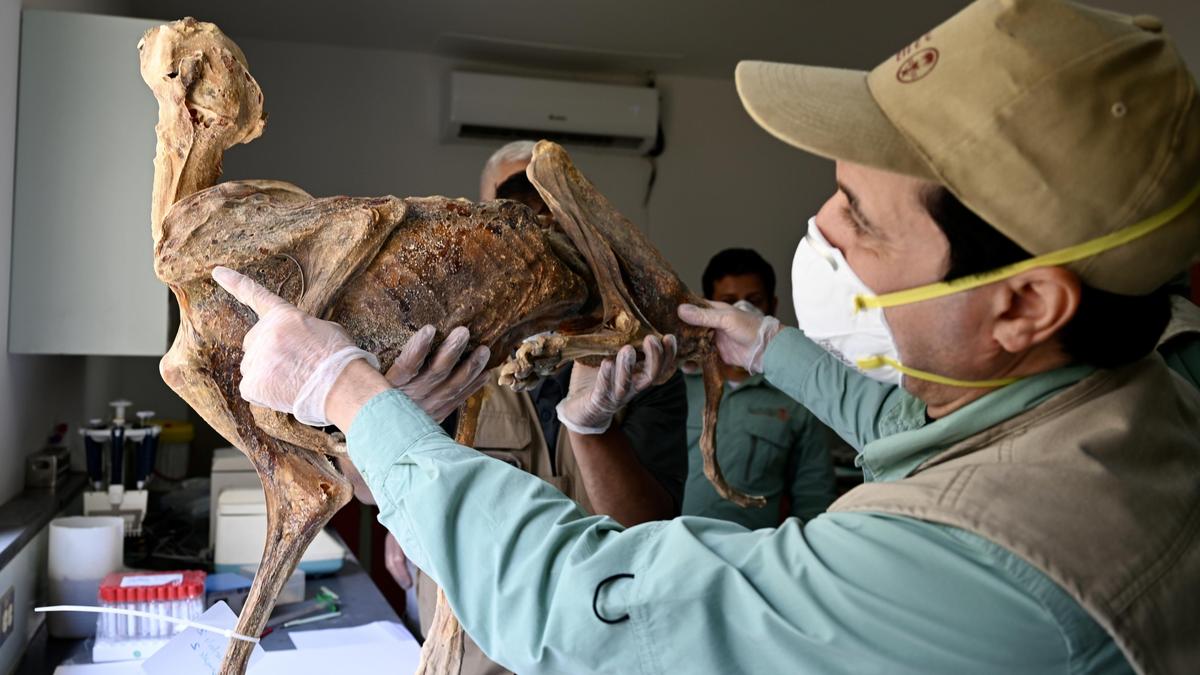
Amidst this dire scenario came a “serendipitous discovery” recently in the caves of Saudi Arabia of the “long-term presence” of cheetahs. Scientists discovered seven naturally mummified animals and skeletal remains of 54, reported in the latest edition of Nature Communications Earth and Environment.
The remains, unearthed from the Lauga cave network in the Arar area of northern Saudi Arabia, dated back to 4,223 years ago and some to just over a century ago, giving scientists a valuable opportunity to understand the evolutionary history of cheetahs in their former range. They concluded that “rewilding” of cheetahs in Saudi Arabia can be sourced from the closest subspecies of the discovered cheetahs”, potentially paving the way for their ‘return’.
Genomic data of these specimens showed the presence of two subspecies, the Asiatic cheetah (A. j. venaticus) and the north-western African cheetah (A. j. hecki), neither of which occur in the Arabian Peninsula any more. The many caves in the region could have been used as denning sites for the creatures. The study used palaeo-chronological dating to establish the time period, genomic sequencing to identify subspecies, and radiographic analysis to determine age.


Witness the blood moon during the lunar eclipse day in India and other countries, through pictures here.

Discover the fascinating world of hydroxyl megamasers, powerful cosmic lasers revealing secrets of distant galaxies and the universe's evolution.

Discover how India's unique resources could lead to groundbreaking advancements in global cancer care and research.

Discover groundbreaking research on Mars lightning, innovative smart materials, and a universal ageing marker in just one minute.

A launch vehicle’s ascent battles gravity to gain orbital velocity, while re-entry is a controlled struggle against the atmosphere to systematically shed that immense kinetic energy through aerobraking, thermal protection and precise guidance within the re-entry corridor. Operating as a semi-ballistic body, the crew module performs a deorbit burn, manages communication blackout, and deploys a three-stage parachute system to ensure a safe splashdown.

The Nissan Gravite is a budget-friendly seven-seater MPV designed for practical family use in India. Sharing its platform with the Renault Triber, it offers flexible 2-to-7 seating, a removable third row, generous boot space, and a fuel-efficient 1.0-litre petrol engine delivering around 19 km/l. With features such as a floating touchscreen, wireless connectivity, digital instrument cluster, and six airbags as standard, the Gravite blends affordability, safety and everyday usability in a compact footprint tailored to urban and small-family needs.

Discover the dedication of Tamil Nadu's teenage cyclists competing at the Track Asia Cup, balancing sport and academics.

Explore how Salar de Pajonales in Chile serves as a vital Mars analogue for studying microbial life and ancient fossils.

NASA revamps its Artemis lunar program to address delays and ensure a Moon landing by 2028.