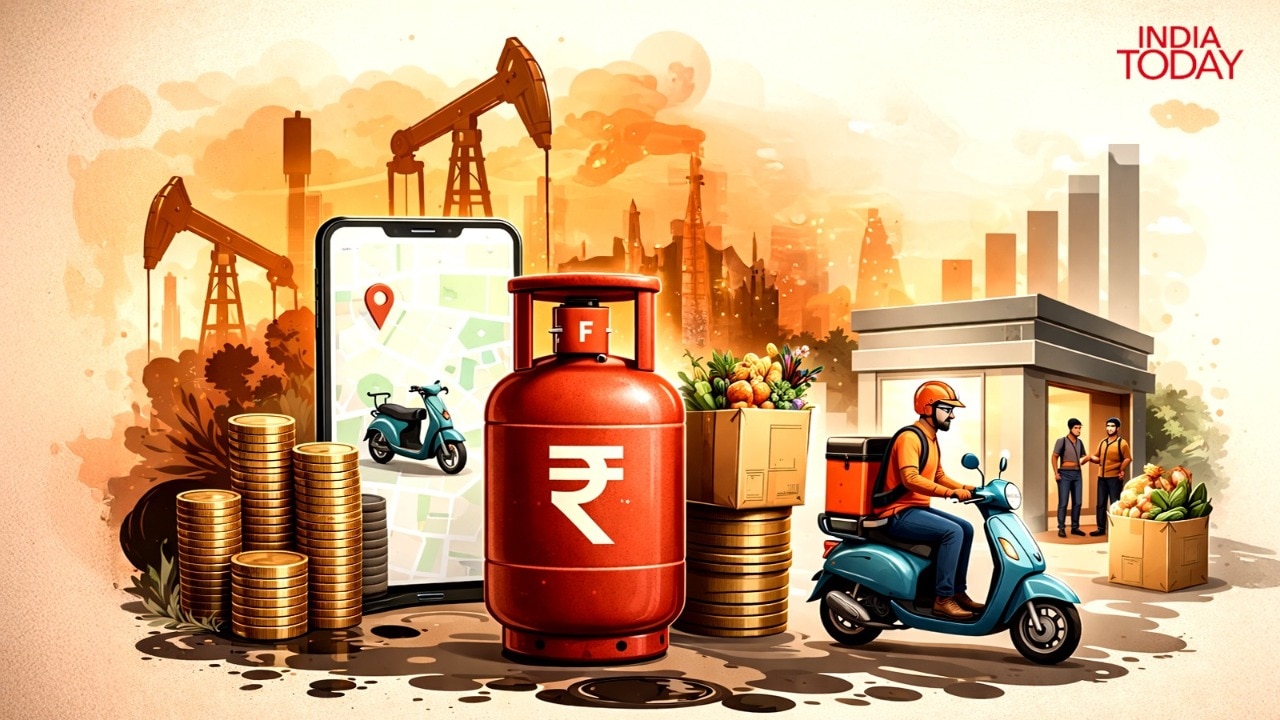
Could rising gas prices make your quick commerce orders costlier?
India Today
Quick commerce has become the go-to option for instant groceries and food deliveries. But with LPG prices rising and supply concerns growing, the cost pressure may be building behind the scenes. Could this soon make your quick commerce orders costlier? Let's have a look.
The ongoing concerns around LPG availability and rising gas costs may not just affect household kitchens. They could quietly ripple into India’s fast-growing quick commerce sector as well. Built on speed, convenience and thin margins, the industry depends on a large network of food vendors and cloud kitchens that rely heavily on LPG. If gas becomes costlier or harder to access, the pressure may start building behind the scenes.
Though the impact may not immediately show up on delivery apps, if prices keep rising or supply tightens further, the strain on vendors could slowly reshape menus, pricing and even consumer ordering habits.
Most consumers associate quick commerce with delivery bikes and mobile apps. But behind the scenes, LPG plays an important role.
Thousands of partner restaurants and cloud kitchens depend on LPG to prepare food ordered through delivery platforms. Many quick commerce apps are now delivering hot meals, ready-to-eat items and bakery products within minutes.
Madhav Kasturia, CEO and Founder of Zippee, believes the real pressure on quick commerce begins here. “For quick commerce, the real damage is upstream. India’s cloud kitchen market, valued at $1.2 billion in 2025 and projected to reach $3.7 billion by 2034 at a 12.28% CAGR, runs almost entirely on LPG,” Kasturia says.
If LPG becomes more expensive or supply tightens, cooking costs rise immediately. Smaller kitchens operating on thin margins may be forced to either increase prices or reduce menu options.


Sensex has declined over 6,000 points or roughly 7.5% in a little over two weeks as global tensions and rising oil prices triggered selling in equities.


Speaking in Parliament, Union Petroleum and Natural Gas Minister Hardeep Singh Puri said India has adequate fuel stocks, and there is no cause for concern over availability.

Industry sources told India Today TV that airline operators are now paying additional insurance charges for every aircraft flying into the Middle East, significantly increasing the cost of operations on these routes.

Under law, a domestic household is generally allowed to keep two LPG cylinders of 14.2 kg each at a time. This usually includes one cylinder connected for use and another spare cylinder kept as backup.

Early signals from GIFT Nifty suggest that the benchmark indices could open lower when trading begins. GIFT Nifty futures were trading at 23,784.50 at around 7:58 am. This indicates that the Nifty 50 may open below Wednesday's closing level of 23,866.85.

When markets fall sharply, fear often takes over investing decisions. But did you know continuing SIPs during market crashes has historically rewarded disciplined investors?

The move comes as global energy markets remain on edge due to escalating tensions linked to the conflict involving Iran, which has raised fears of disruptions to crude oil shipments from the Middle East.

India consumes roughly 5.3 to 5.5 million barrels of crude oil every day. However, domestic production is only about 0.6 million barrels per day. This means the country depends on imports for nearly 85% of its oil needs.

At around 10:47 am, the BSE Sensex was down 750.68 points or 0.96% at 77,455.30, while the Nifty 50 slipped 208.25 points or 0.86% to 24,053.35.

Air India said the fuel surcharge is due to the sharp rise in aviation turbine fuel (ATF) prices since early March 2026, triggered by supply disruptions in the Gulf region.

Rahul Bhatia expressed gratitude to employees who worked tirelessly to restore operations during that challenging period, praising their resilience and dedication.

The Iran-US conflict has disrupted shipping through a key global oil export route, pushing oil prices higher. As a result, airline tickets on some routes have become much more expensive, and there are growing concerns that travel demand could weaken if the situation continues.