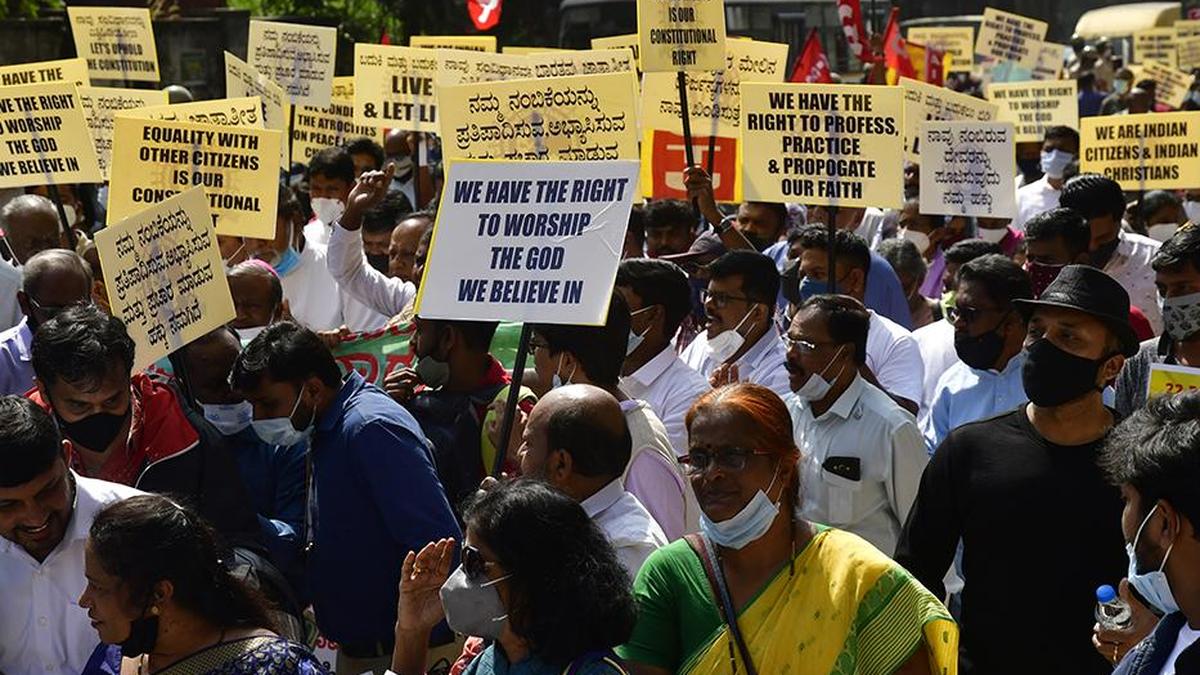
Conversion politics, the challenge to secularism
The Hindu
Anti-conversion laws risk deepening social divisions
There have been recurrent media reports of arrests of Muslims from diverse social and professional backgrounds — they include gym owners, medical practitioners, and religious clerics — on allegations of participating in organised networks that facilitate religious conversion from Hinduism to Islam. These reports have predominantly emerged from North India, particularly Uttar Pradesh and Uttarakhand. Most of the cases remain under investigation. If substantiated, such developments could indicate a new form of ideological churn within segments of Muslim society in India. Otherwise, they risk being perceived as manufactured narratives driven by an ideologically motivated state.
The last widely acknowledged instance of mass conversion to Islam in India occurred in February 1981 in Meenakshipuram, Tamil Nadu, where 558 Dalits embraced Islam to escape entrenched caste oppression. Reflecting on the episode, Atal Bihari Vajpayee observed that Hindu society suffered from long-standing ills, particularly distinctions based on birth and caste. The conversions were thus rooted in inequalities internal to Hindu society.
Also Read | What we know so far about the Supreme Court’s ruling on reservation for converted Dalits
Religious conversion — particularly from Hinduism to Islam and Christianity — has long been a contentious issue. Mahatma Gandhi, in particular, according to Laura D. Jenkins, author of Religious Freedom and Mass Conversion in India, viewed mass conversions not only as a threat to the poor and the uneducated but also to anti-colonial unity.
The most symbolically powerful conversion in modern Indian history was that of Dr. B.R. Ambedkar, who embraced Buddhism in 1956. On October 13, 1935, Ambedkar had declared his intention to leave Hinduism at the Depressed Classes Conference in Yeola. He said, “I was born a Hindu, but I will not die a Hindu.” For Ambedkar, conversion was an act of emancipation. In the intervening period, he repeatedly urged Dalits to leave Hinduism for any religion of their choice, including Islam.
He even took the initiative for Dalits to convert to Sikhism, which found unexpected support from Dr. B.S. Moonje, a prominent leader of the Hindu Mahasabha, who encouraged Hindu leaders to endorse the conversion. However, this met opposition from Mahatma, C. Rajagopalachari and Pandit Madan Mohan Malviya. One of Gandhi’s principal arguments against Ambedkar leaving Hinduism was the belief that Dalit followers would abandon him once he ceased to be a Hindu. Had Gandhi been alive today, he would have realised how profoundly mistaken this assessment was. The enduring reverence for Ambedkar among Dalits, despite, and indeed because of, his conversion, stands as a powerful rebuttal to that prognosis.


Voters in Kavundampalayam constituency demand better roads, bus connectivity, and improved waste management as elections approach.

Israeli airstrike in Gaza kills four, targeting a reported terrorist cell amid ongoing tensions despite a ceasefire.

The Sabala food festival in Visakhapatnam highlights natural farming, traditional diets, and sustainable living, attracting 50,000 visitors.

Industrialist Kiran Mazumdar-Shaw, executive chairperson, Biocon Limited took to the social media platform X, tagging Union Minister for Road Transport and Highways Nitin Gadkari, to highlight the bad road stretches on Hosur Road on Sunday. “Whilst NHAI boasts of its road infrastructure across the country, why is the country’s key IT corridor NH44 - Hosur Road so shoddily designed and ill-maintained? It’s an eyesore - the medians and barricades are terrible, and the shoulders are not asphalted. Despite several complaints over several years there is no response,” she wrote.

Congress criticises PM Modi's proposal to increase Lok Sabha seats, calling it a "Weapon of Mass Distraction" from pressing issues.

Stalin criticizes the Central government for delaying projects in Tamil Nadu due to political animosity, highlighting DMK's achievements.

AIADMK intensifies campaign in coastal districts, leveraging anti-incumbency and strong voter base to reclaim lost Assembly seats.

Padmanabhapuram eyes balanced growth in infrastructure and development

The battle intensifies in central Bengal as Congress leaders Adhir Ranjan Chowdhury and Mausam Noor challenge Trinamool dominance.

CM Revanth Reddy urges youth to shift focus from drugs to sports, highlighting Hyderabad's rich athletic legacy.

Visakhapatnam police booked over 20,000 traffic violations in nine days, emphasising helmet use and speed limit adherence for safety.

Karnataka Rakshana Vedike plans a protest against Governor Gehlot over concerns on third language grading in SSLC exams.

In an early morning incident, a tragic road accident in north Bengaluru’s Yelahanka claimed the lives of two pedestrians on Sunday, the police said.