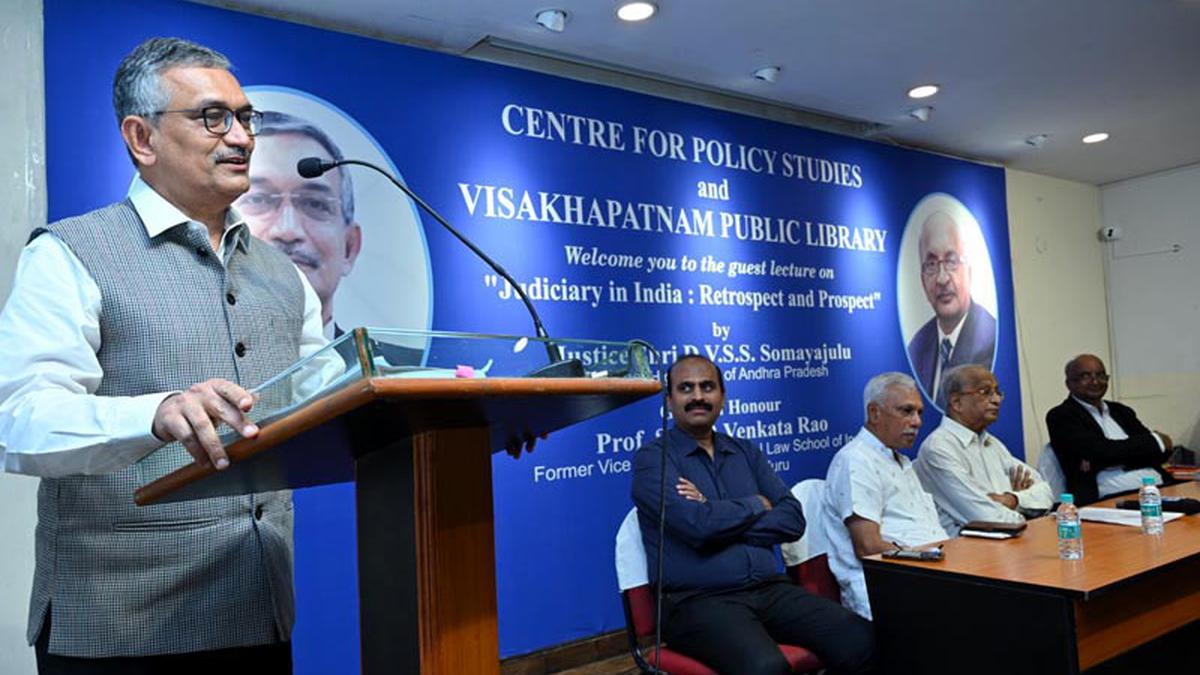
Constitution is supreme, not judiciary or legislature, says Justice Somayajulu
The Hindu
He referred to the important judgments in the initial period of the apex court and narrated how the concepts of fundamental rights and judicial review were treated in the earlier period and the later period.
It’s neither the judiciary nor the legislature, but the Constitution that is supreme in India, Justice D.V.S.S. Somayajulu, Judge of Andhra Pradesh High Court, has said.
Speaking on ‘Judiciary in Retrospect and Prospect’ at a meeting organised jointly by the Centre for Policy Studies and Visakhapatnam Public Library, Justice Somayajulu traced the growth and role played by the Supreme Court during the last seven decades.
He referred to the important judgments in the initial period of the apex court and narrated how the concepts of fundamental rights and judicial review were treated in the earlier period and the later period.
Starting from the A.K. Gopalans case, Justice Somayajulu referred to the growth of the law by judicial interpretation leading up to the famous case of Kesavananda Bharati, wherein the basic structure doctrine was propounded.
He said that forward-looking interpretations led to the growth of law in the areas such as women’s rights and protection of women form sexual harassment. He said that the need for a solution and the need to address a problem led the Supreme Court to lay down guidelines for protection of women in the Visakha case. This was not judicial activism, but judicial action to solve an existing problem that needed an immediate solution.
He said that when there was executive or legislative inaction, the courts stepped in to give a solution, and immediately address the issue. He also referred to the human rights jurisprudence, the growth of Public Interest Litigation and the benefits from the same.
He said that even a letter or a post card was treated as a petition, and access to justice was now available to the poorest of the poor.


From traditional handicraft items from Manipur to a variety of dress materials from across state by women Self-Help group members are on display at the stalls at the National SARAS mela in Karavali Utsava ground in Mangaluru. The nine-day long mela began on Friday.

India participated as an observer at the Board of Peace meeting, reaffirming its support for a viable Palestinian state.

T.N. Deputy Chief Minister inaugurates CREDAI FAIRPRO 2026, showcasing over 500 real estate projects from 80 developers in Chennai.

Andhra Pradesh prioritizes Guntur Mirchi Yard's development with a new committee focused on quality yields and farmer support.

Navy delegates from 50 countries explore natural dyeing and local crafts at Sankalpa Art Village during the International Fleet Review.

Farmers complained about indiscriminate stone quarrying taking place in Madurai district, particularly at Kallanai in Kalligudi taluk. They urged authorities to take necessary action to stop the indiscriminate quarrying activities and protect the environment

Madras High Court dismisses Ramadoss's petitions to freeze 'mango' symbol, emphasizing resolution through civil court, not writs.

After more-than-two-year wait, the flyover at Goripalayam junction will be commissioned on Saturday. As of now, the main arm of the new flyover, named after freedom fighter Netaji Subash Chandra Bose, will help to decongest vehicular movement from Tamukkam junction till Nelpettai junction on East Veli Street.

PAC criticizes the government for poor execution and financial delays in the ₹4,455 crore SANKALP skill development scheme.

Coimbatore is emerging as a leading hub for Global Capability Centres in Tamil Nadu, driven by strong educational infrastructure and investment.

Peace talks between fishermen from Rameswaram and Karaikal aim to resolve fishing territory disputes and ensure maritime harmony.

Telangana's Food Safety Department inspects 122 establishments in a statewide drive, enforcing compliance on cereal products and safety standards.

The Greater Bengaluru Authority expands to 86 members, enhancing representation with key political figures included.