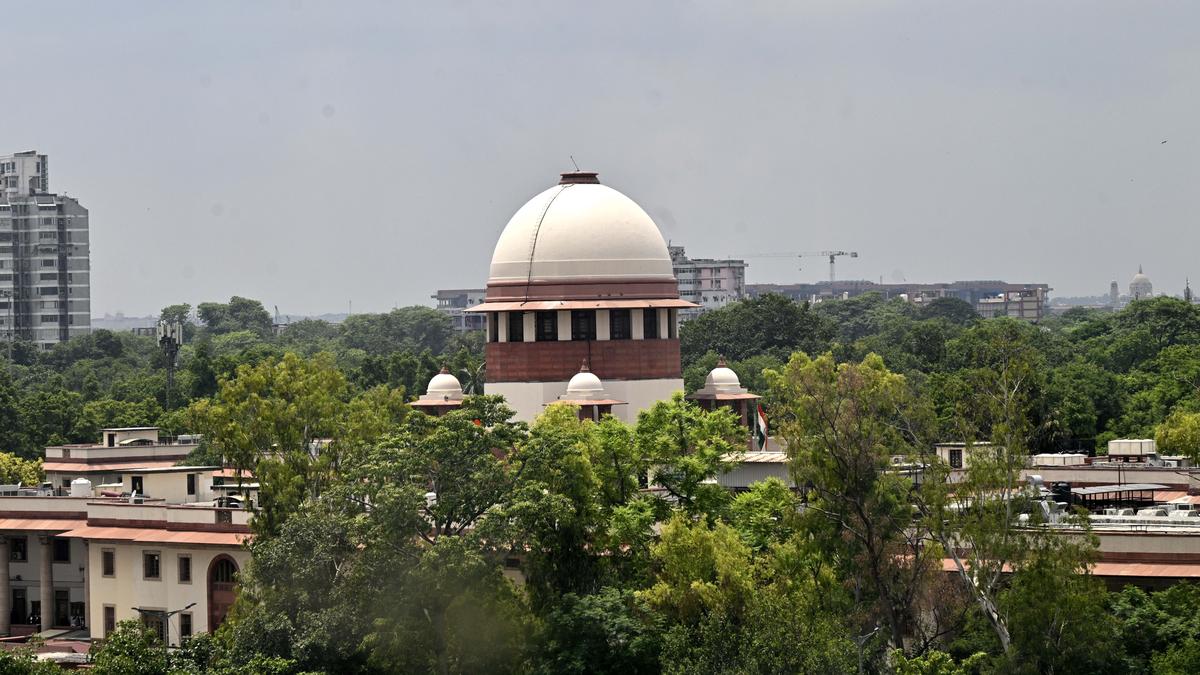
Claims of development and high per capita income contradict high BPL population: Supreme Court
The Hindu
Supreme Court questions high development claims, per capita income, and distribution of food grains to poor in India.
The Supreme Court on Wednesday (March 19, 2025) questioned the claims of high development rate and per capita income when certain States have about 70% of their population living below poverty line, and wondered whether distribution schemes of subsidised essential food grains really reached the poor in the country.
“There are States which utilise or project the development card, saying our per capita income is high, we have progressed so well, but we find that 70% of their population are declared below poverty line (BPL)... How can these two factors go together? There is an inherent contradiction if 70% people are BPL and still you claim a high per capita income,” Justice Surya Kant, heading a Bench, observed orally.
The apex court wondered whether the subsidised ration system, meant to provide food security to the deserving poor, was merely a ploy by governments to garner popularity.
The court was hearing petitions seeking ration cards for migrant workers to ensure food security.
The court had been passing a slew of directions, right from the time of the COVID-19 pandemic, to authorities to undertake welfare measures, including distributing ration cards to migrant workers registered with the e-Shram portal.
Advocates Prashant Bhushan and Cheryl D’Souza, appearing for activists Anjali Bhardwaj, Harsh Mander, and Jagdeep Chhokar, said the contradiction arose from the growing level of inequality.
“The level of inequality has gone up so much that a few people are worth lakhs of crores while a vast majority survive on ₹30 and ₹40 a day,” Mr. Bhushan said.


Anuradha Jonnalagadda took over as in-charge Vice-Chancellor of the University of Hyderabad, focusing on continuity during the transition.

Telangana government awaits committee report on TGSRTC staff absorption, with decisions to be made at an appropriate time.

Telangana's revised pay scale implementation for employees will take timer. The tenure of Pay Revision Commission extended. Govt likely to take decision on reccomendation based on its report.

Vizianagaram's SP A.R. Damodar highlights 20 accident-prone areas and urges drivers to prioritize safety with helmets and seat belts.

Kerala HC stays disqualification of SNDP Yogam leaders, reversing a single judge's order regarding financial and regulatory compliance issues.

Karnataka announces daily supply of 10,000 LPG cylinders to hotels, easing the commercial shortage for the hospitality industry.

Malayalam superstar Mohanlal will be reuniting with filmmaker Priyadarshan, it was announced recently. It will mark the 100th film of Priyadarshan and is backed by Mohanlal’s longtime collaborator, Antony Perumbavoor

Gautham Vasudev Menon loses Madras High Court appeal, ordered to pay ₹4.25 crore to R.S. Infotainment with interest.

AIADMK faces its toughest challenge in 53 years as it prepares for the crucial 2026 T.N. Assembly elections.

Lakmé Fashion Week x FDCI 2026 in Mumbai: What worked and what didn’t

Telangana CM announces underpass beneath Begumpet Airport runway to alleviate traffic congestion in Hyderabad.

Congress leader Ramesh Chennithala claims an alliance between Pinarayi Vijayan, Modi, and Shah aims to undermine UDF in Kerala elections.

CCB arrests Bengaluru couple for running a fake government job scam, cheating over 100 victims out of crores.