Primary Country (Mandatory)

Other Country (Optional)

Set News Language for United States

Primary Language (Mandatory)
Other Language[s] (Optional)
No other language available

Set News Language for World

Primary Language (Mandatory)
Other Language(s) (Optional)

Set News Source for United States

Primary Source (Mandatory)
Other Source[s] (Optional)

Set News Source for World

Primary Source (Mandatory)
Other Source(s) (Optional)
  • Countries
    • India
    • United States
    • Qatar
    • Germany
    • China
    • Canada
    • World
  • Categories
    • National
    • International
    • Business
    • Entertainment
    • Sports
    • Special
    • All Categories
  • Available Languages for United States
    • English
  • All Languages
    • English
    • Hindi
    • Arabic
    • German
    • Chinese
    • French
  • Sources
    • India
      • AajTak
      • NDTV India
      • The Hindu
      • India Today
      • Zee News
      • NDTV
      • BBC
      • The Wire
      • News18
      • News 24
      • The Quint
      • ABP News
      • Zee News
      • News 24
    • United States
      • CNN
      • Fox News
      • Al Jazeera
      • CBSN
      • NY Post
      • Voice of America
      • The New York Times
      • HuffPost
      • ABC News
      • Newsy
    • Qatar
      • Al Jazeera
      • Al Arab
      • The Peninsula
      • Gulf Times
      • Al Sharq
      • Qatar Tribune
      • Al Raya
      • Lusail
    • Germany
      • DW
      • ZDF
      • ProSieben
      • RTL
      • n-tv
      • Die Welt
      • Süddeutsche Zeitung
      • Frankfurter Rundschau
    • China
      • China Daily
      • BBC
      • The New York Times
      • Voice of America
      • Beijing Daily
      • The Epoch Times
      • Ta Kung Pao
      • Xinmin Evening News
    • Canada
      • CBC
      • Radio-Canada
      • CTV
      • TVA Nouvelles
      • Le Journal de Montréal
      • Global News
      • BNN Bloomberg
      • Métro
China’s EAST reactor keeps the fire of magnetic fusion burning
Premium

China’s EAST reactor keeps the fire of magnetic fusion burning Premium

The Hindu
Tuesday, February 18, 2025 12:49:44 AM UTC

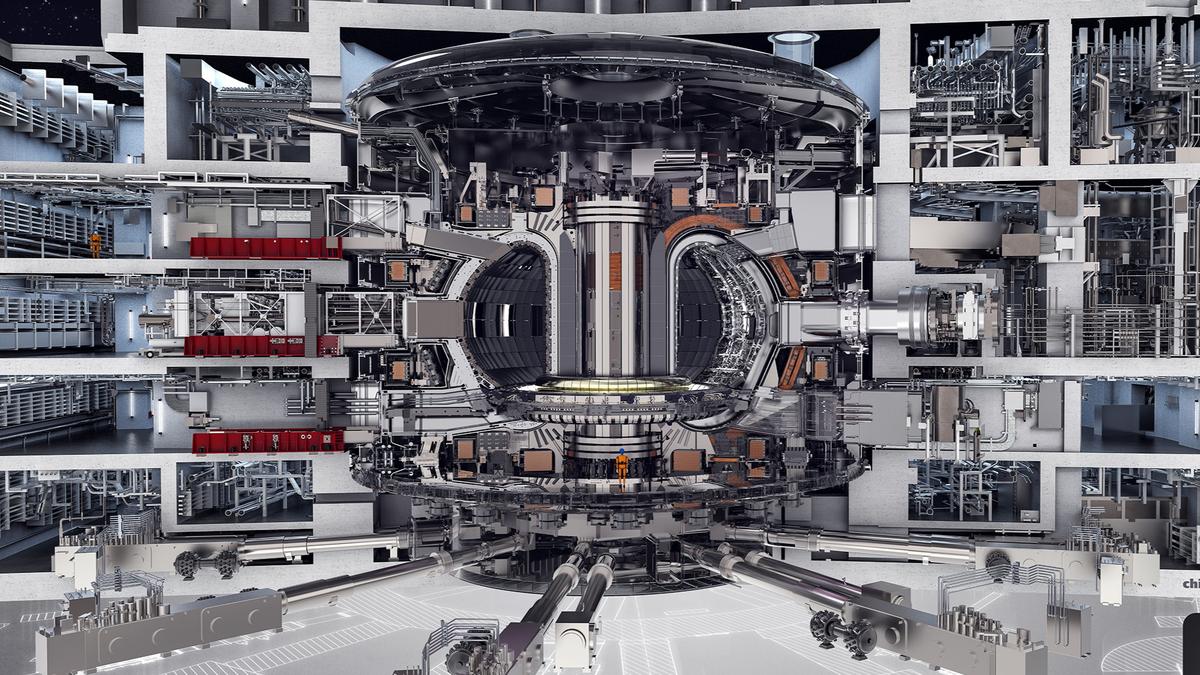
Chinese scientists sustain plasma at 100 million degrees C for 1,066 seconds in EAST, advancing nuclear fusion research.

On January 20, Chinese scientists reported that they were able to maintain a plasma at a temperature of 100 million degrees C for about 1,066 seconds in a nuclear fusion reactor called the Experimental Advanced Superconducting Tokamak (EAST).

In 1938, physicists Otto Hahn and Fritz Strassmann found that energy is produced when the nucleus of an atom breaks apart, a process that Lise Meitner and Otto Frisch explained a year later as a process called ‘fission’. Only four years later, physicists used this principle to build and operate the world’s first reactor with a sustainable nuclear fission reaction.

By this time physicists also knew that energy is also produced when two atomic nuclei fuse together, a process called fusion. Nuclear fission produces harmful radioactive waste whereas nuclear fusion doesn’t. This is why developing a nuclear fusion reactor has become an important technological goal for a world keenly interested in new sources of clean energy.

The problem is the amount of energy required to start and sustain a fusion reaction. A nuclear fission reaction can be kicked off by shooting neutrons of suitable energy at the atoms of unstable nuclei like uranium. For fusion to occur, however, the nuclei need to be exposed to a temperature of at least 100 million degrees C.

The lightest nucleus in nature is of hydrogen, consisting of a single proton. An isotope of hydrogen called deuterium has one proton and one neutron in its nucleus. The nucleus of another isotope called tritium has one proton and two neutrons. Deuterium-deuterium fusion requires a higher temperature to begin than deuterium-tritium fusion. This is because the extra neutron in the tritium nucleus helps overcome the repulsion of like-charges between the protons.

The fusion of a deuterium and a tritium nucleus creates a non-radioactive helium-4 nucleus, a neutron, and 17.6 MeV of energy, which is significant. The neutron can be directed to a blanket of materials surrounding the reactor that capture it and release more heat.

While deuterium is abundant in seawater, there are no natural deposits of tritium and it is very hard to produce. At present it is mostly created as a by-product in heavy-water fission reactors in Canada, India, and South Korea.

Read full story on The Hindu
Share this story on:-
More Related News
The People’s Envoy: How Helmut Schippert made Chennai his canvas

A tribute to Helmut Schippert who launched Chennai Photo Biennale and brought together artistes, writers, and environmentalists during his stint as director of the Goethe-Institut and beyond

Why do we feel the need to go to the bathroom when we’re nervous or scared? Premium

Discover why stress triggers bathroom urges, as adrenaline affects bladder sensitivity and gut contractions during anxiety.

Why does India need bioremediation? | Explained

Explore the necessity, types, challenges, and potential of bioremediation in India for environmental restoration and public health.

Researchers identify key genetic factors causing oral cancer early among Indian tobacco chewers

Researchers in India uncover genetic factors linked to early oral cancer onset in tobacco chewers, enhancing cancer prediction and prevention.

Mahindra XEV 9S first drive: A world-class experience engineered for Indian families

Mahindra’s XEV 9S is a modern, family-focused electric SUV with premium design, a spacious tech-rich cabin, refined performance and advanced safety features. Discover variants, pricing and real-world impressions in our detailed review.

Why Samantha Ruth Prabhu is betting big on pickleball’s India boom Premium

Samantha interview: On pickleball, her battles with a rare autoimmune condition and learnings

Explore the Akkulam Glass Bridge in Thiruvananthapuram for an adrenaline-filled, scenic experience

Experience the thrilling Akkulam Glass Bridge in Thiruvananthapuram, offering stunning views and adventure activities for all ages.

‘Our minds gaslight us into thinking climate change isn’t a big deal’ Premium

Climate scientists and advocates long held an optimistic belief that once impacts became undeniable, people and governments would act. This overestimated our collective response capacity while underestimating our psychological tendency to normalise, says Rachit Dubey, assistant professor at the department of communication, University of California.

Next decade will define Indian space exploration: Shubhanshu Shukla

Indian astronaut Shubhanshu Shukla predicts a transformative decade for India’s space exploration and international collaboration.

Bakelite, the first synthetic plastic Premium

On December 7, 1909, Belgian-American chemist Leo Baekeland’s process patent for making Bakelite was granted, two years after he had figured it out. Bakelite is the first fully synthetic plastic and its invention marked the beginning of the Age of Plastics. A.S.Ganesh tells you more about Baekeland and his Bakelite…

Unlocking the potential India’s research in medicine Premium

Explore the challenges and opportunities in enhancing India's medical research ecosystem to unlock its potential for groundbreaking discoveries.

The rise of the secure workspace

Explore how India’s flexible workspaces are transforming into secure, intelligent environments that safeguard data and enhance employee confidence.

Affordable housing: the missing pillar in India’s urban growth

Discover how collaborative policies and innovative financing can unlock affordable housing in India's urban growth landscape.

An excerpt from Michelin-starred chef Suvir Saran’s memoir, ‘Tell My Mother I Like Boys’

“When I turned to the mirror, it caught me unguarded. The reflection was both familiar and foreign.”

Why do faucets drip even when you close them tight? Premium

A new paper published in Physical Review Letters explains how a water jet breaks up into unstoppable droplets. Physicists found that the disturbances that trigger the breakup of ‘laminar jets’ (or arc-shaped stream of liquids) into droplets, is not caused by external noise or dysfunctional nozzles but by “thermal capillary waves”.

World Soil Day: Grassland soils, not trees, anchor India’s climate resilience Premium

On World Soil Day 2025, Banni teaches us a profound lesson: our strongest climate solutions lie beneath our feet. The deep roots of native grasses have been storing carbon for millennia, long before the word “sequestration” entered our vocabulary.

What do ‘Stranger Things’, John Lennon and Malayalis have in common

Discover how Kerala Tourism creatively connects global icons like John Lennon and Stranger Things to the state's rich culture and heritage.

Malaria parasites corkscrew their way deeper through skin Premium

Discover how malaria parasites navigate through skin using helical motion to efficiently overcome environmental noise and find blood vessels.

Explore Goa’s cultural legacy at Heritage First Festival

Heritage First Goa, founded by author Heta Pandit, Jack Ajit Sukhija and Snigdha Manchanda, is dedicated to preserving and promoting Goa’s built, natural and cultural heritage

Try edible insects and fermented raw foods at this food festival at the Science Gallery Bengaluru

Calorie is a year-long exhibit at the Science Gallery Bengaluru that questions our relationship with food. The Namma Oota food festival is part of it and offers quizzes, open mics and some unique food stalls

One-atom experiment settles Einstein’s challenge in Bohr’s favour Premium

Researchers confirm Bohr's predictions over Einstein's theory in a groundbreaking one-atom experiment, revealing insights into quantum behavior.

© 2008 - 2025 Webjosh  |  News Archive  |  Privacy Policy  |  Contact Us