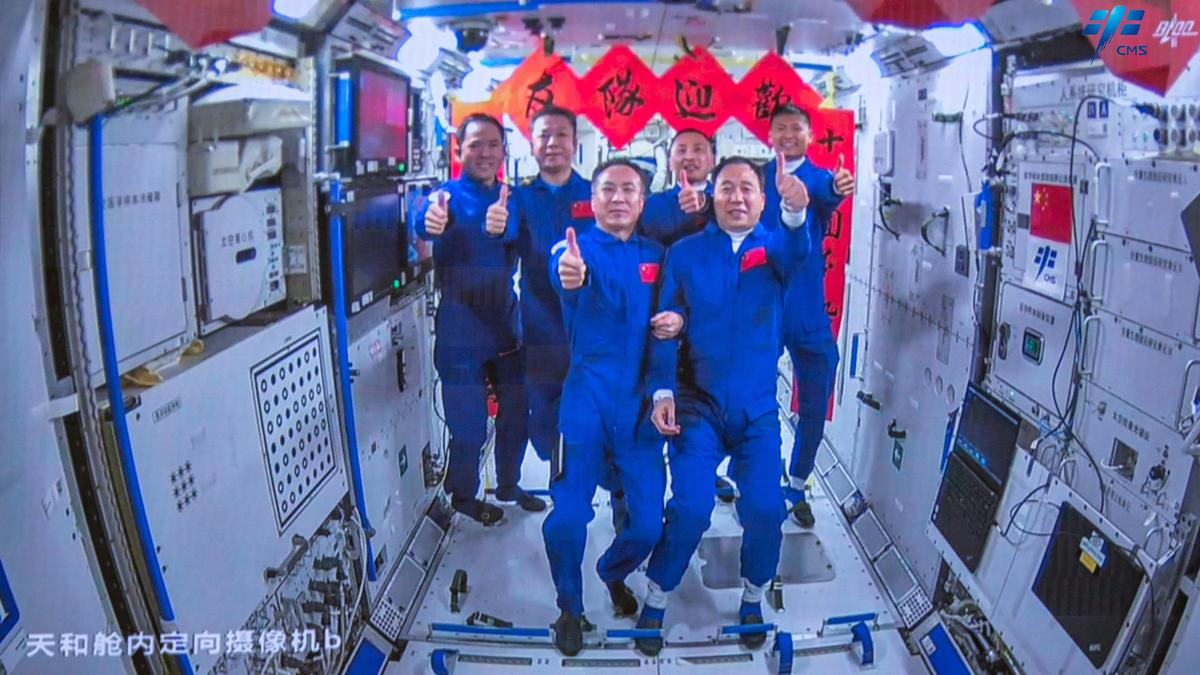
China may launch next-generation crewed spacecraft as early as 2027
The Hindu
China's next-gen crewed spacecraft, capable of carrying up to seven astronauts, may fly for the first time between 2027-2028, said a veteran Chinese astronaut.
China's next-generation crewed spacecraft, which can transport up to seven astronauts, may fly for the first time between 2027 and 2028, a veteran Chinese astronaut said.
China's manned space flights began in 2003 when former fighter pilot, Yang Liwei, was sent into orbit in a small bronze-coloured capsule, the Shenzhou-5, becoming China's first man in space and an instant hero cheered by millions at home.
"In the future, a new generation of spacecraft will be used on crewed lunar missions, to build our space station, and for deep-space exploration," the state-run Guangzhou Daily cited Yang as saying at a Chinese university on Monday.
Recent tests on the return capsule of the next-generation spacecraft have been "very successful", with their first flights estimated to take place between 2027 and 2028, said Yang, currently deputy chief designer of China's manned spaceflight project.
Also Read | China successfully launches new manned spaceship with first civilian on board
The next-generation spacecraft was first tested in 2020.
Since China's space station became operational late last year, the focus has returned to a project to send astronauts to the moon by 2030, with engineers recently disclosing more details of the plan - from the type of carrier rockets to be used to the spacecraft transporting astronauts and other equipment.


In its first edition, the Madras Art Salon spotlights the works of journalist and artist Narayan Lakshman at The Botanical Club, a social space in the British Deputy High Commission, Chennai

Cholesterol enhances melanoma cell invasion by making nuclei squishier, revealing a potential treatment target in cancer progression.

The designers reinterpret the Swedish artist’s symbolic forms and colour energy through contemporary resortwear silhouettes

Discover the inspiring legacy of Bibha Chowdhuri, a pioneering woman in physics and a trailblazer in STEM history.

Discover the inspiring legacy of Bibha Chowdhuri, a pioneering woman in physics and a trailblazer in STEM history.

Ashdeen’s Spring 2026 collection features saris inspired by the designer’s Parsi gara archive

Red ochre burials, ritual markings and myths across cultures show that red repeatedly marks liminal thresholds such as puberty, sacrifice and death; anthropologists argue that the colour functions as a technology of collective ritual and value, binding communities through shared symbolic acts

India approves 23 institutions for quantum labs under the National Quantum Mission, aiming to advance quantum technology and research.

India approves 23 institutions for quantum labs under the National Quantum Mission, aiming to advance quantum technology and research.

The Gaza conflict exacerbates environmental damage, emitting millions of tonnes of CO2 and threatening climate stability in West Asia.

Chefs and cookery experts share smart kitchen hacks, hybrid cooking methods and appliance tips to help households reduce LPG use without compromising on food

Discover groundbreaking research on Titan's lakes, bat vaccinations, and the unique aroma of ripening bananas in just one minute.

IRSO's NavIC system faces challenges as the last atomic clock fails, reducing operational satellites for navigation services.