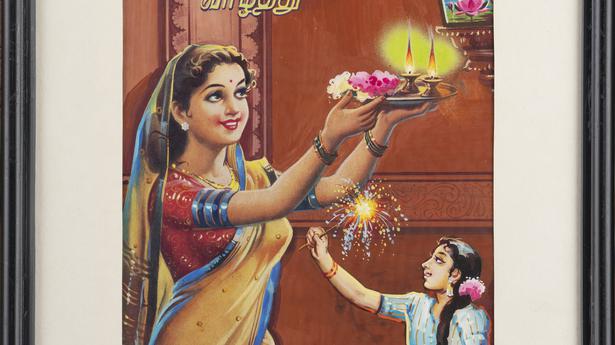
Chennai exhibition traces the genesis and growth of commercial art from Madras
The Hindu
Chennai-based Ashvita Gallery’s latest display traces the genesis and growth of commercial art from Madras — from calendars to advertisements and, of course, cinema posters
These tints, landscapes, faces and motifs are all too familiar; we grew up seeing them on calendars, periodicals and advertisements. Now, save for the occasional resurrection that cashes in on their ‘retro’ value, commercial art is inching towards obscurity. At Ashvita’s quaint gallery space, a narrative is being created on how commercial art, which dominated many a home over the past hundred years, saw a movement in Madras, parallel to the rest of India. The exhibit is titled The Popular Picture: One Hundred Years of Commercial Art from Madras.
Look around and you find, for instance, a calendar that dates back to 1966: A scene that depicts the Hindu god Shiva surrounded by pious devotees is juxtaposed by columns of dates and a masthead that reads Murali Traders. A 1970 poster carries perhaps the most widely-shared and replicated painting of another Hindu god, Balamurugan, that reads With best compliments from: Sri Mangalambiga Stores — Dealers in stainless steel and general merchants.
These widely-circulated works of art are most often not attributed, yet are vital to the visual language of the country. “This show exists because we wanted to ask people questions like: ‘What is fine art? Who classifies it as fine art? Why does Hussain get a museum exhibition and not say, Konderaju and Aykan,’” says Ashvin E Rajagopalan, curator of the display. Most of these artworks were discarded. “They became objects of no value because they were free. Today we are able to give them a context.”
The focus of the display that brings seven artists to the fore does not stray away from Madras. Initially, it was not a 100-year history, says the curator.
It all started with a Tanjore painting of lord Rama that came into their collection by chance. “Right at the bottom, in older Tamil, it said that anyone who wanted to buy prints of such artworks, were required to go to shop number so and so, in Broadway, dated 1888. A lot of such paintings are classified as Tanjore paintings on paper, even in museums today. But we figured out that college students would come to lithography presses in Broadway, which has been a hub of calendars, greeting cards and posters for the past 100 years, to print them on lithographs in black-and-white which were later hand coloured. It therefore became inexpensive and could be easily replicated. This happened around the same time when works of artists like Raja Ravi Varma came to the printing presses.” And so, the influences are hard to miss. When an artist’s visuals get commercialised in this scale, popularity follows. And when these visuals stay in homes for long periods of time, it becomes the idea itself; of gods and goddesses, landscapes and sceneries.
From there, the narrative shows how this movement branched out to different aspects: On display are also magazine covers and calendars that hold “state-of-the-art photoshop work of that time”. In that sense, they would paint, cut the font (for text) and stick it, and send the negative of the whole panel to the press. Only a few of the magazines had offset technology then. Ananda Vikatan was one of the first publications to go offset in the 1930s. Their magazines that carried artworks on the cover were highly anticipated by the Tamil-speaking population. Similarly, a set of draft designs for the Rajinikanth movie Pandian (2000) shows hand-sketched, highly-skilled work that combines cut-and-paste elements.
The late 1800s also saw a crop of photography students setting up studios across Tamil Nadu. “The studio’s job was commercial work: apart from photos and portraits, they would also work on greeting cards and calendars. And when you enlarge a photo, it starts becoming blurred, and to sharpen it the studio would have people doing finishing touches with colours. Photo studios thus were hubs of commercial artists,” says Ashvin. A section of the display pays homage to this part of history.


Abhishek Banerjee challenges BJP's Suvendu Adhikari in Nandigram, pledging community health initiatives if Trinamool Congress wins.

Rising LPG shortages in Karnataka boost firewood demand, reviving an informal market as households and hotels seek alternatives.

Against the backdrop of intense poll activity, a 400-metre stretch of an arterial road in the outskirts of Chennai (technically in Madurapakkam panchayat under Tambaram assembly constituency) presents a salute to the idea of res publica, which underpins India’s system of governance, where citizens have a say, at least before a government is securely ensconced in the seat of power. A Republic Day initiative shines bright every night

Fadnavis claims zero FIR in Ajit Pawar crash is a defamation attempt by Karnataka against Maharashtra's investigation efforts.

Set to unfold as a one-day pop-up on April 5, the Easter Sadya brings together both vegetarian and non-vegetarian menus, offering a peek into the food traditions of the Syrian Christian (Nasrani) community. While the traditional Sadya is often associated with dishes such as sambar, avial, and rice, this version expands to include community-specific festive dishes.

BJP nominates mother of R.G. Kar victim Abhaya to contest from Panihati in West Bengal Assembly elections.

Veteran Malayalam actor-director E.A. Rajendran passes away at 71, leaving behind a rich legacy in the film industry.

Dakshina Kannada Zilla Panchayat has rolled out digital mode of water bill generation and collection in 23 gram panchayats on a pilot basis for the first time in Karnataka. This is set to be extended to the remaining 200 panchayats shortly, according to the Zilla Panchayat Chief Executive Officer Narwade Vinayak Karbhari.

Bengaluru police questioned a man carrying ₹6 lakh for medical expenses at Vidhana Soudha, later releasing him after verification.

BJP accuses Bengaluru's Congress government of corruption in e-Khata issuance, halting infrastructure projects due to financial mismanagement.

Misinformation in Hyderabad sparks panic buying, causing disruptions as residents react to unfounded rumors of an impending lockdown.

Bengaluru Metro extends services until 2 a.m. on March 28 for IPL match, ensuring convenient travel for spectators.

A bus truck-collision in Andhra Pradesh's Markapuram district, killing several. Catch LIVE updates here!