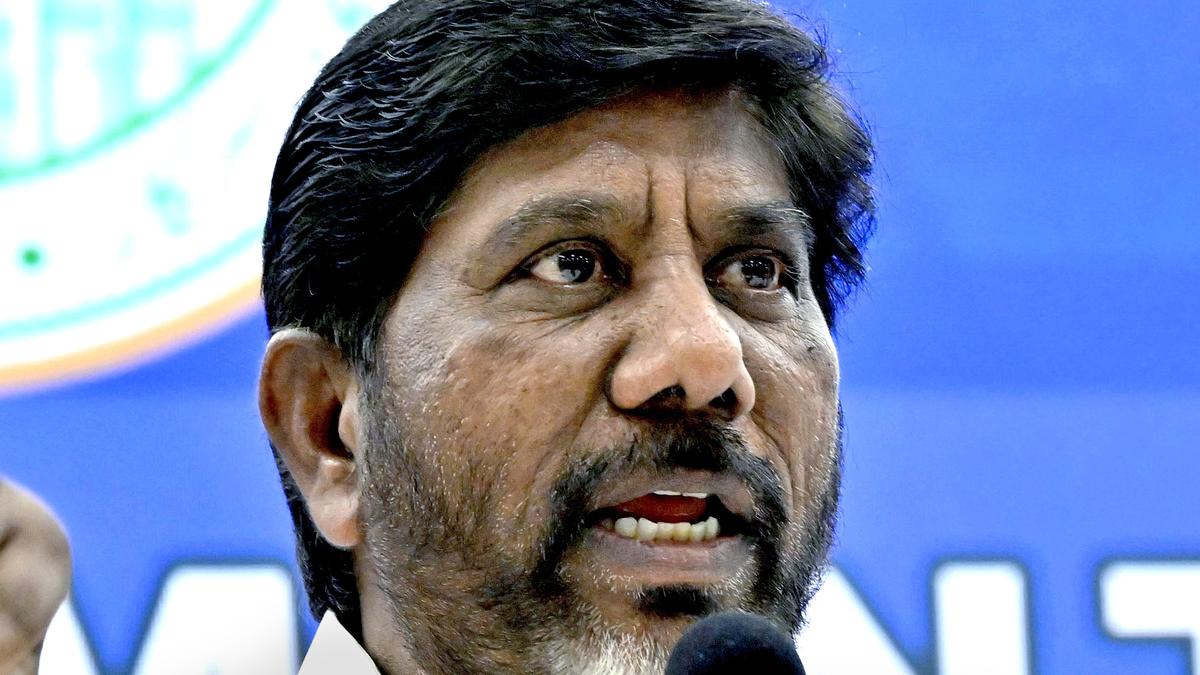
Caste survey to reach out benefits of welfare schemes more effectively to targeted sections, says Bhatti
The Hindu
Deputy CM praises public response to Caste Survey, highlighting its importance in welfare scheme planning for marginalized sections.
Thanking the people for their large-scale participation in the Caste Survey, Deputy Chief Minister Mallu Bhatti Vikramarka has asserted that people responded positively to the government’s initiative aimed at reaching out the benefits of welfare schemes more effectively to the deserving sections.
The data collected during the caste survey would be a crucial tool to plan and implement welfare schemes for the weaker and marginalised sections. “This is like full body check-up, an X-ray as our leader Rahul Gandhi calls it enabling us to ensure targeted reach of welfare schemes to the eligible sections,” he said.
The Deputy Chief Minister said the government would place the three volumes of the caste survey, except for data pertaining to individuals, in the public domain soon. The survey was conducted in a meticulous and systematic manner so that there was no scope for complaints from any quarters. As a result, close to 97 per cent individuals and households took part in the survey make the report survey accurate.
“Few vested interests conspired to stall the process by creating apprehensions in the minds of the people. But people repelled the campaign and participated in large numbers,” he said. With the successful completion of the survey, the country was now looking at Telangana as a role model with its initiative.


Abhishek Banerjee challenges BJP's Suvendu Adhikari in Nandigram, pledging community health initiatives if Trinamool Congress wins.

Rising LPG shortages in Karnataka boost firewood demand, reviving an informal market as households and hotels seek alternatives.

Against the backdrop of intense poll activity, a 400-metre stretch of an arterial road in the outskirts of Chennai (technically in Madurapakkam panchayat under Tambaram assembly constituency) presents a salute to the idea of res publica, which underpins India’s system of governance, where citizens have a say, at least before a government is securely ensconced in the seat of power. A Republic Day initiative shines bright every night

Fadnavis claims zero FIR in Ajit Pawar crash is a defamation attempt by Karnataka against Maharashtra's investigation efforts.

Set to unfold as a one-day pop-up on April 5, the Easter Sadya brings together both vegetarian and non-vegetarian menus, offering a peek into the food traditions of the Syrian Christian (Nasrani) community. While the traditional Sadya is often associated with dishes such as sambar, avial, and rice, this version expands to include community-specific festive dishes.

BJP nominates mother of R.G. Kar victim Abhaya to contest from Panihati in West Bengal Assembly elections.

Veteran Malayalam actor-director E.A. Rajendran passes away at 71, leaving behind a rich legacy in the film industry.

Dakshina Kannada Zilla Panchayat has rolled out digital mode of water bill generation and collection in 23 gram panchayats on a pilot basis for the first time in Karnataka. This is set to be extended to the remaining 200 panchayats shortly, according to the Zilla Panchayat Chief Executive Officer Narwade Vinayak Karbhari.

Bengaluru police questioned a man carrying ₹6 lakh for medical expenses at Vidhana Soudha, later releasing him after verification.

BJP accuses Bengaluru's Congress government of corruption in e-Khata issuance, halting infrastructure projects due to financial mismanagement.

Misinformation in Hyderabad sparks panic buying, causing disruptions as residents react to unfounded rumors of an impending lockdown.

Bengaluru Metro extends services until 2 a.m. on March 28 for IPL match, ensuring convenient travel for spectators.

A bus truck-collision in Andhra Pradesh's Markapuram district, killing several. Catch LIVE updates here!