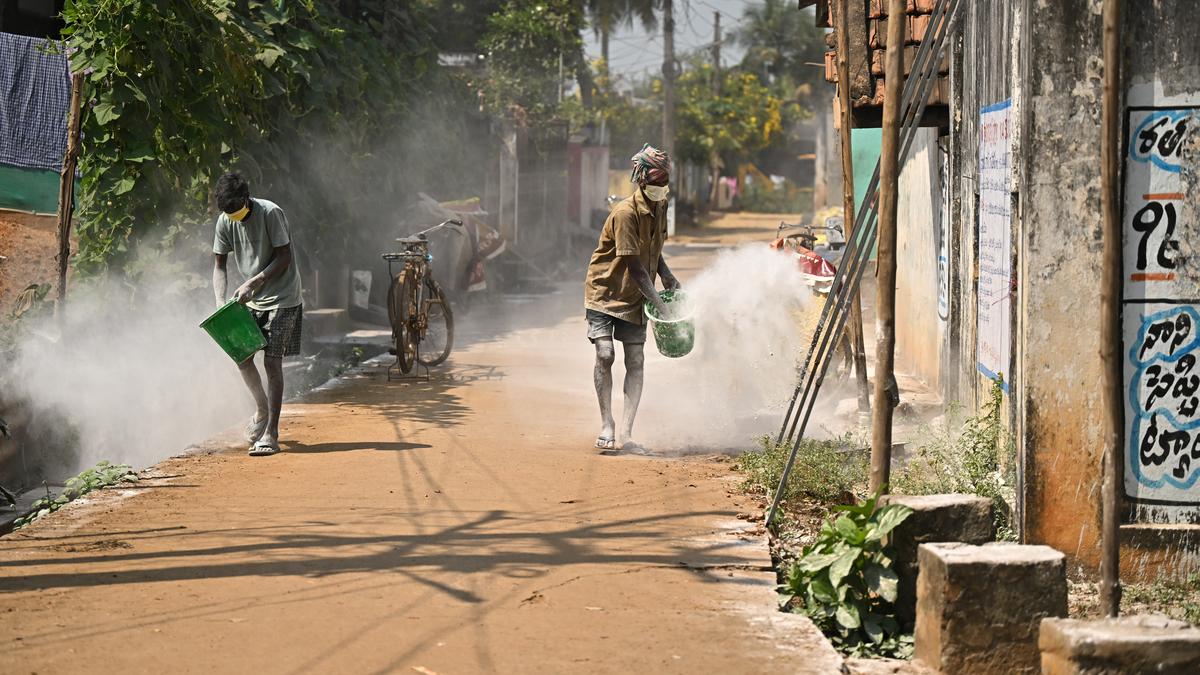
Bird flu outbreak in Andhra Pradesh: Burden of bird blight Premium
The Hindu
Bird flu outbreak in Andhra Pradesh leads to culling of thousands of chickens, impacting local economy and food supply.
The Zilla Parishad School in Badampudi village, West Godavari district, Andhra Pradesh, usually filled with children’s laughter and lesson chants during the day, was eerily silent on February 13. The school courtyard, where students played and chased each other during recess, is littered with fallen leaves.
The school was declared a holiday that Thursday and the premises had been made a temporary isolation centre for the official teams assigned to cull the birds from the coops contaminated by bird flu, which are less than 1 km away.
The four members of a team of experts from the Sri Venkateswara Veterinary University (SVVU) of Tirupati adjust their Personal Protective Equipment (PPE) kits in a classroom.
The team inspected the bird flu-affected poultry farms at Badampudi in Eluru district, Velpur in West Godavari district, and Kanuru Agraharam in East Godavari district.
Eluru District Joint Director of Animal Husbandry, T. Govindaraju, says about 1,000 PPE kits and other safety gear were provided to the 20 teams conducting the culling operation even as he guides the visiting team of experts to a poultry farm in Badampudi.
Each team is comprised of 20 workers and is supervised by a veterinary assistant surgeon (VAS), he adds.
The experts’ team quietly enters the poultry farm, where the workers and Animal Husbandry officials have been working for the past two days.


Abhishek Banerjee challenges BJP's Suvendu Adhikari in Nandigram, pledging community health initiatives if Trinamool Congress wins.

Rising LPG shortages in Karnataka boost firewood demand, reviving an informal market as households and hotels seek alternatives.

Against the backdrop of intense poll activity, a 400-metre stretch of an arterial road in the outskirts of Chennai (technically in Madurapakkam panchayat under Tambaram assembly constituency) presents a salute to the idea of res publica, which underpins India’s system of governance, where citizens have a say, at least before a government is securely ensconced in the seat of power. A Republic Day initiative shines bright every night

Fadnavis claims zero FIR in Ajit Pawar crash is a defamation attempt by Karnataka against Maharashtra's investigation efforts.

Set to unfold as a one-day pop-up on April 5, the Easter Sadya brings together both vegetarian and non-vegetarian menus, offering a peek into the food traditions of the Syrian Christian (Nasrani) community. While the traditional Sadya is often associated with dishes such as sambar, avial, and rice, this version expands to include community-specific festive dishes.

BJP nominates mother of R.G. Kar victim Abhaya to contest from Panihati in West Bengal Assembly elections.

Veteran Malayalam actor-director E.A. Rajendran passes away at 71, leaving behind a rich legacy in the film industry.

Dakshina Kannada Zilla Panchayat has rolled out digital mode of water bill generation and collection in 23 gram panchayats on a pilot basis for the first time in Karnataka. This is set to be extended to the remaining 200 panchayats shortly, according to the Zilla Panchayat Chief Executive Officer Narwade Vinayak Karbhari.

Bengaluru police questioned a man carrying ₹6 lakh for medical expenses at Vidhana Soudha, later releasing him after verification.

BJP accuses Bengaluru's Congress government of corruption in e-Khata issuance, halting infrastructure projects due to financial mismanagement.

Misinformation in Hyderabad sparks panic buying, causing disruptions as residents react to unfounded rumors of an impending lockdown.

Bengaluru Metro extends services until 2 a.m. on March 28 for IPL match, ensuring convenient travel for spectators.

A bus truck-collision in Andhra Pradesh's Markapuram district, killing several. Catch LIVE updates here!