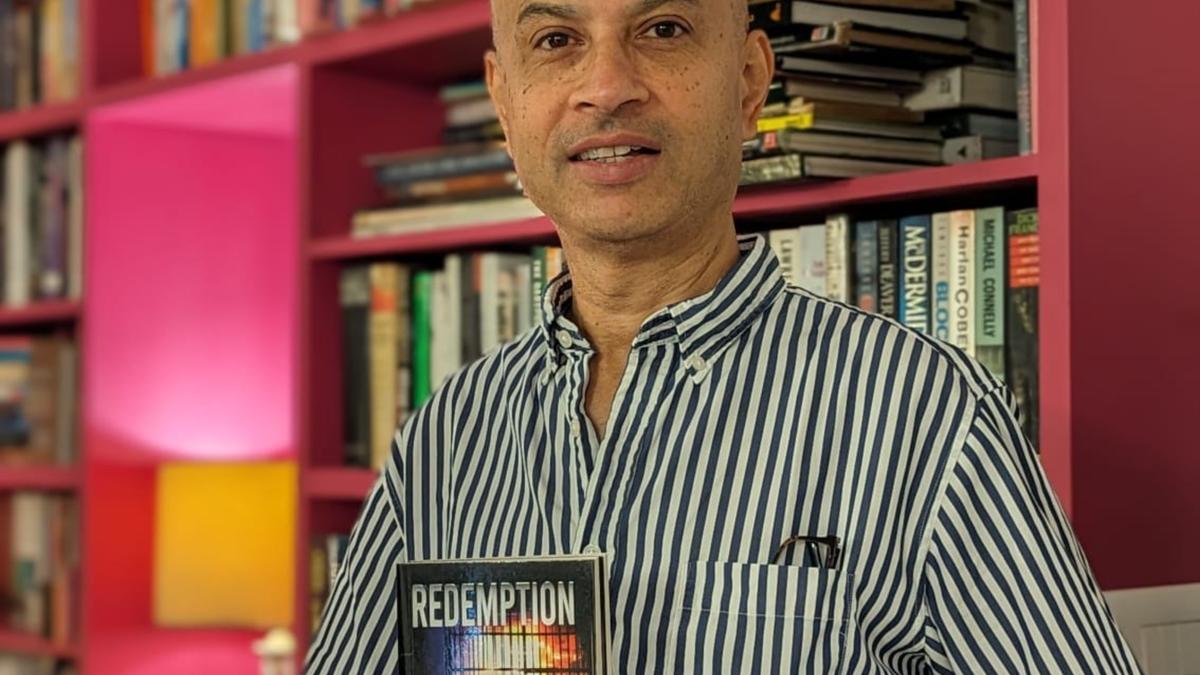
Bengaluru-based author Harish Vasudevan talks about his debut novel ‘Redemption’
The Hindu
Bengaluru-based author Harish Vasudevan talks about his debut novel ‘Redemption’
Redemption (Westland), Harish Vasudevan’s debut novel, navigates the murky waters of power dynamics and the repercussions of a single day that spirals into a nightmare for an ordinary family. The novel is set in 2007 Bengaluru, a city at the cusp of technological revolution and societal shifts. It promises to take readers on a journey of crime and retribution.
On the path to becoming a novelist, Harish, who’s based in Cooke Town, Bengaluru, navigated the transition with a perspective shaped by a career in marketing, where storytelling forms the core of connecting with audiences. “My interest in mystery and thriller genres, fuelled by admiration for authors such as Robert Parker and Raymond Chandler, has always been a part of me,” Harish explains the genesis of his literary venture. The inception of Redemption finds its roots in personal strife and societal injustices, particularly influenced by his daughter’s encounter with bullying and the disconcerting response from those in authority.
Harish’s narrative is not merely a product of imagination but a reflection of the troubling realities of the misuse of power and legal failings in India. “The turning point came with a series of alarming incidents in India that caught my attention,” he recounts, drawing upon real-life events that underscore a disturbing pattern of power abuse. Through Redemption, he has channelled his frustrations and concerns into a storyline that spotlights the resilience of an ordinary family ensnared in extraordinary circumstances, advocating for a narrative where justice seeks to reclaim its lost ground.
The journey of crafting Redemption presented Harish with various challenges, particularly in character development and narrative expansion. “Going through the complexities of character development was my most formidable challenge,” he admits, underscoring the transition from dealing with data and facts to navigating the nuanced domain of emotions and character arcs.
Harish’s foray into character creation demanded a departure from his comfort zone, necessitating a deep dive into the intricacies of human emotion and societal dynamics to breathe life into the inhabitants of his fictional world.
Moreover, his transition from the succinct and impactful realm of blogging to the expansive and immersive world of a novel marked a significant shift in his creative process. “Crafting a novel, a vastly different endeavour, required a significant shift in approach,” he explains, highlighting the challenge of sustaining reader engagement across the sprawling landscape of a novel. This shift demanded mastery over narrative progression, ensuring that each chapter not only contributed to the story’s forward momentum but also encapsulated enough intrigue to keep the reader engaged.
Choosing 2007 as the novel’s setting was a deliberate decision by Harish, aiming to capture a critical moment in the evolution of mobile technology and its societal implications. “The protagonist, a mother seeking vengeance for a heinous crime committed against her daughter, leverages her expertise as a mobile phone developer,” he explains, situating the narrative at the dawn of the smartphone era. This temporal setting is not merely a backdrop but a pivotal element that shapes the protagonist’s journey, underlining her connection to the burgeoning world of mobile technology and its role in her quest for justice.


Diya Chitale and Manav Thakkar reach semifinals, while Yashaswini Ghorpade upsets top seed Sreeja Akula at National TT Championships.

DYFI criticizes A.P.'s job calendar for failing unemployed youth, demanding a revision to include 1 lakh posts and higher age limits.

‘Lethargic’ officials who left Chambal sanctuary to the mercy of sand miners will be held liable: SC
Supreme Court holds negligent officials accountable for enabling illegal sand mining in Chambal Sanctuary, emphasizing habitat protection laws.

Work on the Srisailam Left Bank Canal tunnel resumes after 13 months, with completion targeted by 2027-end, says Minister Reddy.

Ancient ‘Vanni’ tree at Sri Meenakshi Sundareswarar Temple tilts; steps on to restore it

Bengaluru Metro penalises 14 passengers for disrupting services with loud singing, following a viral clip of their antics.

ASR district plans a 122 km world-class trekking network, enhancing tourism and local employment across Araku, Paderu, and Lambasingi.

Development without impact: Coastal residents of Kanniyakumari and Nagercoil constituencies voice discontent

Environmentalists in Kakinada celebrate World Sparrow Day, urging conservation efforts for sparrows and migratory birds.

T.K. Govindan secures full support from K. Sudhakaran for Kerala Assembly polls 2026 as a UDF-backed Independent candidate.

Karnataka implements weekly reviews and control rooms to combat rural drinking water shortages during the summer months.

BJP leads candidate selection for upcoming bypolls, while Congress faces internal challenges and community pressure in Bagalkot and Davangere.

A man died in a Kolkata hospital lift, prompting accusations of negligence against the West Bengal government and hospital authorities.