Barashahid Dargah, a tall symbol of communal harmony Premium
The Hindu
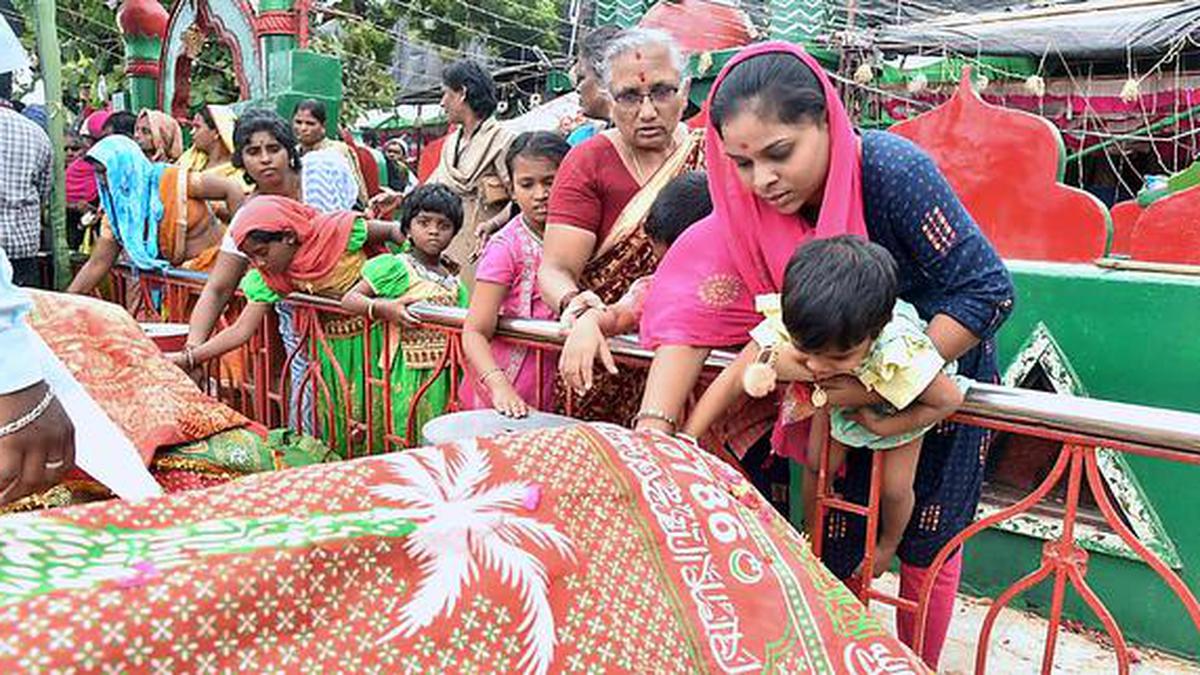
Nellore's Barashahid Dargah is a symbol of communal harmony, attracting devotees of all faiths. It was built to commemorate 12 warriors who fought the British forces and is being renovated at a cost of ₹15 crore. During Muharrum, pilgrims from all over India and abroad come to seek blessings and exchange Rotis for their wishes. The practice began in the 18th century when the royal couple of the princely State of Arcot visited the Dargah and the queen was miraculously cured of her illness. The festival is celebrated as a 'State festival' with a 'Gandhamohotsavam' procession.
Barashahid Dargah stands tall as a symbol of communal harmony on the banks of the picturesque Swarnala Cheruvu (Golden water tank) in Nellore, attracting devotees cutting across religious lines, especially during the holy month of Muharrum.
Twelve warriors fighting the British forces turned martyrs, and in their memory, a beautiful Dargah was constructed in veneration in this coastal city, also known as ‘Simhapuri’.
The complex of tombs, which is being given a face-lift at a cost of ₹15 crore, including a Masjid by the State Government, attracts pilgrims not only from all over the twin Telugu-speaking States of Andhra Pradesh and Telangana but also from other parts of the country as well as from overseas for the ‘Rotiyaan Ki Eid’, also known as ‘Rottela Panduga’ in local parlance as their long list of wishes get fulfilled one after another in succession.
The annual Urs has been celebrated for centuries, coinciding with the first month of the Islamic calendar when the death of Prophet Muhammed’s grandson, Hussein Ibn Ali, is commemorated as the latter was brutally martyred during the Battle of Karbala on the tenth day of the month known as the Day of Ashura then.
Nellore formed part of the then princely State of Arcot in the Carnatic region, which rose to prominence after the downfall of the Mughals. The practice of exchanging Rotis was, in fact, started in the 18th century by the royal couple.
Tracing the origin of the practice, which has now assumed a secular tone over a period with believers cutting across religious lines coming from far and near seeking the blessings of the martyred soldiers, Maulvi Ismail Khadri recalls the queen of Nawab of Arcot, who had been ruling Nellore and Chittoor districts along with several districts in the present day Tamil Nadu suffered from serious incurable illness. She got a miracle cure for the disease with the blessings of the martyred souls after visiting the holy precincts.
Happy over the prayers bearing fruit, the royal couple started the practice of exchanging Rotis at the Dargah located in the Dargamitta area by standing in the placid waters of Swarnala Cheruvu. The Shia sect festival of the medieval period gradually gained popularity during the first half of the 20th century. Initially, the Rotis were made with devotion by devotees at their homes and exchanged. With the pilgrims’ rush going up in geometric proportions subsequently, stalls sprung up to make available Rotis to devotees who come to Nellore after travelling long distances. Rotis are exchanged seeking, among other things, health, wealth, prosperity, job, marriage, progeny, house construction and promotion in the workplace.


Abhishek Banerjee challenges BJP's Suvendu Adhikari in Nandigram, pledging community health initiatives if Trinamool Congress wins.

Rising LPG shortages in Karnataka boost firewood demand, reviving an informal market as households and hotels seek alternatives.

Against the backdrop of intense poll activity, a 400-metre stretch of an arterial road in the outskirts of Chennai (technically in Madurapakkam panchayat under Tambaram assembly constituency) presents a salute to the idea of res publica, which underpins India’s system of governance, where citizens have a say, at least before a government is securely ensconced in the seat of power. A Republic Day initiative shines bright every night

Fadnavis claims zero FIR in Ajit Pawar crash is a defamation attempt by Karnataka against Maharashtra's investigation efforts.

Set to unfold as a one-day pop-up on April 5, the Easter Sadya brings together both vegetarian and non-vegetarian menus, offering a peek into the food traditions of the Syrian Christian (Nasrani) community. While the traditional Sadya is often associated with dishes such as sambar, avial, and rice, this version expands to include community-specific festive dishes.

BJP nominates mother of R.G. Kar victim Abhaya to contest from Panihati in West Bengal Assembly elections.

Veteran Malayalam actor-director E.A. Rajendran passes away at 71, leaving behind a rich legacy in the film industry.

Dakshina Kannada Zilla Panchayat has rolled out digital mode of water bill generation and collection in 23 gram panchayats on a pilot basis for the first time in Karnataka. This is set to be extended to the remaining 200 panchayats shortly, according to the Zilla Panchayat Chief Executive Officer Narwade Vinayak Karbhari.

Bengaluru police questioned a man carrying ₹6 lakh for medical expenses at Vidhana Soudha, later releasing him after verification.

BJP accuses Bengaluru's Congress government of corruption in e-Khata issuance, halting infrastructure projects due to financial mismanagement.

Misinformation in Hyderabad sparks panic buying, causing disruptions as residents react to unfounded rumors of an impending lockdown.

Bengaluru Metro extends services until 2 a.m. on March 28 for IPL match, ensuring convenient travel for spectators.

A bus truck-collision in Andhra Pradesh's Markapuram district, killing several. Catch LIVE updates here!