Average groundwater table up in Telangana, but red zone of overexploited water basin increases by 36%
The Hindu
Telangana's water table rises due to 22% excess rainfall, but number of areas where water levels dropped below 20 metres has increased
A 22% excess rainfall has ensured that the water table in Telangana is at 10.17 metres below ground level (BGL) as against the last year’s [2024] depth of 10.51 metres (BGL) and decadal average of 10.88 metres BGL, according to Telangana Groundwater Department. While this presents a rosy picture about the ground water table, the Ground Water Resource Assessment of the State as a whole raises worrying questions.
“Nearly 500 villages in the State are overexploiting the ground water resources. This is dangerous as the levels of harsher chemicals like fluoride increase in the water as the water table goes down,” said K. Laxma, Director, Telangana Ground Water Department.
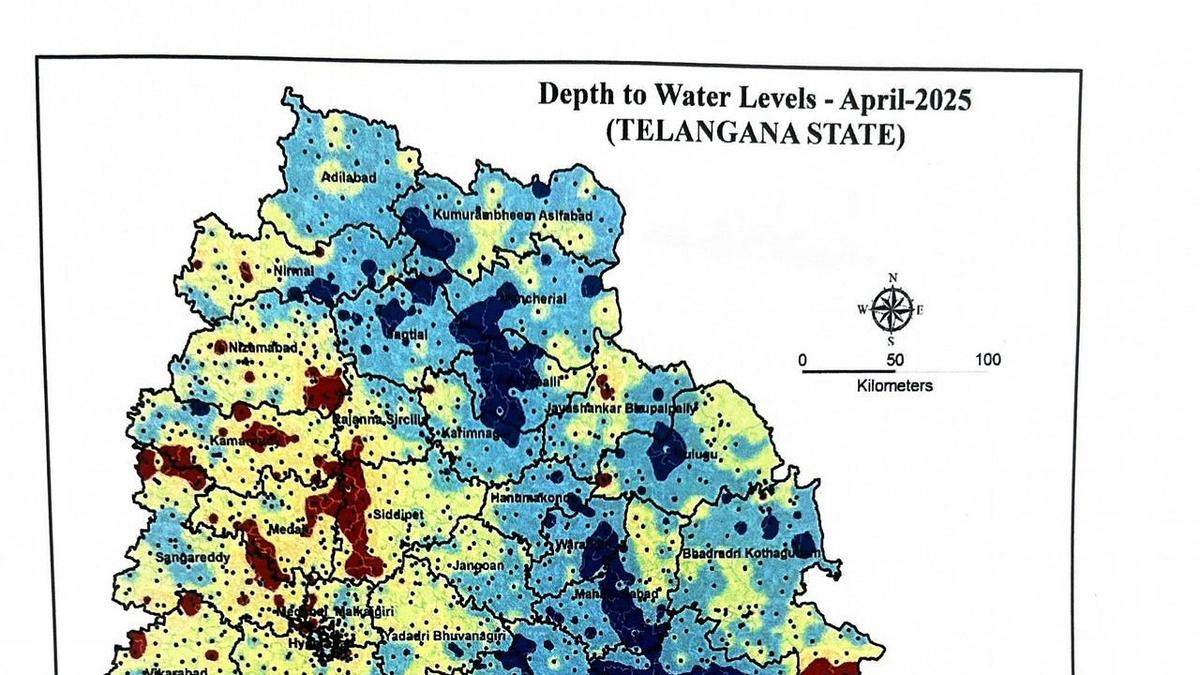
The water table showed a rise in 440 mandals (72%) and a drop in 172 mandals (28%). More worryingly, deep-water level area (greater than 20m) increased by 1262 square kilometres or 36%: from 3452 sq km to 4714 sq. km.
Once an area is declared as having over-exploited groundwater basin, an automatic six-month ban on sinking of new borewells kicks in under the Telangana Water, Land and Trees Act of 2002: “No well shall be sunk in such areas except wells sunk for public drinking purposes or hand pump for public or private drinking water purposes.”
“We really should get worried if the water level drops below the 20 metre mark which is categorised as a red zone. The area under this red zone has increased. This has serious consequences as it shows depleted water levels, signifying serious water stress that may impact humans, agriculture, and the environment. It also increases risks of water contamination,” informs Mr. Laxma.
Mapped across the State, chunks of areas in Medchal-Malkajgiri, Medak, Siddipet, Kamareddy, Nizamabad and Rangareddy are now in the red zone showing water stress. In contrast, the eastern districts like Mulugu, Warangal, Mahbubabad, Suryapet, and Khammam are water-stress free as are the northern districts of Asifabad, Mancherial, Adilabad, Jagtial and Peddapalli.
“Telangana has 85% land that has the subsurface of igneous rock, which is hard and has limited permeability. Only 15% land in the State has sedimentary and metamorphic rock surface with greater permeability. This is a limiting factor for the recharge of ground water. Aggravating the situation, the anthropogenic activity with road surfaces and concretisation has led to increased runoffs reducing the recharge of aquifers,” says Mr. Laxma.


The government plans to amend the FCRA, introducing new regulations for NGO asset management and accountability for key functionaries.

The draft policy for “Responsible Digital Use Among Students”, released on Monday by the Department of Health and Family Welfare, has recommended that parents set structured routines with clear screen-time rules and prioritise privacy, safety, and open conversation with children on digital well-being.

Police Observer Sushant Kumar Saxena conducts surprise inspection at Shencottai police station, reviewing warrants and security arrangements ahead of elections.

Andhra Pradesh government to launch key projects in April, focusing on industrial growth and infrastructure development, says Nara Lokesh.

Lok Sabha refers the Corporate Laws (Amendment) Bill to a JPC amid opposition concerns over CSR provisions dilution.

SHG members in Kanniyakumari use snakes and ladders to raise election awareness and boost voter turnout.

Government accelerates consultations for early implementation of the Women’s Reservation Act to ensure women’s representation in 2029 elections.

CM A. Revanth Reddy distributes ₹1 crore insurance cheques to families of deceased Electricity department employees, enhancing financial security for workers.

The Bengaluru Traffic Police (BTP) registered 634 cases of drunk driving during a week-long special enforcement drive conducted across the city between March 16 and March 22.

GHMC intensifies action against property tax defaulters, seizing properties and offering a One Time Settlement scheme for payments.

CCB arrests three drug peddlers in Mangaluru, seizing ₹2.5 lakh worth of MDMA and other valuables.

TVK's 28 candidates in Puducherry include former BJP MLAs, a sitting Independent, and a retired police IG.

BRS submits notice on private member bill to Speaker