Auschwitz museum begins emotional work of conserving 8,000 shoes of murdered children
The Hindu
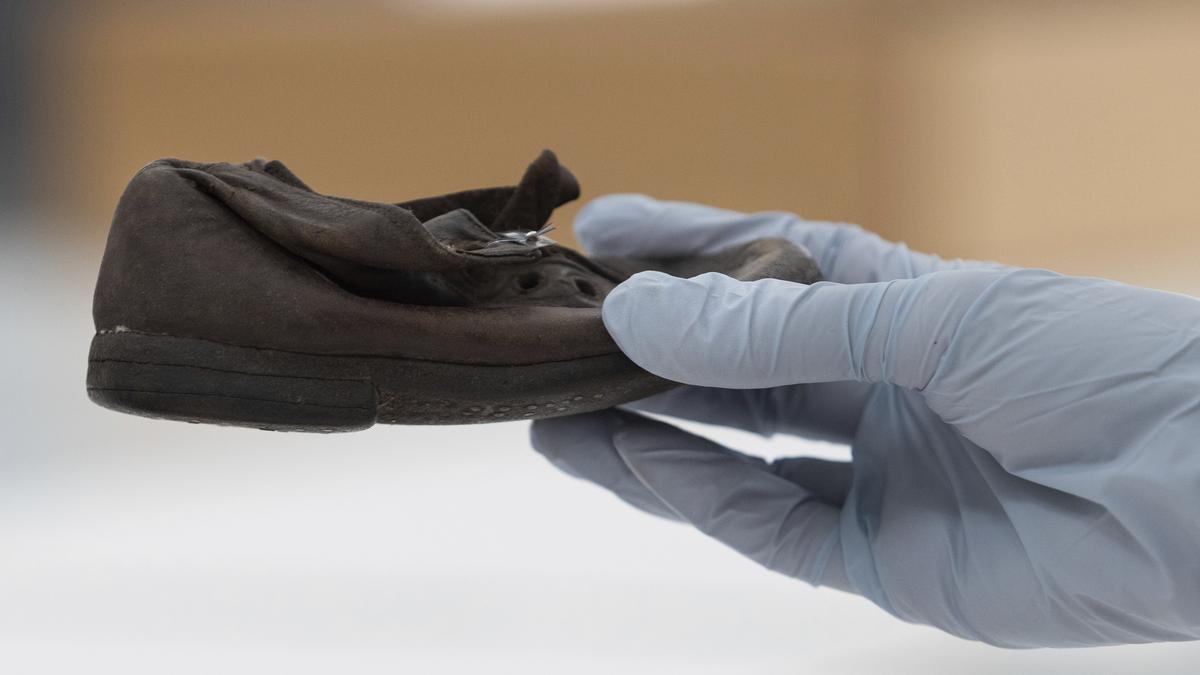
Auschwitz museum is working to conserve 8000 shoes of children who were murdered in the Auschwitz concentration camp.
In a modern conservation laboratory on the grounds of the former Auschwitz camp, a man wearing blue rubber gloves uses a scalpel to scrape away rust from the eyelets of small brown shoes worn by children before they were murdered in gas chambers.
Colleagues at the other end of a long work table rub away dust and grime, using soft cloths and careful circular motions on the leather of the fragile objects. The shoes are then scanned and photographed in a neighboring room and catalogued in a database.
The work is part of a two-year effort launched in April to preserve 8,000 children’s shoes at the former concentration and extermination camp where German forces murdered 1.1 million people during World War II. Most of the victims were Jews killed in Dictator Adolf Hitler’s attempt to exterminate the Jews of Europe.
The site was located during the war in a part of Poland occupied by German forces and annexed to the German Reich. Today it is a memorial and museum managed by the Polish state, to whom the solemn responsibility has fallen to preserve the evidence of the site, where Poles were also among the victims. The Germans destroyed evidence of their atrocities at Treblinka and other camps, but they failed to do so entirely at the enormous site of Auschwitz as they fled the approaching Soviet forces in chaos toward the war’s end.
Eight decades later, some evidence is fading away under the pressures of time and mass tourism. Hair sheered from victims to make cloth is considered a sacred human remain which cannot be photographed and is not subjected to conservation efforts. It is turning to dust.
But more than 1,00,000 shoes of victims remain, some 80,000 of them in huge heaps on display in a room where visitors file by daily. Many are warped, their original colors fading, shoe laces disintegrated, yet they endure as testaments of lives brutally cut short.


U.S. official Elbridge Colby emphasizes India's vital role in the Indo-Pacific, highlighting mutual benefits despite existing differences.

Philippine President Marcos declares national energy emergency amid Middle East conflict, ensuring fuel and essential goods supply stability.

Mohammad Baqer Zolqadr appointed as Iran's new security chief, succeeding Ali Larijani after his assassination.

Israel plans to occupy southern Lebanon amid escalating violence, targeting Hezbollah and causing widespread destruction and civilian casualties.

Trump reveals Secretary Hegseth was pivotal in discussing military action against Iran amid escalating tensions in the Middle East.

Iran arrests 466 individuals for online activities threatening national security amid ongoing tensions with Israel and the U.S.

China protests to Japan over a break-in at its Tokyo embassy, demanding a thorough investigation and accountability.

After securing a historic mandate in Nepal’s polls, Balendra Shah and the RSP face the task of navigating the West Asia conflict and managing ties with India, China and the U.S.

A magnitude 7.6 earthquake struck near Tonga, prompting evacuations but no tsunami warnings or immediate damage reports.

Iran launches missile attacks on Israel, rejecting Trump's negotiation claims as 'fake news,' escalating regional tensions and market volatility.

A large explosion at Valero refinery in Port Arthur, Texas, prompts shelter-in-place order for nearby residents, no injuries reported.

Kim Jong Un vows to solidify North Korea's nuclear status and labels South Korea as its "most hostile" adversary.

U.S.-Israel war on Iran LIVE: Follow The Hindu for updates on the West Asia conflict on March 24, 2026