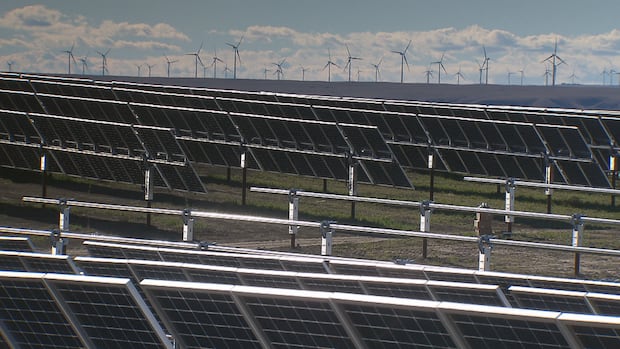
ATCO blames Alberta power policies as it devalues wind and solar projects by $408M
CBC
One of Alberta’s biggest and most venerable companies is declaring a $408-million hit to the value of its wind and solar projects in the province, and is largely blaming the Smith government’s electricity system reforms for being “detrimental” to investment in renewable energy.
ATCO Ltd.’s power subsidiary Canadian Utilities reported the devaluation of its roughly $1 billion in Alberta renewable energy assets in a recent financial disclosure.
It says that policy changes to the transmission network have forced the company to heavily curtail the output of its major wind turbine project in southeast Alberta — and adds that a looming overhaul of transmission rules stands to harm that and other renewable projects even more.
The company may pursue “legal recourse” if negotiations and lobbying efforts fail to modify the government’s system reforms, the Feb. 26 company management discussion report states.
“The company believes the changes in policy, and resulting uncertainty for large infrastructure investment, is detrimental to the government of Albertaʼs stated objectives to promote investment in the province of Alberta,” the document states.
The Smith government has prided itself on creating an investor-friendly climate in Alberta, and slashing regulation that it derides as “red tape.”
But it has faced repeated criticism from the renewable sector for doing the opposite: applying regulations that have deterred development of new wind and solar installations. Renewable energy advocates say they’re a low-cost, low-carbon power source, but Premier Danielle Smith and her government have criticized them as intermittent and less reliable than other generation types like natural gas.
Canadian Utilities’ report signals that the province’s electricity policies are not only impairing the renewable sector’s potential growth, but also projects already built in Alberta.
“Almost everywhere else, you build as much wind and solar as you possibly can, because they're low cost, and then you design the system around them,” said Tim Weis of the Pembina Institute, an Alberta-based environmental think tank.
“And frankly, we're kind of doing the opposite.”
On Oct. 5, 2022, ATCO announced a $730-million acquisition of renewable projects in Ontario and Alberta, including the 202-megawatt Forty Mile wind farm in southeast Alberta. It was a major foray by a massive Alberta conglomerate into the province’s then-burgeoning wind and solar power market; ATCO said it cemented the company’s place “at the forefront of the energy transition.”
One day later, Danielle Smith was crowned United Conservative Party leader and incoming premier.
A skeptic when it comes to the merits of renewable power, her government has imposed a range of new limits to renewable project development, including a seven-month moratorium on new approvals in 2023. Reforms to the broader electrical system, made in the name of reliability have been widely criticized by companies and groups involved in wind and solar.
Canadian Utilities says one key harmful change to its existing power generators is the end of a longstanding policy called “zero congestion.” It guaranteed that the province would build new transmission lines to accommodate new private-sector electricity developments, but the government has shifted from that policy in favour of one that accepts some system congestion.


Kelly Cove Salmon Ltd. wants to expand the boundaries of its salmon farm off the coast of Brier Island, N.S., but there is fear an expansion could force out longtime lobster fishermen in the area.

From running a store that was considered the heart of a community, to forging friendships with neighbours that felt familial, those brutally harmed or killed by Allan Legere are remembered as much more than victims.

Toronto police have identified a 60-year-old woman as the city's fourth homicide victim of the year.

A candlelight vigil was held Friday evening in Montreal for Chong Woo Kim, the owner of a corner store who was murdered the day before while at work.

While calls are growing to ban paid plasma donations in light of donor deaths, not everyone agrees stopping it is the best option.

CBC's road trip series Land of Living Stories explores inspiring stories of community spirit from across Saskatchewan. In our latest visit, CBC-Radio Canada hit the road to La Ronge. This is the third of a multi-part series from that community.

Aleesha Baxter woke up in her three-year-old daughter's bedroom early Monday morning to the sound of loud bangs.

A new interactive safety map aims to help people navigate dating apps safely.

Alberta’s two largest river basins have become one, part of a suite of major updates to the province’s water rules that came into force this week.

A set of agreements signed last month between the federal government and the Musqueam Indian Band has sparked debate, confusion and political reaction across British Columbia.

The Canadian Severe Storms Laboratory (CSSL) has been operating for a year now. It's a nationwide project based at Western University, where data from scientists and engineers across the country are used to study extreme weather and help communities better prepare for future events.

Abby Chapman had to calm herself before she could send an email to her supervisor. Her hands were shaking too much to type.

Chief Jamie Moses of Pehdzeh Ki First Nation enthusiastically welcomed news on Thursday that Ottawa is supporting the Mackenzie Valley Highway. And he spoke of the potential it has to transform his community in Wrigley moving forward.