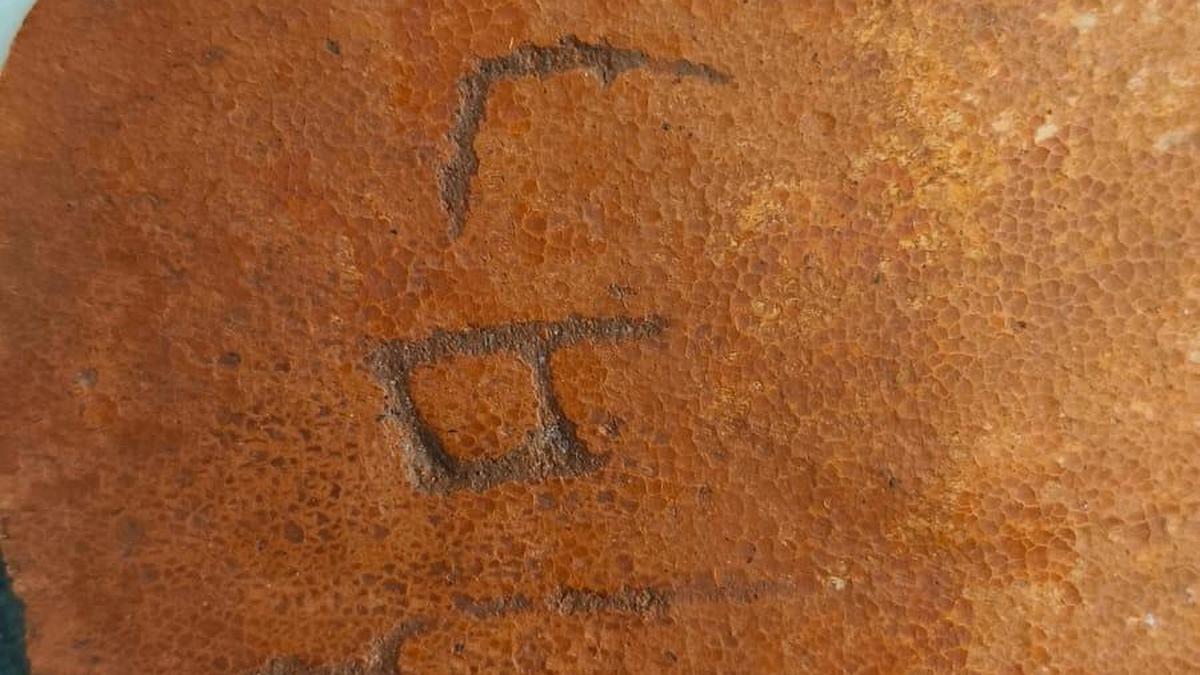
ASI team discovers potsherd with Tamil-Brahmi inscription at Kumarikkalpalayam
The Hindu
ASI uncovers a potsherd with Tamil-Brahmi inscription dating to the late 1st century BCE in Tiruppur.
Excavations by the Archaeological Survey of India (ASI) at a habitation mound in Kumarikkalpalayam hamlet in Tiruppur district have led to the discovery of a potsherd bearing a short inscription that is paleographically dated to the late 1st century BCE-early 1st century CE.
A team led by P. Aravazhi, Superintendent Archaeologist (in charge), ASI Tiruchi Circle, began excavations in the last week of February 2026 for a stratigraphy study of a site in Uthukuli Taluk, which lies within an agricultural field and represents an extensive Iron Age and Early Historic habitation, comprising a mound and an adjacent megalithic burial complex.
“The fragment, part of a storage jar made of black-and-red ware, carries five Tamil-Brahmi characters that can be read as ‘Irumpurai’,” according to Y. Subburayulu, Senior Epigraphist and formerly Professor, Tamil University, Thanjavur.
The title (of the inscription) is historically associated with the Chera rulers of the Karur region, located about 95 km east of the excavation site, during the Sangam period.
In addition to the inscribed sherd, a variety of ceramic types have been unearthed, including red-slipped ware, black-and-red ware, and russet-coated ware.
“The excavations are still under way. There are high possibilities for finding more such inscriptions,” Assistant Superintending Archaeologist V. Muthukumar said.


Red zones in Chennai for PM Modi's visit; drone ban enforced from April 3-4 for heightened security measures.

Akshay Kumar’s horror-comedy Bhooth Bangla has got a new release date as Ranveer Singh’s Dhurandhar: The Revenge continues to dominate the box-office.

Chhattisgarh HC convicts Amit Jogi in 2003 murder case of NCP leader Ramavatar Jaggi, sentencing him to surrender in three weeks.

Last year, just before the start of Chhath Puja, excess water discharged into the holy river from Hathnikund Barrage in Haryana diluted the pollutants and made the water appear relatively ‘cleaner’ in Delhi.

Noorbina Rasheed resigns from IUML's Vanitha League, citing neglect and gender representation issues ahead of Kerala Assembly elections.

Andhra CM Chandrababu Naidu emphasizes Amaravati's significance for the people, criticizing Jagan's rejection of it as the capital.

The five newly-formed city corporations under the Greater Bengaluru Authority (GBA) have presented their maiden budgets, with the West City Corporation recording the largest outlay at ₹4,732.73 crore and the Central City Corporation having the smallest outlay of ₹3,426.60 crore.

ASI uncovers a potsherd with Tamil-Brahmi inscription dating to the late 1st century BCE in Tiruppur.

AAP requests Rajya Sabha to replace Raghav Chadha as Deputy Leader with Ashok Mittal, limiting Chadha's speaking time.

As five city corporations in Bengaluru roll out their maiden budgets, the numbers show a divide in how much each corporation can raise and how much they must depend on outside support.

AIADMK announces seat-sharing details for the National Democratic Alliance ahead of the Tamil Nadu Assembly elections on April 23.

Prakash Karat defends SDPI's support for LDF, emphasizing CPI(M)'s stance against communal organizations and rejecting claims of a personality cult.

Mysuru railway division achieves record passenger revenue of ₹449.13 crore, marking significant growth in multiple revenue segments.