Artemis II, the international space race, and what is at stake for the U.S.
The Hindu
Explore the significance of NASA's Artemis II mission in the U.S.-China space race and its implications for lunar exploration.
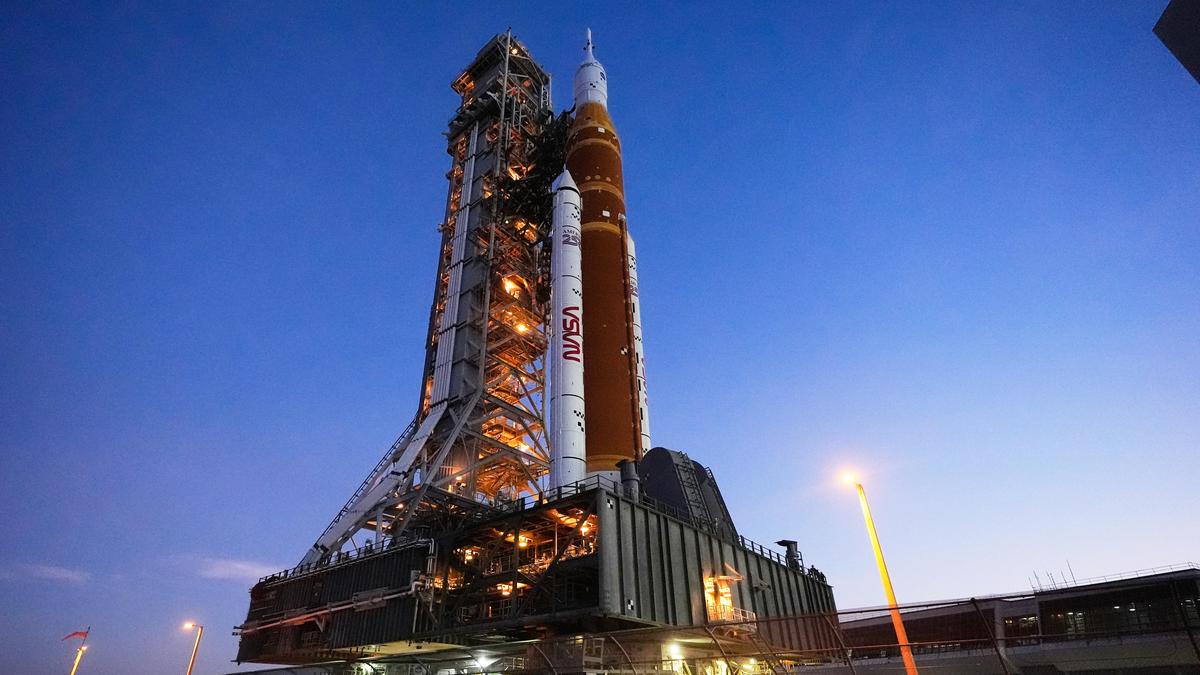
The NASA Artemis II mission is set to launch no earlier than April 1, 2026. If the lift-off is successful, the giant rocket will send humans to near the moon for the first time in more than half a century. In so doing, it will make an important milestone for the U.S. space programme. Its crew — commander Reid Wiseman, pilot Victor Glover, mission specialist Christina Koch, and Canadian Space Agency astronaut Jeremy Hansen — will also become the first humans to travel beyond low-earth orbit since Apollo 17 in 1972. Glover will also become the first person of colour, Koch the first woman, and Hansen the first non-U.S. citizen to embark on a lunar trajectory.
The Artemis II mission uses the Space Launch System (SLS) rocket and the crew capsule is called Orion. The SLS will propel Orion into a free-return trajectory around the far side of the moon, reaching around 7,500 km from the moon’s surface before the earth’s gravity pulls them back to splash down in the Pacific Ocean in a little over a week.
The mission does not plan to land on the moon. Instead, NASA is flying it to prove that the whole system — from the ground teams to the rocket and its crew — works as designed and the processes to land humans on the moon are ready.
After the SLS core stage is separated, the crew will spend 24 hours in a high orbit around the earth as it checks the capsule’s life-support and environment systems. If they’re all in order, they will fire Orion’s trans-lunar injection burn. The crew will also test manual piloting and proximity operations, communications and navigation systems, and a high-speed data relay and collect data about physiological and biological responses of the human body to deep-space travel.
Once Orion has finished going around the moon, it will be pulled towards the earth by gravity. NASA engineers expect the capsule will enter the earth’s atmosphere at a speed of around 40,000 km/hr. Its 5-metre-wide heat shield will endure temperatures as high as 5,000 C.
NASA will be collecting important data at this time because during the Artemis I mission in 2022, engineers found that Orion’s heat shield was eroded during re-entry as gases trapped in the shield’s material cracked it. In response, NASA used the same material but this time modified the re-entry trajectory so that Orion spends less time in the atmosphere as it descends.


Explore the significance of NASA's Artemis II mission in the U.S.-China space race and its implications for lunar exploration.

LPG crisis LIVE updates: Aviation Turbine Fuel (ATF) prices have crossed the ₹2 lakh per kilolitre mark; domestic cooking gas LPG rates, which were last hiked by ₹60 per 14.2 kg cylinder on March 7 unchanged. Follow The Hindu for more updates.

The BJP's 2026 Kerala manifesto promises job creation, AIIMS, a high-speed rail network, and enhanced welfare initiatives.

Kalaburagi's first March Tree Festival celebrates spring, promoting awareness of tree conservation and climate change effects.

Kumbakonam seeks district status and infrastructure improvements ahead of the 2028 Mahamaham festival amid ongoing civic challenges.

Vijayawada police divert heavy vehicles to West bypass to reduce traffic congestion and enhance road safety measures.

Malayalam filmmaker Ranjith remanded in judicial custody after arrest for sexual harassment allegations involving a young actress.

Kalaburagi City Corporation's ₹215 crore budget faces a ₹5.92 crore deficit amid calls for improved revenue and infrastructure.

Critics allege Kerala's 2026 Assembly polls weaponize women's issues for smear campaigns, undermining genuine safety concerns.

Commercial LPG cylinder prices in Hyderabad rise by ₹214.50, now costing ₹2,321 per refill.

Mangalore University presents a ₹68.34 crore deficit budget for 2026-27, continuing financial challenges over the past three years.

Assembly elections LIVE updates: Get real-time updates, full polling schedules, candidate lists and key constituency analysis as India prepares for the May 4 counting day. Follow The Hindu for more updates.

Vijay's TVK comes out with its list of nominees in one go, seems to have not learnt its lesson from the Karur stampede