An unlikely art pilgrimage | Notes from the Islamic Arts Biennale 2025
The Hindu
Explore the Islamic Arts Biennale in Jeddah, showcasing centuries of Islamic art and culture in a contemporary setting.
In a way, it is a transaction between two terminals. Arriving at the King Abdulaziz International Airport in Jeddah, the planeloads of white-clad pilgrims, preparing for the visit to Mecca, follow a distinct route that is largely closed to non-Muslims.
In a parallel trajectory, visitors to the airport’s Western Hajj Terminal enter an entirely different world of the Aga Khan award-winning space — of tent-like canopies that lead to a state-of-the-art museum. The ground of Jeddah, deemed holy, allows both these spaces to reflect on the Islamic faith and the extraordinary artefacts it has produced over the centuries.
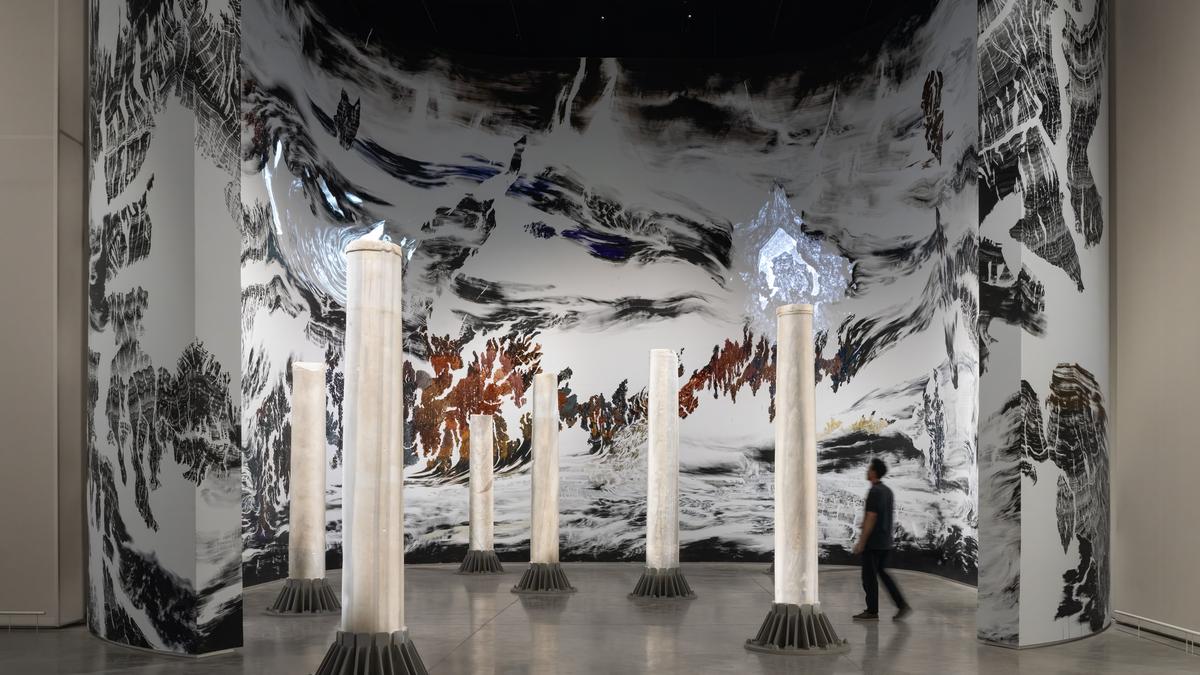
The second Islamic Arts Biennale, titled And All That Is In Between, is a biennale like no other. In manuscripts, architectural elements, religious symbols like the kiswah which covers the holy Kaaba, arms and armour, and objects of luxury and beauty, an entire world seems to unfold. The exhibition derives its distinction not only from its elegant staging, but also in its unabashedly religious assertion. Historians and scholars note that as compared to western art, the Islamic arts have not received the same degree of critical or theoretical analysis. Perhaps, this series of events, led by the Diriyah Biennale Foundation, can initiate a new bout of scholarship.
At a time when the Arab world is under pressure to resolve its regional crisis and unitedly resist the U.S.’ intentions for Gaza, the focus on Saudi Arabia is intense. Against a background of human rights concerns and investigations led by western agencies, the current geopolitical crisis casts the kingdom in a new role, as the centre of gravity in the Arab world. As a cosmopolitan enterprise that posits medieval arts with contemporary installations, the biennale marks a clearly articulated ambition within the region. In the last two decades, the Arab world has transformed its profile as a centre for education and the arts.
With Julian Raby, the affable former director of the National Museum of Asian Art at the Smithsonian, as lead curator, the biennale inevitably throws up some important questions. Perhaps the principal one is about how Islamic art can be separated from its producers, artisans and makers, who often belong to other faiths and cultures, bringing their own motifs, weaves and colour palettes to use. Nonetheless, the exhibition marks a breathtaking view of artefacts loaned from over 30 institutions, including the Victoria and Albert Museum, the Vatican Apostolic Library and the Louvre, presented in state-of-the-art vitrines and lighting that would be the envy of any world museum.
The exhibition itself, with open and closed spaces, engages the mind and the eye with its dazzling display. Amin Jaffer, one of the biennale’s artistic directors and director also of the Al Thani Collection, creates one of the highlights in a section titled ‘Al Mukhtani’, that features precious objects from Qatar’s ruling family. A Mughal ruby-encrusted water sprinkler, engraved spinels and huge emeralds, a plate depicting life on the Nile from the 8th century, the early decades of the Muslim calendar, and gold coins from Byzantium are some of the precious objects on view. The fabulous Briolette of India diamond that weighs 90 carats (believed to have been acquired by Queen Eleanor of Aquitaine in the 12th century, making it the oldest diamond in the world), royal robes and Mughal paintings by masters of Jahangir’s atelier all enrich this viewing.
An unusual section named ‘Al Madar’ or the Orbit takes a sweeping view of the science of heavenly constellations, and analyses the genius of mathematics and its uses in astronomy. Curated by Abdul Rahman Azzam, it introduces the astrolabe (al-asturb in Arabic) that helped calculate the movement of stars and navigate ship voyages.


Opposition MPs and activists voice strong concerns against proposed amendments to the Transgender Persons Act at a Delhi hearing.

Telangana Chief Minister Revanth Reddy intends to shape the party’s future with young faces

Iran-Israel war: Follow the latest updates from The Hindu on the West Asia war, on March 22, 2026

Karnataka plans delegation to Union government for Mahadayi basin project clearances and seeks water release from Maharashtra.

Ekante Bliss hosted a walkathon in Tirupati to promote health, community engagement, and support social impact initiatives.

Maharashtra raises commercial LPG supply by 20% to 50% of pre-crisis levels, benefiting hotels and food-related businesses.

Mumbai police arrest eighth suspect in Rohit Shetty residence firing case, linking the incident to the Shubham Lonkar gang.

Governor Arlekar emphasizes that justice must embody human values, fairness, and accessibility for all citizens at VIT conference.

Justice Bhuyan emphasizes the judiciary's role as impartial, condemning reckless criminal cases and advocating for dissent and fair bail practices.

Vijay announces candidates for all 30 Puducherry Assembly segments as TVK prepares to contest independently on April 9.

Kerala LDF ministers declare assets nearing ₹2 crore each amid upcoming elections, revealing financial details and legal challenges.

Sunil Ambekar of RSS discusses organisational changes and initiatives to unify India and address social challenges in an exclusive interview.

Pinarayi Vijayan predicts the BJP will fail again in Kerala, emphasising the Left's enduring strength and commitment to development.