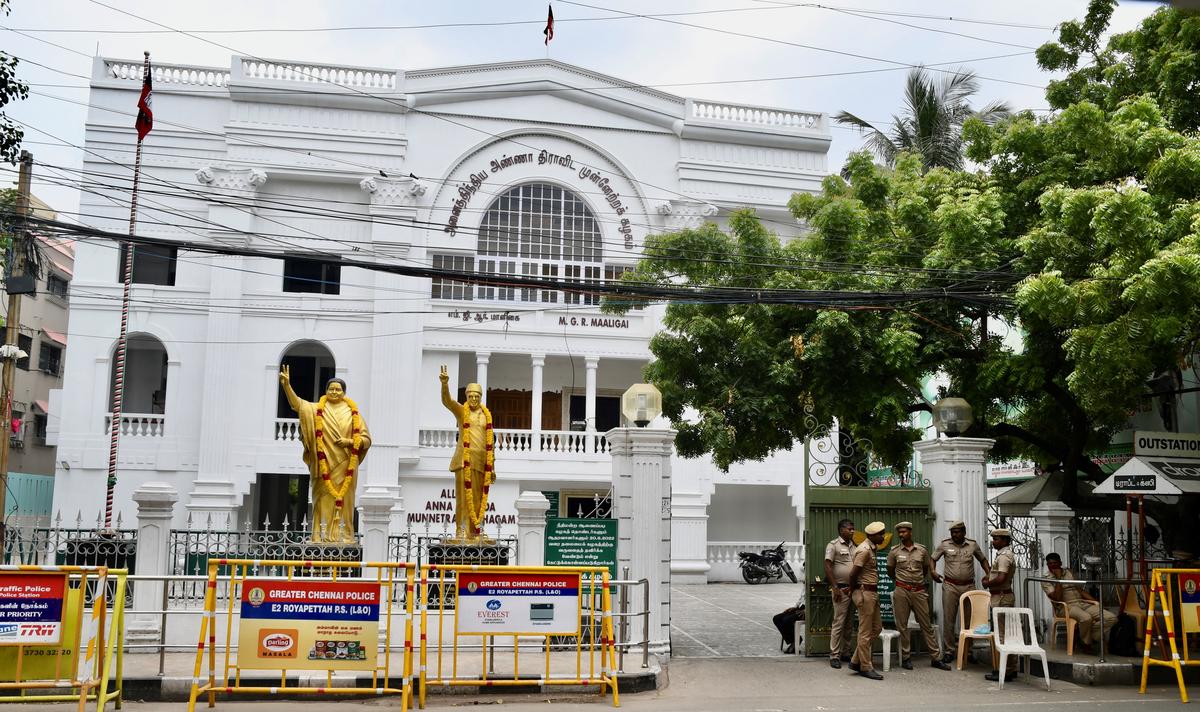
AIADMK maintains silence over Supreme Court’s verdict on EWS quota
The Hindu
CHENNAI
The two camps in the AIADMK, led by interim general secretary Edappadi K. Palaniswami and deposed coordinator O. Panneerselvam, are maintaining silence over the Supreme Court’s judgment upholding the constitutional validity of the 10% quota for the economically weaker sections (EWS) among the general category.
A couple of leaders in the Palaniswami camp say consultations are under way within the organisation and also with legal experts so that the party takes a cohesive stand on the issue.
Mr. Palaniswami’s statement, issued on Tuesday in response to the DMK regime’s decision to form the Human Resources Reforms Committee, was also silent on the issue, even though it touched upon the concept of social justice in general and the 69% reservation in particular. The AIADMK’s interim general secretary contended that, going by the terms of reference for the panel, the move would lead to the end of the 69% reservation system, and would go against the concept of social justice.
What is inexplicable is that the previous AIADMK regime did not favour the implementation of the 10% quota in Tamil Nadu. In fact, even with respect to issuing income and asset certificates to candidates belonging to the EWS for admission to Central educational institutions or employment in the Central government, it had, at one stage, taken a stand not to permit tahsildars to issue such certificates.
It was only after the issue went to the Madras High Court in mid-2020 that the government decided to revisit it. Later, the tahsildars were allowed to issue the certificates only for the purpose of admission to Central educational institutions or jobs at the Centre. [There has been no change in the position since then, says an official.]
In July 2019, Mr. Panneerselvam, the then Deputy Chief Minister, chaired a meeting of 21 political parties to examine the 10% quota and the Medical Council of India’s offer to increase the sanctioned strength of students in medical colleges by 25%, in the event of the State agreeing to implement the quota. At the meeting, a majority of the parties expressed their opposition to the idea, whereas a handful of parties, such as the BJP, the Congress, the CPI(M) and the Puthiya Tamizhagam, supported the vertical reservation.
Two years ago, when the AIADMK regime and Governor Banwarilal Purohit developed differences over clearance for a Bill providing 7.5% horizontal reservation for NEET-qualified students of State government schools in undergraduate medical admissions, a proposal was mooted informally for securing the ruling party’s approval for the 10% quota in exchange for assent to the horizontal reservation. However, the AIADMK stuck to its position against the EWS quota and, eventually, the then Governor gave his assent after the government decided to take the executive route to enforce the 7.5% quota, sources recall.


Abhishek Banerjee challenges BJP's Suvendu Adhikari in Nandigram, pledging community health initiatives if Trinamool Congress wins.

Rising LPG shortages in Karnataka boost firewood demand, reviving an informal market as households and hotels seek alternatives.

Against the backdrop of intense poll activity, a 400-metre stretch of an arterial road in the outskirts of Chennai (technically in Madurapakkam panchayat under Tambaram assembly constituency) presents a salute to the idea of res publica, which underpins India’s system of governance, where citizens have a say, at least before a government is securely ensconced in the seat of power. A Republic Day initiative shines bright every night

Fadnavis claims zero FIR in Ajit Pawar crash is a defamation attempt by Karnataka against Maharashtra's investigation efforts.

Set to unfold as a one-day pop-up on April 5, the Easter Sadya brings together both vegetarian and non-vegetarian menus, offering a peek into the food traditions of the Syrian Christian (Nasrani) community. While the traditional Sadya is often associated with dishes such as sambar, avial, and rice, this version expands to include community-specific festive dishes.

BJP nominates mother of R.G. Kar victim Abhaya to contest from Panihati in West Bengal Assembly elections.

Veteran Malayalam actor-director E.A. Rajendran passes away at 71, leaving behind a rich legacy in the film industry.

Dakshina Kannada Zilla Panchayat has rolled out digital mode of water bill generation and collection in 23 gram panchayats on a pilot basis for the first time in Karnataka. This is set to be extended to the remaining 200 panchayats shortly, according to the Zilla Panchayat Chief Executive Officer Narwade Vinayak Karbhari.

Bengaluru police questioned a man carrying ₹6 lakh for medical expenses at Vidhana Soudha, later releasing him after verification.

BJP accuses Bengaluru's Congress government of corruption in e-Khata issuance, halting infrastructure projects due to financial mismanagement.

Misinformation in Hyderabad sparks panic buying, causing disruptions as residents react to unfounded rumors of an impending lockdown.

Bengaluru Metro extends services until 2 a.m. on March 28 for IPL match, ensuring convenient travel for spectators.

A bus truck-collision in Andhra Pradesh's Markapuram district, killing several. Catch LIVE updates here!