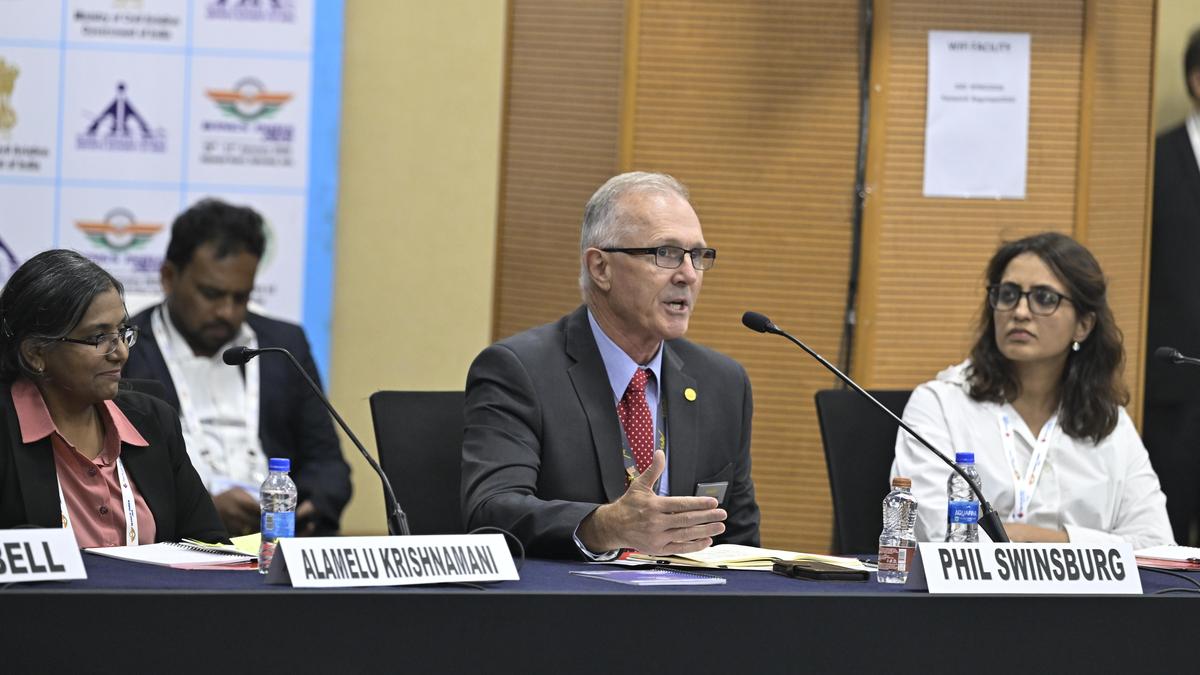
Advanced Air Mobility not a distant dream for India but an ongoing transition: Civil Aviation Secretary at Wings India 2026
The Hindu
India's Advanced Air Mobility is a current transition, not a distant dream, emphasizing urgent policy challenges and industry execution.
Advanced Air Mobility, or AAM, is no longer a distant ambition tied to Vision 2047 but a transition that has already begun, Civil Aviation Secretary Samir Kumar Sinha said at Wings India 2026 on Thursday, January 29.
Speaking at a session titled India’s Skyward Arc: Accelerating AAM from Vision 2047 to Reality, Sinha framed the debate not as futuristic speculation but as an urgent policy and ecosystem challenge. He described advanced air mobility as one of the most exciting frontiers in global aviation.
Designed for small passenger loads and capable of operating without additional runways, electric vertical take-off and landing platforms, or eVTOLs, have the potential to transform urban transport, emergency services, logistics and business connectivity, he said. “For India, the technology carries strategic significance. With rising congestion and infrastructure constraints in cities, advanced air mobility could complement surface transport by enabling cleaner, quieter and more efficient movement,” he added.
He revealed that a recent review within the Ministry concluded that India’s regulatory and policy framework for eVTOL and AAM is largely in place and comparable to developments in Western markets.
While the policy framework may be evolving, industry participants stressed that execution will determine the pace of adoption.
Kanika Tekriwal, Chairperson of the FICCI Advanced Air Mobility Taskforce and Co-founder and CEO of JetSetGo, highlighted the need for early engagement with state governments. “Helicopter take-off currently requires 29 permissions involving fire services, ambulance services, police and district administration. Replicating that model for every eVTOL movement would be unworkable,” she said.


Anna University partners with Ramco Systems to create an advanced ERP lab for enhanced industrial engineering education.

NDA announces candidates for 12 Kozhikode seats in Kerala Assembly polls 2026 as UDF and LDF ramp up campaigning.

As India formulates its next steps in the Israel-U.S.-Iran war, it is necessary to consider not only what it will mean for the whole region but also its own ties with each neighbour

CITU criticizes the Centre's privatization efforts for VSP, alleging employee removal over production increase and financial mismanagement.

Visakhapatnam Customs House's short film "Right Turn" wins Honourable Jury Mention at the 10th Indian World Film Festival.

Economist Arvind Subramanian advises CM Revanth Reddy on strengthening Telangana's finances during a meeting in Hyderabad.

Supreme Court emphasizes stakeholder consultation for legal education reforms, hesitant to change five-year law course duration.

Authorities in Andhra Pradesh are set to tranquillise a roaming tiger near Annavaram temple for safety and conservation.

MEA criticizes USCIRF for bias, urging focus on vandalism of Hindu temples in the U.S. over selective criticism of India.

Bengaluru's Urban Development aims to beautify underutilized flyover spaces, enhancing city aesthetics and improving green cover initiatives.

Indian Navy warships escort merchant vessels in the Gulf of Oman, ensuring safe passage amid regional tensions under Operation Sankalp.

A rare crab species exhibiting both male and female traits was discovered in Silent Valley, revealing unique biological characteristics.

Gujarat court convicts five in 2016 Una flogging case; punishment announcement scheduled for March 17, 2026.