Aditya-L1: its functioning and purpose
The Hindu
. Aditya L1 mission to observe Sun, unravel mysteries of its dynamics, help understand climate variation on Earth. Solar activity measured in terms of sunspots, solar flares, CMEs, solar wind. Aditya L1 to observe Sun 24X7, measure space weather parameters, help predict geomagnetic storms, understand space weather dynamics.
Usually when we huddle near a fire, we feel warm and as we move away, that warmth is reduced. But surprisingly the sun and its atmosphere don’t follow this rule. Made up of a soup of positively charged protons, negatively charged electrons and other ions mixed with the solar magnetic field, extending somewhere between 10 and 20 solar radii from the surface of the Sun, the solar corona, the atmosphere of the Sun is an enigma. While the surface of the Sun is 5,600 degrees, the corona, interestingly, is about two million degrees. “We have some idea of why it is so, but the problem is not fully resolved,” says Dipankar Banerjee, Director of Aryabhatta Research Institute of Observational Sciences (ARIES). “Observations from Adtiya L1 will help us understand the dynamics of the Sun and how solar variability impacts the climate on Earth and affects the space weather,” he adds.
Discovered by mathematician Joseph Louis Lagrange, L1 is one of the five points located approximately 1.5 million kilometres away, where the gravitational forces of the Sun and the Earth are in equilibrium. Hence, a spacecraft placed at L1 orbits the Sun at the same rate as Earth and affords an uninterrupted view of the Sun, making it an ideal observation post for space-based solar observatories.
The L1 is currently home to the European Space Agency (ESA)- National Aeronautics and Space Administration (NASA) Solar and Heliospheric Observatory (SOHO) observing the Sun and its dynamics. Aditya L1 will join this observatory to unravel the mysteries of the dynamics of the Sun.
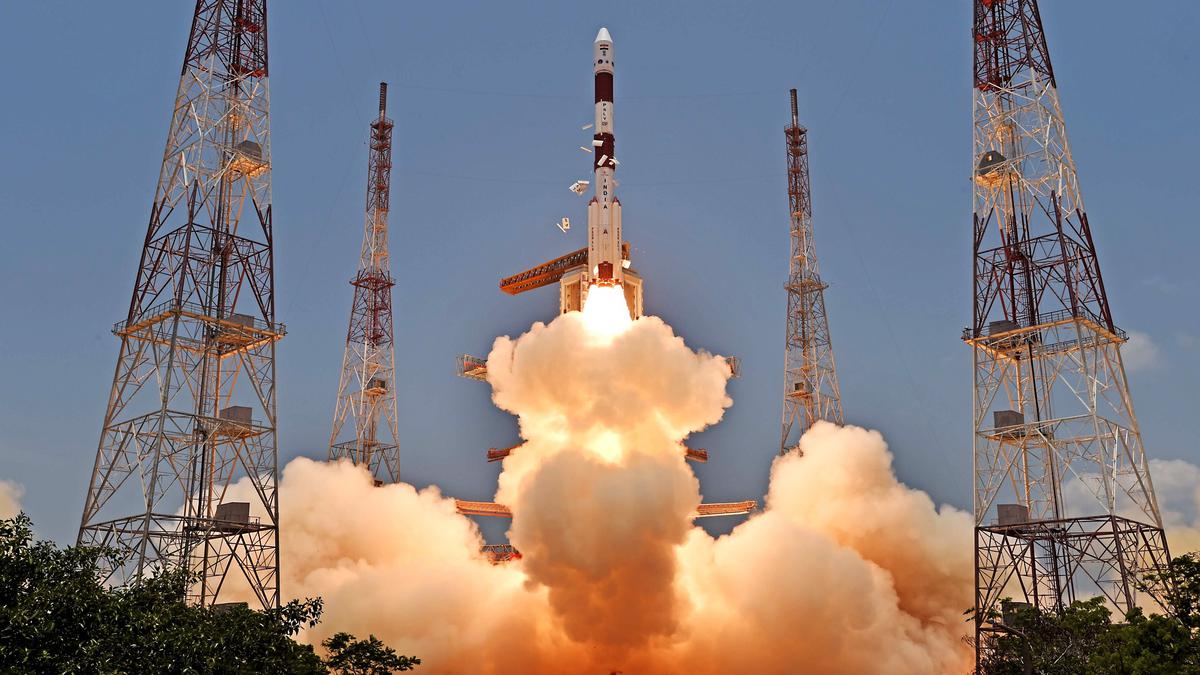
Launched on September 2, the craft will undergo five orbit-raising manoeuvres before being slingshot to the L1 point. The ship will coast for about four months before it reaches L1. At that stage, the thrusters will be fired to make the craft circle around the L1, placing it in what is known as a halo orbit around L1. From this vantage point, Aditya L1 can observe the Sun 24X7 using its four remote sensing payloads, and measure in-situ the various parameters of space weather.
Like a heartbeat, solar activity is measured in terms of the number of sunspots. Sunspots are cooler regions on the Sun’s surface which increase and decrease in a cycle of 11 years. When the Sun is active, the number of sunspots is in the hundreds, and at solar minimum, the numbers are nearly zero. However, according to Anamparambu Ramaprakash, who is with the Pune-based Inter-University Centre for Astronomy and Astrophysics, “despite the variation in solar activity, the emission in visible and long wavelengths is nearly steady. Whatever changes we observe in the solar radiation, nearly 80% occur in the ultraviolet range,” he says. The Earth’s upper atmosphere absorbs most of the solar UV rays. “The absorbed energy affects the atmosphere’s composition, temperature and other parameters. It is imperative to know how far variation in the UV rays emitted by the Sun contributes to climate variability on Earth,” he adds.
The Solar Ultraviolet Imaging Telescope (SUIT) developed by the Inter-University Centre for Astronomy & Astrophysics, in close collaboration with the ISRO, the Center of Excellence in Space Sciences India, Mohanpur, the Manipal Academy of Higher Education etc, will observe the UV radiation from different zones of the solar atmosphere. The onboard intelligence system will detect any sudden appearance of bright spots, such as solar flares (a sudden burst of high energy visible light, UV rays, X rays and Gamma rays) on the disc. The automated system will trigger the rapid imaging of different layers, and thus, we will obtain a 3D tomographic view of the Sun. “With this system in place, the event’s progression through the layers of the solar atmosphere can be imaged,” says Mr. Ramaprakash. Combining the data from the Solar Low Energy X-ray Spectrometer (SoLEXS) and the High Energy L1 Orbiting X-ray Spectrometer (HEL1OS) developed by the ISRO’s Bengaluru based U. R. Rao Satellite Centre with SUIT, “ can [help us] gain insights into the emergence, progression and energetics of transient events on the surface of the Sun in the UV region”.
Observing the Sun using the SUIT will enable us to better understand climate variation on Earth. “Earth’s climate has definitely changed. Global warming is real. The data from SUIT and other papers of Aditya L1 will help us resolve the contribution of natural and anthropogenic factors driving climate change,” says Mr. Ramprakash.


Discover efficient pressure cooking techniques to save up to 50% on fuel. OPOS B Ramakrishnan tells you how

Mercedes-Benz CLA 250+ with EQ Technology review: design, performance, range and features explained. Discover how the new electric CLA combines advanced AI, long range, fast charging and futuristic styling for the next generation of luxury EVs.

Pi Day is celebrated every year on March 14, honouring the significance of the mathematical constant π and its applications in mathematics.

Discover how sculptural interior design transforms modern spaces, blending creativity and functionality to evoke emotion and identity.

A study reveals that certain antibiotics can cause long-lasting changes in gut microbiome diversity for up to eight years.

Indian scientists and international experts are divided over a study questioning the viability of a nuclear reactor fuel called HALEU-thorium; while critics cite safety risks, proponents argue the technology is vital to achieve national energy goals.

ISRO and AIIMS partner to enhance space medicine research, focusing on human health during long-duration space missions.

A practical guide to induction setups for students, families, and home food businesses as India’s LPG supply faces its biggest disruption in years

Explore the electrifying Oscars 2026 race, featuring standout films, baffling nominations, and memorable performances amid a cinematic transition.

Zai and Rom Whitaker’s latest book for young readers, The Book of Indian Snakes, tackles common misconceptions surrounding snakes, highlighting their utility to humans

Discover PC Mahalanobis's pivotal role in India's statistical revolution and his lasting influence on modern statistics in this episode.

Explore why nothing can exceed light speed and the paradoxes that arise if it were possible.

Scientists have engineered bacteria to produce designer proteins by smuggling artificial amino acids, enabling precise drug delivery and multifunctional applications.