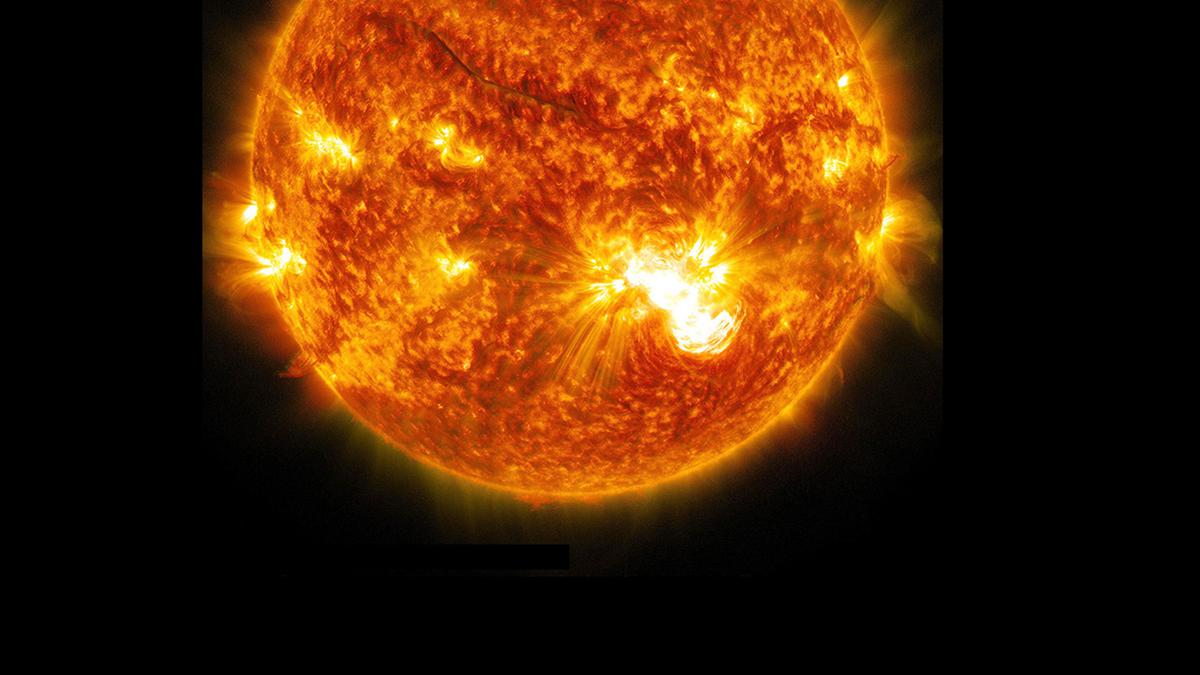
Aditya-L1 captures first glimpse of solar flares
The Hindu
The Indian Space Research Organisation (ISRO) on Tuesday said the HEL1OS payload has captured the first high-energy X-ray glimpse of solar flares.
The High Energy L1 Orbiting X-ray Spectrometer (HEL1OS) payload, onboard the Aditya-L1 spacecraft, has captured the first glimpse of solar flares.
Aditya-L1, the first space-based Indian mission to study the sun, was launched on September 2 and is currently on its journey to the destination of sun-earth L1 point (L1).
The Indian Space Research Organisation (ISRO) on Tuesday said the HEL1OS payload has captured the first high-energy X-ray glimpse of solar flares.. “During its first observation period on October 29, the High Energy L1 Orbiting X-ray Spectrometer (HEL1OS) on board Aditya-L1 recorded the impulsive phase of solar flares. The recorded data is consistent with the X-ray light curves provided by NOAA’s GOES [National Oceanic and Atmospheric Administration’s Geostationary Operational Environmental Satellites] ,” ISRO said.
The space agency added that the HEL1OS, commissioned on October 27, “is set to monitor the sun’s high-energy X-ray activity with fast timing and high-resolution spectra. HEL1OS data enables researchers to study explosive energy release and electron acceleration during impulsive phases of solar flares”.
HEL1OS was developed by the Space Astronomy Group of the U. R. Rao Satellite Centre, ISRO, Bengaluru.
Aditya-L1 will arrive at the L1 point in January 2024 and the satellite will spend its mission life orbiting around L1 in an irregularly shaped orbit. L1 is about 1.5 million km from the earth.


Test your knowledge with the quiz on Science films at the Oscars through history

Set between the Siwalik hills and the plains, Butwal offers travellers a mix of regional cuisine, pilgrimage trails to Lumbini and the comfort of Hyatt’s new hospitality landmark

Explore 2026's wallpaper trends in India, highlighting botanicals and handmade designs that enhance modern homes with nature-inspired aesthetics.

Mercedes-Benz CLA 250+ with EQ Technology review: design, performance, range and features explained. Discover how the new electric CLA combines advanced AI, long range, fast charging and futuristic styling for the next generation of luxury EVs.

AI tool for sparrow conservation

BTS’s comeback with ‘Arirang’ marks a major global music event. When does the album release, and where can you watch their concert live stream? We have all the details

The 2026 U.S. cholesterol guidelines urge starting screening and treatment at 30 to prevent cardiovascular disease effectively.

Olam Festival 2026 in Thiruvananthapuram returns March 27-29 with 120+ vendors, music, art, and cultural zones.

A few storytellers in Thiruvananthapuram share their journeys, challenges, and evolving methods on World Storytelling Day, inspiring young minds.

76-year-old Kurian Jacob from Kerala triumphs with seven medals, including five golds, at the Open Masters Games in Abu Dhabi.

Explore the nature of the human mind as an emergent property of brain activity and complex neural interactions.

CERN's Large Hadron Collider discovers the Xi-cc-plus particle, enhancing understanding of quantum mechanics and baryon behavior.

Vibha Batra’s latest book, Spotless (Hachette India) is a novel in verse for young adults