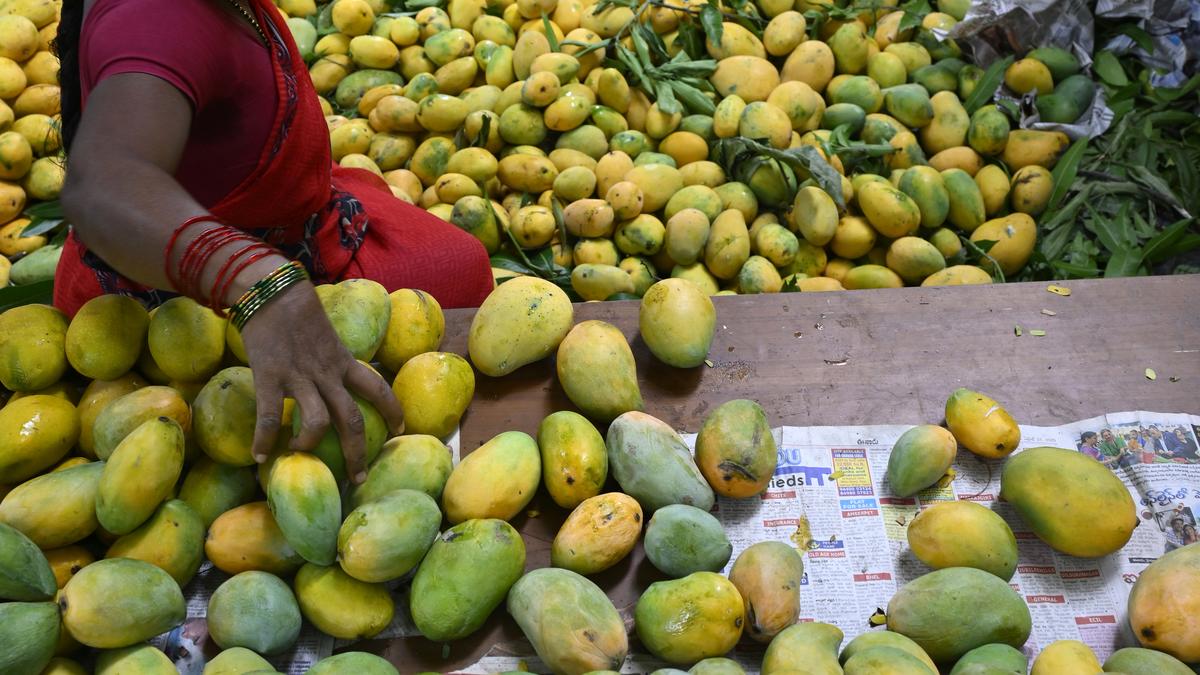
A tale of sweet and tangy mangoes in Hyderabad
The Hindu
A tale of mangoes sold in Hyderabad markets, where are the fruits sourced from, the competition between traditional vendors and online giants, concerns over calcium carbide, revival of lesser-known varieties, and sentimental connections to raw mangoes.
From April to June, Hyderabad transforms into a vibrant tapestry of golden hues as its streets overflow with an exquisite array of mangoes. Besides the fruits from various parts of Telangana, lorries laden with varieties such as Himayat, Daseri, Benishan, Alphonso and Rasalu roll in from Andhra Pradesh, Karnataka, Maharashtra and Gujarat.
This season, however, the king of fruits had to weather quite a storm to reach the city. Early this year, unseasonal rains and winds struck Andhra Pradesh and Telangana, significantly impacting Hyderabad’s primary mango suppliers. This flooded the wholesale markets with unripe kairi [unripe mango variety in Hindi], which jacked up prices (₹200-₹400 a kg) early in the season, until market forces ironed out the spikes.
Batasingaram, the city’s mango hub, handles 3,000 to 5,000 quintals of the fruit daily in peak season, with average prices pegged around ₹2,345 a quintal. Jambagh, another market, processes 500–800 quintals in the initial days of the season and 1,000-1,500 quintals in April.
Vendors like Zubair in Kothapet are busy with customers, as buying mangoes becomes a cherished ritual for many in the city. “Himayat is the favourite,” notes one vendor. “We ripen these mangoes with calcium carbide just two days before sale.” Current prices are steady compared to last year, ranging from ₹70-₹200 a kg depending on the variety.
This mango season also presented a striking juxtaposition: traditional vendors vis-à-vis quick commerce giants who offer rapid doorstep delivery.
While retail shops sell organic Banganapalli variety at ₹150-₹400 a kg, a quick-commerce establishment charge ₹79.12 a kg. Consumers are reluctant to buy the fruit from street vendors owing to concerns about calcium carbide.
Abdul Qadeer, president of the Jambagh market, speaks for the vendors. “Farmers follow regulations. The fear surrounding [calcium] carbide harms their livelihood. Where would smaller vendors turn to if consumers begin shopping online for supposedly fresh and organic products?”


Perundurai's industrial growth faces challenges of pollution, water scarcity, and healthcare, impacting residents ahead of the 2026 elections.

The Travancore Devaswom Board asserts that courts should respect community beliefs in its Supreme Court submission on Sabarimala's entry issue.

Karnataka cancels Deendayal Upadhyay event at KSOU due to protocol violations, citing inconsistency with university objectives.

Illegal pickle unit busted in Hyderabad, one arrested; unhygienic stock worth ₹3 lakh seized

Karnataka has entered a state of demographic transition where a large working-age population will no longer be enough to drive economic growth, and future gains will depend on how productively people are employed, the ‘State of Working India 2026’ report said.

Key demands in Sulur Assembly constituency include reviving the powerloom sector, addressing farmers' needs, and protecting River Noyyal.

Kodihalli urges Karnataka CM to allocate ₹10,000 crore revolving fund for seamless procurement of farm products under MSP scheme.

Kerala's political parties continue to marginalize women candidates, highlighting a troubling disconnect between gender demographics and representation.

The High Court of Karnataka on Tuesday ordered the issue of a notice to the State government on a PIL petition, which had complained about disturbances caused to people residing in the localities around the National Public School situated in Rajajinagar 5th block due to use of loudspeakers with high volume in the school and parking of school buses in residential areas.

China is extensively mapping ocean floors to enhance submarine warfare capabilities against the U.S. and allies across key oceans.

AIADMK's 2026 manifesto promises free rations, women's benefits, education reforms, and economic growth initiatives for Tamil Nadu.

The vehicle towing drive will soon resume in the city to ease traffic congestion. The Bengaluru Traffic Police (BTP), in coordination with the Greater Bengaluru Authority (GBA), is set to relaunch the vehicle towing drive across the city shortly to tackle traffic congestion and illegal parking.

Panic buying, not shortage, is leading to long queues at Hyderabad petrol pumps.