A course to bring alive the hidden naturalist in you Premium
The Hindu
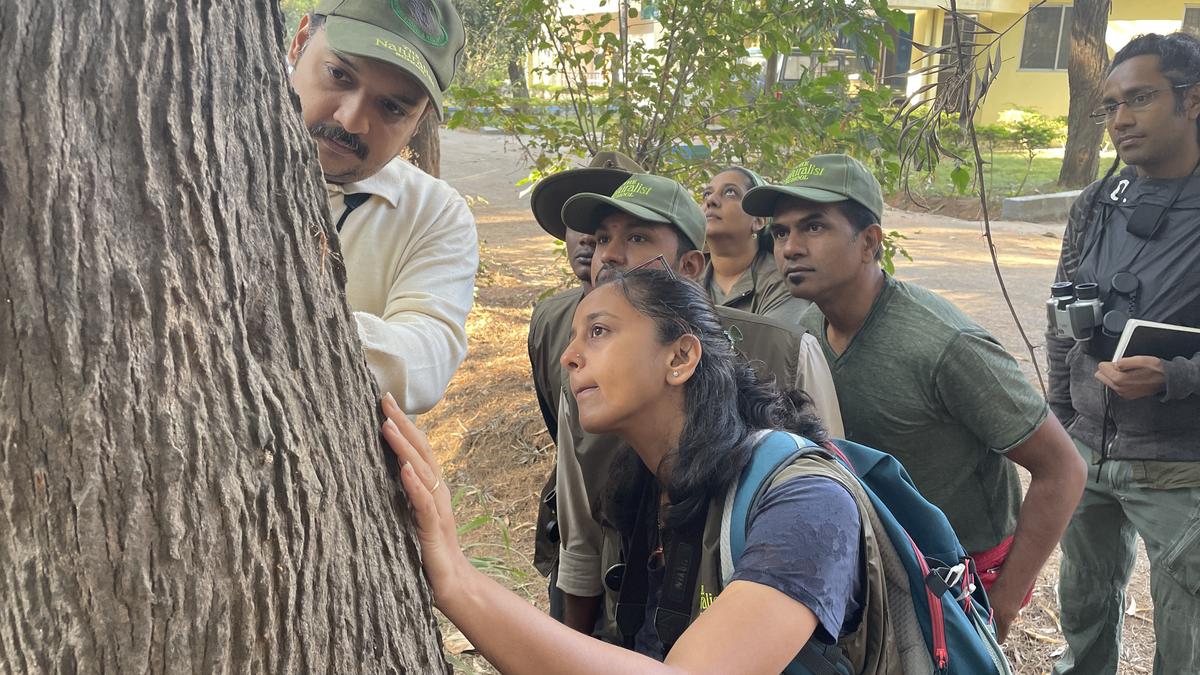
“There is a naturalist in each one of us,” says Priya Venkatesh, the Founder-Director of The Naturalist School (TNS), a Bengaluru-based social enterprise offering long and short-term courses for anyone curious about the natural world.
“There is a naturalist in each one of us,” says Priya Venkatesh, the Founder-Director of The Naturalist School (TNS), a Bengaluru-based social enterprise offering long and short-term courses for anyone curious about the natural world.
Priya explains the rationale behind the initiative, which taps into the idea of multi-modal intelligence in humans. “One of them is the naturalist intelligence,” says Priya. She also believes that all human beings have an “innate ability” to connect with nature.
Bringing alive the naturalist in us is bringing alive the curiosity within us, says Priya, who believes in the power of wonder when it comes to interacting with nature. The vision of the organisation’s Naturalist Centre of Excellence (NCOE), which is all set to launch India’s first Certified Naturalist Course (CNAT) on May 25, taps into this inherent curiosity about nature and aims to create a cohort of naturalists who will become “storytellers, weaving narratives that resonate in the hearts of listeners, igniting a spark of wonder and a sense of responsibility towards the Earth.”
The 750-hour-long course, recognised by the Ministry of Skill Development (MSDE), is accredited by the National Council of Vocational Education and Training (NCVET) and was developed in partnership with the Tourism and Hospitality Skills Council (THSC). It intends to offer a multidimensional learning experience about the living world as well as has a vocational goal.
Some of the modules which will form part of the course include a study of Indian biodiversity, learning how to create interpretive nature experiences, nature photography, an introduction to forest laws and working on participants’ communication skills. “The NCOE course isn’t just about training naturalists. It is about nurturing a generation of storytellers who can bridge the gap between humans and the environment, ensuring a future where both can flourish,” she says.
In 1983, the Mexican architect and environmentalist Héctor Ceballos-Lascuráin coined the word “ecotourism” which he defined as “responsible travel to natural areas that conserves the environment, sustains the well-being of the local people, and involves interpretation and education.” Since then, the ecotourism industry has grown massively with the global ecotourism market size projected to grow from $260.76 billion in 2024 to $759.93 billion by 2032, at a CAGR of 14.31% during the forecast period, according to the market research organisation, Fortune Business Insights.
While India still occupies only a small fraction of the industry, it is a fast-expanding one as a March 24 report by The Federation of Hotel and Restaurant Associations of India (FHRAI), KPMG and the PHD Chamber of Commerce and Industry (PHDCCI), indicates. The eco-tourism sector here is expected to grow at 15.7% between 2019 and 2027 to reach $4.55 billion. This is not particularly surprising given that the country hosts some of the most diverse habitats in the world. “From deserts, glaciers, freshwater bodies, plateaus—you name it and we have it,” says Priya.


Residents of Anna Nagar face severe encroachments, traffic congestion, and pollution issues, demanding urgent action and regulation.

Karnataka State Human Rights Commission inspects Raichur's hostels, jail, and bus stand, addressing human rights and facility concerns.

Delhi's inaugural International Film Festival showcases over 125 films, promoting the capital as a global film hub.

U.S.-Israel war on Iran LIVE: Follow The Hindu for updates on the West Asia conflict on March 25, 2026

Police Commissioner A. Arun addresses public grievances, receiving 23 petitions and urging swift action from officials at the camp.

Thirumavalavan urges CM Stalin to ensure Kamal Haasan’s MNM contests the Assembly elections to strengthen the alliance.

Two killed and 23 injured in a sleeper bus accident in central Delhi; investigation ongoing.

Governor Shiv Pratap Shukla inaugurates the 74th All India Police Football Championship in Hyderabad, emphasizing sports' role in policing.

Visakhapatnam police recover ₹66 lakh in property from 54 arrested in February, solving 62 crime cases.

OPS claims EPS's lost credibility will undermine AIADMK's election manifesto, as DMK promises have proven reliable and effective.

Explore Modakkurichi's agrarian challenges, development gaps, and tourism potential as it gears up for the upcoming elections.

The Govindapura police have successfully traced an 84-year-old man suffering from dementia who had gone missing last month, following a sustained 25-day search operation across the city.

First randomisation of EVMs and VVPATs held in Dindigul, Theni districts