Primary Country (Mandatory)

Other Country (Optional)

Set News Language for United States

Primary Language (Mandatory)
Other Language[s] (Optional)
No other language available

Set News Language for World

Primary Language (Mandatory)
Other Language(s) (Optional)

Set News Source for United States

Primary Source (Mandatory)
Other Source[s] (Optional)

Set News Source for World

Primary Source (Mandatory)
Other Source(s) (Optional)
  • Countries
    • India
    • United States
    • Qatar
    • Germany
    • China
    • Canada
    • World
  • Categories
    • National
    • International
    • Business
    • Entertainment
    • Sports
    • Special
    • All Categories
  • Available Languages for United States
    • English
  • All Languages
    • English
    • Hindi
    • Arabic
    • German
    • Chinese
    • French
  • Sources
    • India
      • AajTak
      • NDTV India
      • The Hindu
      • India Today
      • Zee News
      • NDTV
      • BBC
      • The Wire
      • News18
      • News 24
      • The Quint
      • ABP News
      • Zee News
      • News 24
    • United States
      • CNN
      • Fox News
      • Al Jazeera
      • CBSN
      • NY Post
      • Voice of America
      • The New York Times
      • HuffPost
      • ABC News
      • Newsy
    • Qatar
      • Al Jazeera
      • Al Arab
      • The Peninsula
      • Gulf Times
      • Al Sharq
      • Qatar Tribune
      • Al Raya
      • Lusail
    • Germany
      • DW
      • ZDF
      • ProSieben
      • RTL
      • n-tv
      • Die Welt
      • Süddeutsche Zeitung
      • Frankfurter Rundschau
    • China
      • China Daily
      • BBC
      • The New York Times
      • Voice of America
      • Beijing Daily
      • The Epoch Times
      • Ta Kung Pao
      • Xinmin Evening News
    • Canada
      • CBC
      • Radio-Canada
      • CTV
      • TVA Nouvelles
      • Le Journal de Montréal
      • Global News
      • BNN Bloomberg
      • Métro
50 years since the launch of Aryabhata

50 years since the launch of Aryabhata

The Hindu
Saturday, April 19, 2025 12:33:23 AM UTC

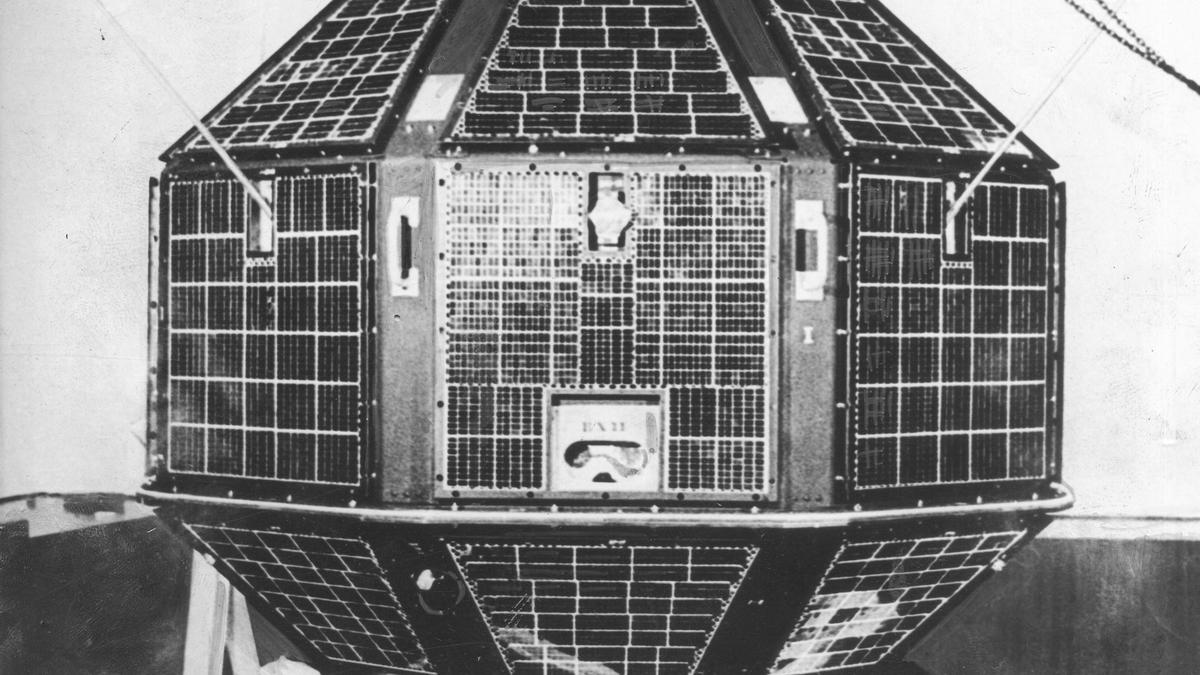
Half a century has passed since India successfully launched Aryabhata, its first satellite, on April 19, 1975. This success proved to be the solid foundation for India’s space programme, which has grown by leaps and bounds in the five decades since. A.S.Ganesh takes you back to where it all started…

Named after an ancient Indian mathematician and astronomer (5th Century), Aryabhata was India’s first satellite. Launched from Kapustin Yar with the help of the Soviets on April 19, 1975, the launch of this indigenously-built satellite marked the beginning of India’s space age. The successful launch meant that India became just the 11th country in the world to send a satellite into orbit.

Aryabhata was designed as a 26-sided polyhedron that was 1.4 metres in diameter and weighed 360 kg. Barring the top and the bottom, each and every one of the 24 other faces were covered in solar panels.

Once in orbit, Aryabhata went around the Earth every 96.3 minutes. With an inclination of 50.7 degrees, the satellite went around in an orbit with an apogee (furthest point) of 619 km and a perigee (closest approach) of 563 km.

Tasked with conducting experiments in solar physics and X-ray astronomy, Aryabhata tasted minimal success (making observations of an X-ray source) before a power failure halted experiments after five days in orbit. In addition to providing scientists invaluable experience in building satellites, Aryabhata also collected information during its five operational days. It continued to transmit information for some more days. Aryabhata re-entered the Earth’s atmosphere on February 10, 1992 – corresponding to an orbital life of nearly 17 years.

While India’s satellite programme took shape in the 1970s, the scientists in the country had been gearing up for India’s indigenous space programme ever since the space race between Cold War rivals the U.S. and the Soviet Union had begun. In the 1960s, the Indian Space Research Organisation (ISRO) developed a series of sounding rockets for atmospheric and meteorological research under the Rohini rocket programme. Following this success, the ISRO turned their attention towards building our own satellites.

Vikram Sarabhai, physicist and ISRO’s founder, appointed a team of 25 scientists, engineers, and researchers to design and develop a satellite at the Physical Research Laboratory in Ahmedabad. Sarabhai entrusted space scientist Udupi Ramachandra Rao with the task of directing operations and assembling the satellite in Bengaluru.

Considering that Rao himself had only limited experience with regard to making a satellite, the young team that had been put together had to learn on the fly. While this is no easy task in any industry, it was probably doubly difficult in rocket science.

Read full story on The Hindu
Share this story on:-
More Related News
Drogue parachute deployment tests for Gaganyaan mission successful: ISRO

ISRO successfully completed drogue parachute deployment tests for the Gaganyaan mission, advancing safety for human spaceflight.

Rkive and the art of repair

Discover Ritwik Khanna's innovative repair shop Rkive in Mumbai, merging sustainability, creativity, and youthful urgency in fashion.

ISRO to launch U.S. satellite on December 24

ISRO will launch the U.S. BlueBird satellite on December 24, 2025, after postponing from the original December 15 date.

Tiffany, Swarovski and a new language of Christmas decor

Explore unique Christmas ornaments from Tiffany, Swarovski, and more, blending luxury with festive charm for your holiday decor.

Inside Copenhagen’s Alchemist: Chef Rasmus Munk on food, provocation and his India-inspired dishes

Inside Copenhagen’s Alchemist: Chef Rasmus Munk on food, provocation and his India-inspired dishes

Why has the claimed dark matter discovery sparked debate, caution? Premium

Explore the debate surrounding a potential dark matter discovery, highlighting skepticism and the need for rigorous validation in astronomy.

'Extremely exciting': the ice cores that could help save glaciers

Discover how ice cores from the Pamir Mountains could unlock secrets to protect the world's glaciers from climate change.

Why does spicy food make our nose run? Premium

Discover why spicy food causes a runny nose and how capsaicin triggers a protective response in our bodies.

How India established its first research station in Antarctica

In October this year, India announced its intention to build Maitri II, the country’s newest research station in Antarctica and India’s fourth, about 40 forty-odd years after the first permanent research station in Antarctica, Dakshin Gangotri, was established. The Hindu talks to Dr Harsh K Gupta, who led the team that established it

How is Asia-like artemisinin resistance emerging in Africa? Premium

Study reveals rising artemisinin resistance in Africa, echoing Asia's past, urging urgent action to prevent widespread crisis.

The Michelin Guide enters the world of wine with The Michelin Grappe, a new distinction

Michelin launches The Grappe, a new wine distinction, recognizing excellence with one to three grapes, starting with the Burgundy and Bordeaux regions

Inside a scientific experiment that transformed skin cells into embryo-forming eggs Premium

A groundbreaking experiment transforms skin cells into egg-like cells, offering hope for infertility treatments amidst ethical considerations.

Niraba brings sabai grass weaving to contemporary furniture design

Discover Niraba, a collaboration merging Odisha's sabai grass weaving and dhokra craft into contemporary furniture and lighting design.

Africa study catches ‘high-flying’ mosquitoes spreading pathogens Premium

Researchers discovered high-flying mosquitoes carry pathogens, revealing new transmission routes for diseases like malaria and dengue in Africa.

Science quiz: Giants on whose shoulders Newton stood Premium

Test your knowledge of the influential figures in physics who paved the way for Newton's groundbreaking discoveries.

Discover Chennai’s unique Christmas celebrations: Traditions and festivities

Forget what Christmas is supposed to look like. In Chennai, it smells of the sea, plum cake and hot chocolate. Here are 12 ways the city keeps the season merry

Why do we get goosebumps? Premium

Discover the science behind goosebumps, their causes, and their vestigial role in human biology.

Why does yawning cause watery eyes? Premium

Discover why yawning leads to watery eyes, exploring the role of facial muscles and lacrimal glands in tear production.

Countdown for launch of ISRO’s Bluebird Block-2 Mission begins in Sriharikota

Countdown begins for ISRO's Bluebird Block-2 mission, launching a record-breaking communication satellite from Sriharikota on December 24, 2025.

How are we protecting astronauts from deadly space debris?

Learn how astronauts are safeguarded from hazardous space debris through innovative engineering and international collaboration.

National Mathematics Day and the double life of Jantar Mantar Premium

Explore the dual significance of Jantar Mantar as both a mathematical observatory and a designated protest site in Delhi.

Why do students fear math? | National Mathematics Day

Explore the roots of math anxiety in students and discover strategies to foster confidence and understanding in mathematics.

NASA loses contact with MAVEN, which reached Mars with Mangalyaan Premium

NASA loses contact with MAVEN, its Mars orbiter studying the planet's atmosphere, after a decade of successful operations.

ISRO’s LVM3 to launch next-generation communication satellite on Dec. 24

ISRO's LVM3 will launch the BlueBird Block-2 satellite on December 24, providing global high-speed cellular broadband directly to smartphones.

Will new Act aid India’s nuclear development? | Explained Premium

Explore the SHANTI Act's implications for India's nuclear development, replacing outdated laws and targeting significant capacity growth.

© 2008 - 2025 Webjosh  |  News Archive  |  Privacy Policy  |  Contact Us