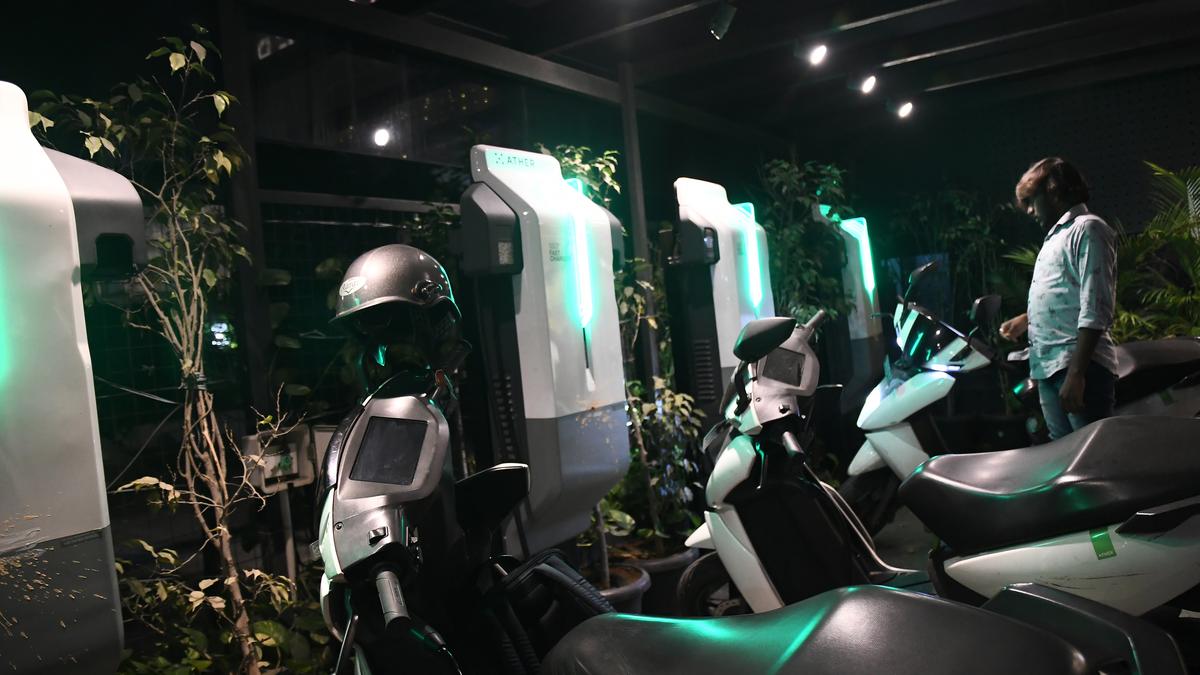
36,000 public EV charging guns needed by 2030 to meet demand: Study
The Hindu
CSTEP study shows Bengaluru needs 36,000 EV charging guns, 400 stations by 2030, with potential impact on grid.
A study conducted by the Centre for Study of Science, Technology, and Policy (CSTEP), a Bengaluru-based think tank, shows that in order to meet the growing demand for electric vehicles (EVs), the city would require more than 36,000 public EV charging guns (25 times more than the number in 2023) and 400 more charging stations by 2030.
By using the stock projection method, the study, which is called “Bengaluru 2030: EV charging demand and infrastructure”, finds that Bengaluru will have more than 23 lakh EVs on the road by 2030. To help this transition, around 141 acres of land (equivalent to having 700 petrol pumps) would be required to set up the charging stations.
It has also identified 400 potential spots for setting up the stations. They include IT parks, metro stations, fuel stations, shopping malls, and nine Regional Transport Office (RTO) zones.
The study further looks at the potential impact the EV demand could have on the electricity grid and estimates that by 2030, the energy demand would be around 3.3 - 4.1 Billion Units (BU), which would account for around 7% to 9% of the city’s annual energy demand. While the peak load from EV charging was 0.096 gigawatts (GW) in 2023, it is expected to touch around 1.2 GW by 2030.
The assessment of business viability for charge point operators indicates that the charger utilisation rates would be 25%–50% in 2030, and the corresponding tariffs for various types of charger guns could be capped at ₹11–15/kWh.
The study also administered detailed survey questionnaires to over 1,000 existing and potential EV users (personal and commercial) and found that over 56% of potential buyers prefer electric vehicles over conventional vehicles. More than 55% of the EV owners (both two-wheelers and four-wheelers) responded that they charged their vehicles either at their residence or workplace, while 40% of the commercial two-wheeler EV users preferred to use public charging stations. Commercial three-wheeler and four-wheeler EV users preferred company-provided charging stations.
The study says that overnight home-charging would cause the least strain on the electricity grid. “Two extreme charging scenarios were considered - 90% of EV users charging at home and 90% at public charging stations. The scenario wherein 90% of EV users charge at public stations could lead to a peak power demand of 1.4 GW, which is 16% of the city’s projected peak power demand. On the contrary, the peak power demand when 90% of EV users charge at home would be 1.1 GW (~7% lower than the 1.2 GW projection for 2030), resulting in relatively lower stress on the grid,” it says.


In its first edition, the Madras Art Salon spotlights the works of journalist and artist Narayan Lakshman at The Botanical Club, a social space in the British Deputy High Commission, Chennai

Cholesterol enhances melanoma cell invasion by making nuclei squishier, revealing a potential treatment target in cancer progression.

The designers reinterpret the Swedish artist’s symbolic forms and colour energy through contemporary resortwear silhouettes

Discover the inspiring legacy of Bibha Chowdhuri, a pioneering woman in physics and a trailblazer in STEM history.

Discover the inspiring legacy of Bibha Chowdhuri, a pioneering woman in physics and a trailblazer in STEM history.

Ashdeen’s Spring 2026 collection features saris inspired by the designer’s Parsi gara archive

Red ochre burials, ritual markings and myths across cultures show that red repeatedly marks liminal thresholds such as puberty, sacrifice and death; anthropologists argue that the colour functions as a technology of collective ritual and value, binding communities through shared symbolic acts

India approves 23 institutions for quantum labs under the National Quantum Mission, aiming to advance quantum technology and research.

India approves 23 institutions for quantum labs under the National Quantum Mission, aiming to advance quantum technology and research.

The Gaza conflict exacerbates environmental damage, emitting millions of tonnes of CO2 and threatening climate stability in West Asia.

Chefs and cookery experts share smart kitchen hacks, hybrid cooking methods and appliance tips to help households reduce LPG use without compromising on food

Discover groundbreaking research on Titan's lakes, bat vaccinations, and the unique aroma of ripening bananas in just one minute.

IRSO's NavIC system faces challenges as the last atomic clock fails, reducing operational satellites for navigation services.