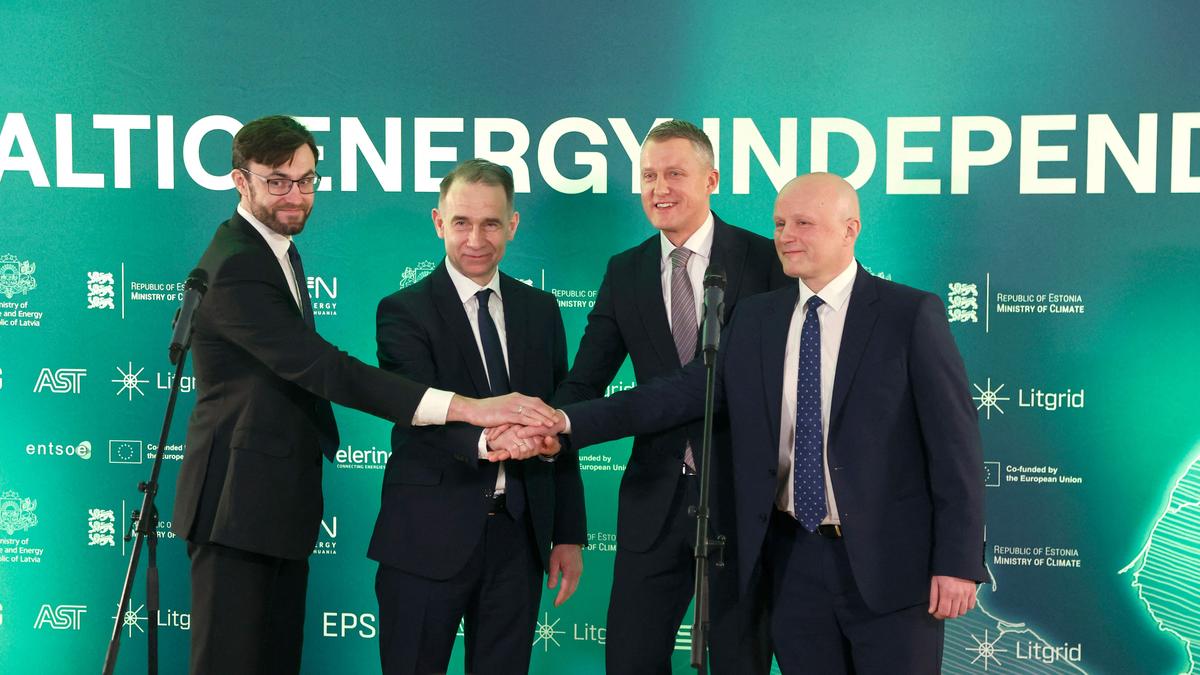
3 Baltic states disconnect from Soviet-era grid to merge with European energy system
The Hindu
Baltic countries cut electricity ties with Russia, joining European energy networks, marking geopolitical shift and independence milestone.
The flow of electricity between the Baltic countries of Estonia, Latvia and Lithuania and Russia was officially severed Saturday (February 8, 2025) morning after officials switched off the Soviet-era grid’s transmission lines and prepared to join the rest of Europe on Sunday (February 9, 2025).
This came more than three decades after the collapse of the Soviet Union, ending the Baltics’ final ties to oil- and gas-rich Russia. For the three countries, as well as the rest of Europe, the move was steeped in geopolitical and symbolic significance.
“The Baltic energy system is finally in our hands, we are in full control,” Lithuania Energy Minister Žygimantas Vaičiūnas told reporters.
On Saturday (February 8, 2025), all remaining transmission lines between them and Russia, Belarus and the Russian exclave of Kaliningrad, wedged between EU members Poland and Lithuania and the sea, were switched off one by one. Lithuania first – where a specially-made 9-meter (about 29-foot) tall clock in downtown Vilnius counted down the final seconds – then Latvia a few minutes later, followed by Estonia.
For 24 hours after detaching from the Soviet-era grid, the Baltic Power System will operate independently. If all goes as planned, the power system will merge with the European energy networks on Sunday (February 9, 2025) afternoon through several links with Finland, Sweden and Poland.
European Commission President Ursula von der Leyen, as well as the presidents of Poland and the Baltic states, are expected for a ceremony in Vilnius on Sunday (February 9, 2025) evening along with other dignitaries.
The Baltic countries, which are all NATO members, have often had chilly ties with Russia since declaring independence from the USSR in 1990 – and relations soured further over Russia’s full-scale invasion of Ukraine in 2022.


A federal judge weighing the merits of the Pentagon’s designation of rising Silicon Valley star Anthropic as a security threat repeatedly questioned the government’s reasons for vilifying the company

When the conflict in West Asia, which began with the U.S. and Israel’s attack on Iran on February 28, escalated into a regional war, analysts said that the war would last as long as Iran had missiles or until the Gulf nations ran out of interceptors. However, with “emergency” military sales, piling monetary costs and a strained supply chain, is the U.S. becoming too constrained in its effort to keep the war going — both militarily and monetarily?

U.S.-Israel war on Iran LIVE: Follow The Hindu for updates on the West Asia conflict on March 25, 2026

Jair Bolsonaro to serve his sentence at home due to health issues, monitored by police, with a review in 90 days.

A New Mexico jury finds Meta liable for harming children's mental health, marking a significant shift in accountability for tech companies.

Modi and Dissanayake discuss energy cooperation, West Asia conflict, and global supply chain disruptions in a recent phone call.

Russia launches a massive drone and missile attack on Ukraine, signaling the potential beginning of a spring offensive.

U.S. official Elbridge Colby emphasizes India's vital role in the Indo-Pacific, highlighting mutual benefits despite existing differences.

Philippine President Marcos declares national energy emergency amid Middle East conflict, ensuring fuel and essential goods supply stability.

Mohammad Baqer Zolqadr appointed as Iran's new security chief, succeeding Ali Larijani after his assassination.

Israel plans to occupy southern Lebanon amid escalating violence, targeting Hezbollah and causing widespread destruction and civilian casualties.

Trump reveals Secretary Hegseth was pivotal in discussing military action against Iran amid escalating tensions in the Middle East.

Iran arrests 466 individuals for online activities threatening national security amid ongoing tensions with Israel and the U.S.