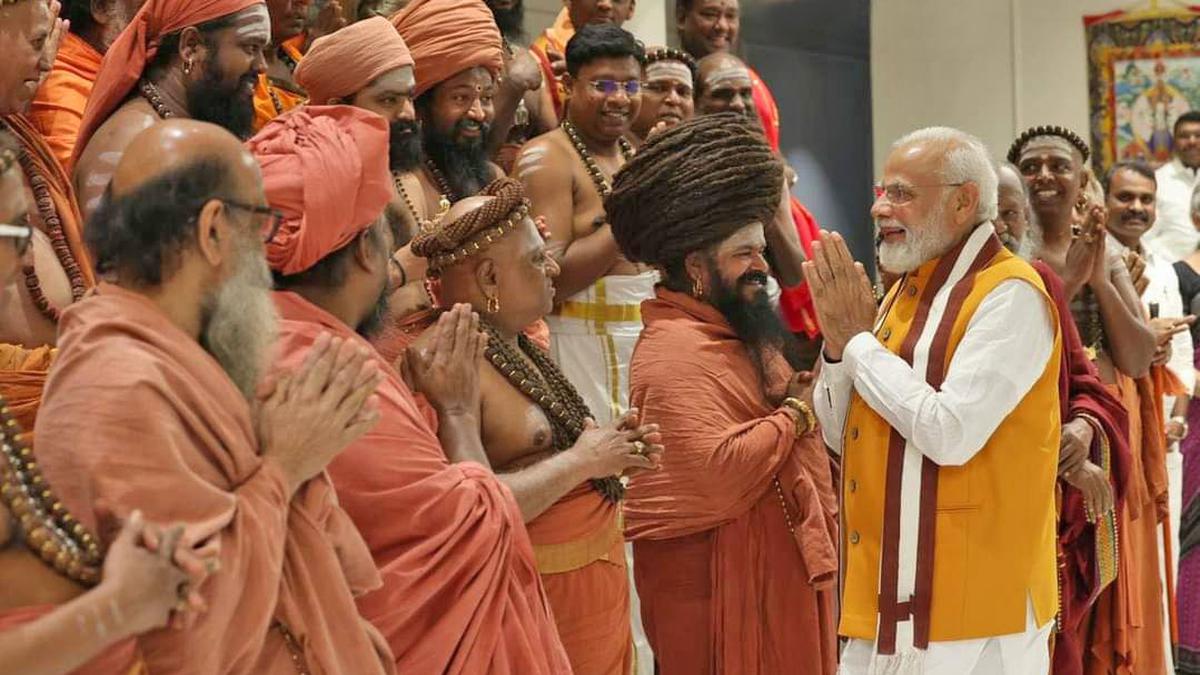
18 Saivite, non-Brahmin Mutts remain the citadels of Tamil language and culture
The Hindu
18 Saivite, non-Brahmin Mutts remain the citadels of Tamil language and culture. Recently, Sri Ambalavana Desikar, the head of the Thiruvavaduthurai Adheenam, along with a group of sanniyasis, all from Tamil Nadu, blessed Prime Minister Narendra Modi, who was prostrating before a Sengol (sceptre) presented by the Adheenam
A sanniyasi (an ascetic or a monk), wearing a headband and neck-piece of rudraksha and boarding a special flight, presents an unusual sight. Recently, when Sri Ambalavana Desikar, the head of the Thiruvavaduthurai Adheenam, along with a group of sanniyasis, all from Tamil Nadu, blessed Prime Minister Narendra Modi, who was prostrating before a Sengol (sceptre) presented by the Adheenam, to be placed in the new Parliament building, the scene drew the nation’s attention to the 18 Saivite, non-Brahmin Mutts or Adheenams in Tamil Nadu.
Emerging in the 16th Century, almost as organisations parallel to temples to propagate the philosophy of Shaiva Siddhanta, these rich institutions own innumerable acres of land, properties and branches. They have always remained the patrons of Tamil language, culture, and music. Besides the heads of the Mutts, there were senior and junior monks. The place of worship is vividly described by U.Ve. Swaminatha Iyer, the grand old man of Tamil and a student of Meenakshisundaram Pillai, the poet laureate of the Thiruvavaduthurai Adheenam.
“I have never seen so many worshippers performing (Siva worship) simultaneously. The entire pujaimatam was filled with large numbers of performing worshippers, and there was an inexhaustible supply of everything necessary for the rituals. The whole place was one huge vision of a magnificent Siva pujai,” Swaminatha Iyer recalls in his autobiography, which has been translated into English by Czech linguist Kamil Václav Zvelebil.
The heads of the Mutts were also great scholars in Tamil and Sanskrit and penned works of merit on Shaiva Siddhanta and Tamil literature. Swaminatha Iyer himself had learnt from the heads of the Mutts, including Melakaram Subramania Desikar and Ambalavana Desikar. The Mutts are known as Adheenam.
Ooran Adigal, the author of Saiva Atheenagal, citing Tamil literary works, says the title, Adheenam, emerged later, and they were known as Mutts earlier. “There is no reference to the word, Adheenam, in The Periyapuranam or other ancient literary works. The place where Saivite minstrels, including Appar and Sambandar, stayed are referred to as Mutts,” he writes.
The Mutts were established by scholars and spiritual gurus and the heads were addressed as ‘Pandaram’. Subsequently, the honorific, ‘Sannithi’, was added, and they became ‘Pandara Sannithi’ and then ‘Gurumaha Sannidhanam’. Poet Kalamegam, in his work Thiruvanaikka Ula, says there were 18 Saivite Mutts. The name of these Mutts found a reference for the first time in Abithana Chintamani published in 1910. Even though there were Mutts during the reign of Cholas, they disappeared with the passage of time and others faded into oblivion.
“Besides the 18 Mutts established on the religious ideology of Shaiva Siddhanta, there are Veera Saiva Mutts such as Thiruporur, Bommapuram, Mailam and Perur,” says Mathusoothanan Kalaiselvan, a historian and expert in the Bhakti literature.


Abhishek Banerjee challenges BJP's Suvendu Adhikari in Nandigram, pledging community health initiatives if Trinamool Congress wins.

Rising LPG shortages in Karnataka boost firewood demand, reviving an informal market as households and hotels seek alternatives.

Against the backdrop of intense poll activity, a 400-metre stretch of an arterial road in the outskirts of Chennai (technically in Madurapakkam panchayat under Tambaram assembly constituency) presents a salute to the idea of res publica, which underpins India’s system of governance, where citizens have a say, at least before a government is securely ensconced in the seat of power. A Republic Day initiative shines bright every night

Fadnavis claims zero FIR in Ajit Pawar crash is a defamation attempt by Karnataka against Maharashtra's investigation efforts.

Set to unfold as a one-day pop-up on April 5, the Easter Sadya brings together both vegetarian and non-vegetarian menus, offering a peek into the food traditions of the Syrian Christian (Nasrani) community. While the traditional Sadya is often associated with dishes such as sambar, avial, and rice, this version expands to include community-specific festive dishes.

BJP nominates mother of R.G. Kar victim Abhaya to contest from Panihati in West Bengal Assembly elections.

Veteran Malayalam actor-director E.A. Rajendran passes away at 71, leaving behind a rich legacy in the film industry.

Dakshina Kannada Zilla Panchayat has rolled out digital mode of water bill generation and collection in 23 gram panchayats on a pilot basis for the first time in Karnataka. This is set to be extended to the remaining 200 panchayats shortly, according to the Zilla Panchayat Chief Executive Officer Narwade Vinayak Karbhari.

Bengaluru police questioned a man carrying ₹6 lakh for medical expenses at Vidhana Soudha, later releasing him after verification.

BJP accuses Bengaluru's Congress government of corruption in e-Khata issuance, halting infrastructure projects due to financial mismanagement.

Misinformation in Hyderabad sparks panic buying, causing disruptions as residents react to unfounded rumors of an impending lockdown.

Bengaluru Metro extends services until 2 a.m. on March 28 for IPL match, ensuring convenient travel for spectators.

A bus truck-collision in Andhra Pradesh's Markapuram district, killing several. Catch LIVE updates here!