₹7.85 lakh crore Defence Budget signals major push for modernisation, future-ready forces: V.K. Saraswat
The Hindu
V.K. Saraswat highlights a ₹7.85 lakh crore Defence Budget, enhancing modernization and future capabilities of India's armed forces.
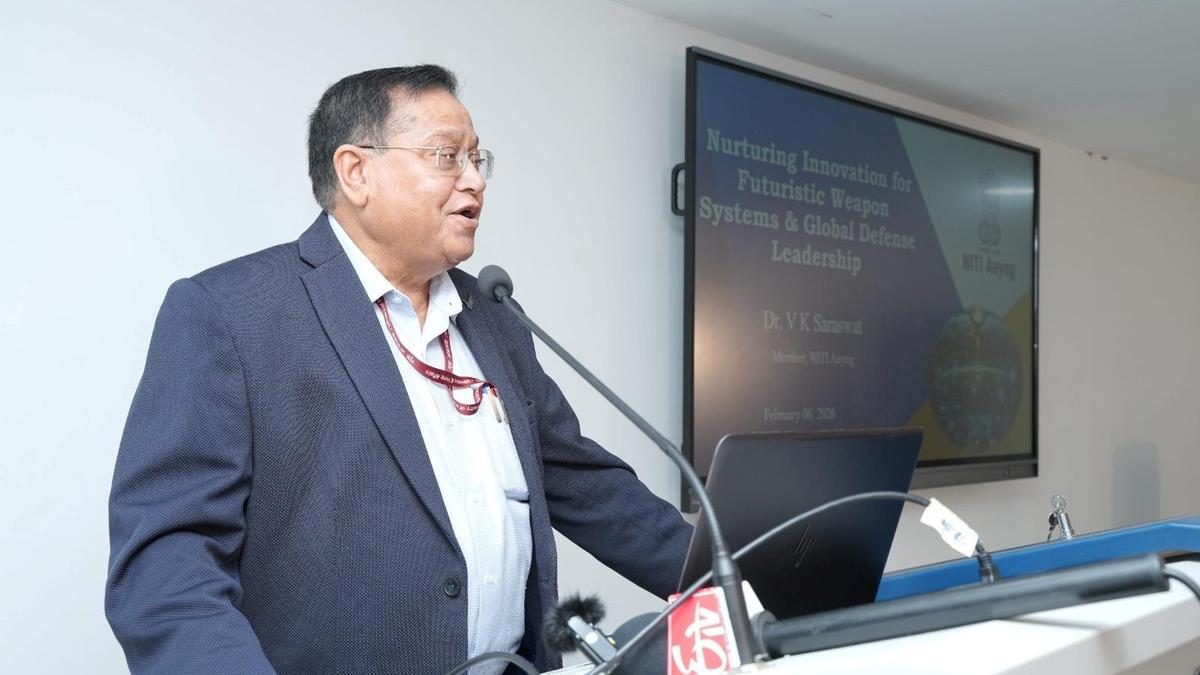
“To modernise all the three services of the Defence sector and enhance their future capabilities, the Central Government has allocated ₹7.85 lakh crore to the Ministry of Defence in Union Budget 2026 -27,” said NITI Aayog member V.K. Saraswat.
Speakihng to The Hindu on the sidelines of a ‘Defence Science Conclave’ organised by a local college in Vijayawada, Mr. Saraswat said the allocation marks a 15.19% increase over the FY 2025 -26 Budget Estimates, and accounts for 14.67% of total Central Government expenditure. “Allocation to DRDO has increased to ₹29,100.25 crore in the current financial year from ₹26,816.82 crore in FY 2025 –26,“ he said.
The distinguished scientist with a vast experience in defence research said the emphasis is on acquiring advanced platforms, cutting-edge technologies and force multipliers. He said the proposal to support States in creating five university townships in the vicinity of industrial and logistics corridors was another major initiative to facilitate training of the youth across multiple research disciplines and align skill development with India’s long-term vision of becoming Viksit Bharat by 2047.
On atomic energy, he said the Sustainable Harnessing and Advancement of Nuclear Energy for Transforming India (SHANTI) Bill, 2025, reflects the government’s effort to modernise the laws governing the nuclear sector.
“It opens the nuclear energy sector to private sector participation for the design, development, manufacturing and large-scale collaboration of nuclear power plants, including small, medium and large modular reactors,” he said, insisting that this shift is critical to achieving India’s target of 100 GW of nuclear power, which cannot be met without the involvement of private sector.
“The idea is to guide the country toward a more advanced and resilient nuclear ecosystem,” he said.


Parliamentary panel urges a review of EPF pensions, highlighting ₹1,000 is insufficient amid rising living costs.

ECI reshuffles 19 senior police officers in West Bengal ahead of upcoming Assembly elections, ensuring transparent and fair polls.

Rajasthan’s employment offices report no government job placements in five years, with over 22 lakh registered job seekers.

In a post shared in his X account, the actor also wrote about his emotional attachment to the State

NIA charges six in Puducherry BJP leader Senthil Kumaran's murder case for attempting to sabotage trial by threatening witnesses.

Bollywood star Hrithik Roshan’s HRX Films has teamed up with Prime Video for ‘Mess’ after the thriller series ‘Storm’. The latest series is directed by Rajesh A Krishnan

Bengaluru NGO PfA Wildlife Hospital replenishes water sources in Turahalli forest to protect urban wildlife from dehydration and human-animal conflict.

Bengaluru NGO PfA Wildlife Hospital replenishes water sources in Turahalli forest to protect urban wildlife from dehydration and human-animal conflict.

Andhra Pradesh Upa Lokayukta orders ₹50.24 lakh payment of EPF and ESI dues to KGBV outsourcing staff in Srikakulam.

Former Puducherry Congress MLA V. Vizeaveny joins BJP

Bajaj Electricals acquires Morphy Richards brand rights in India and South Asia, enhancing innovation and market strategy.

CPI(M) insists on contesting more seats in the 2026 Tamil Nadu Assembly elections amid ongoing seat-sharing negotiations with DMK.

Kerala's Film Policy recognizes cinema as an industry, promoting gender justice and sustainable growth through various strategic reforms.