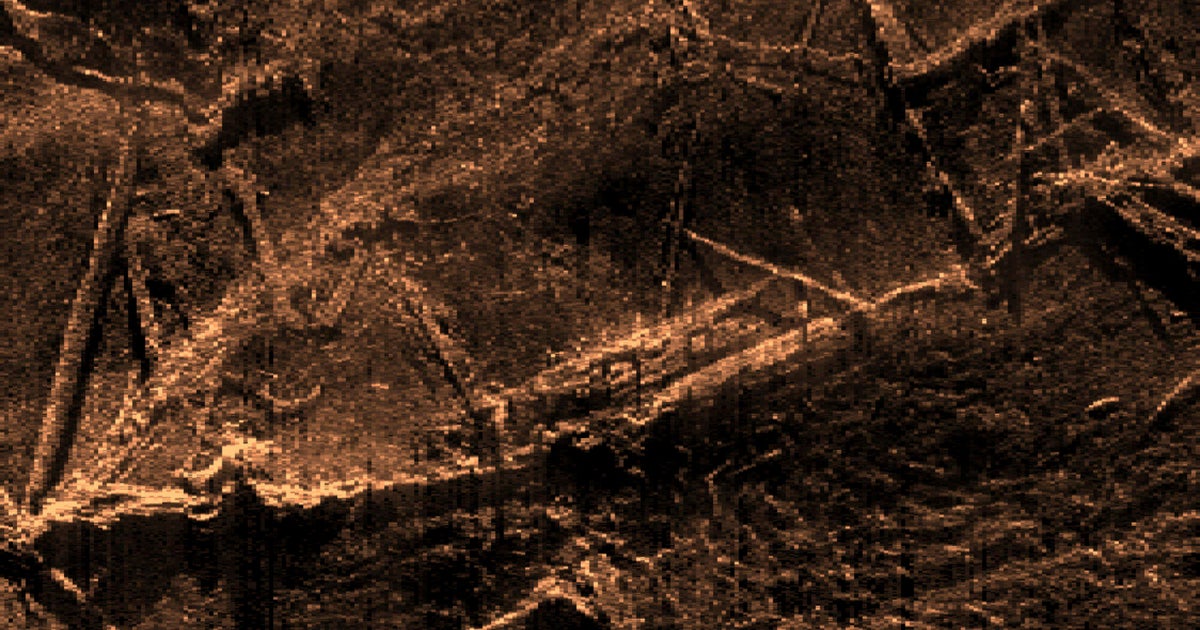
Wreck of last U.S. slave ship remains mostly intact on Alabama coast, researchers say
CBSN
Researchers studying the wreckage of the last U.S. slave ship, buried in mud on the Alabama coast since it was scuttled in 1860, have made the surprising discovery that most of the wooden schooner remains intact, including the pen that was used to imprison African captives during the brutal journey across the Atlantic Ocean.
While the upper portion of the two-masted Clotilda is gone, the section below deck where the captured Africans and stockpiles were held is still largely in one piece after being buried for decades in a section of river that hasn't been dredged, said maritime archaeologist James Delgado of the Florida-based SEARCH Inc.
At least two-thirds of the ship remains, and the existence of the unlit and unventilated slave pen, built during the voyage by the addition of a bulkhead where people were held as cargo below the main deck for weeks, raises questions about whether food and water containers, chains and even human DNA could remain in the hull, said Delgado.


Washington — It's not a palace, but next month the White House is set to be overrun by royals. Gabrielle Ake contributed to this report.

Epic Games, the video game maker behind Fortnite, is laying off more than 1,000 workers amid "extreme" market conditions and a downturn in engagement with its most popular game, CEO Tim Sweeney said in a blog post Tuesday. Edited by Aimee Picchi In:

Security screening lines are so long at some U.S. airports that major airlines are letting passengers cancel or rebook their tickets free of charge during the ongoing partial federal government shutdown. Edited by Alain Sherter In:

Travelers at Houston's George Bush Intercontinental Airport are standing for hours in security lines that may cause more risks for travelers — amid a DHS funding fight that's resulted in TSA staff shortages at major U.S. airports. Kaia Hubbard and Kathryn Krupnik contributed to this report. In:

Washington — President Trump, who calls voting by mail "cheating" and wants to restrict the method, voted by mail this month in Florida's special elections, public records show. In:

Washington — Oklahoma Gov. Kevin Stitt appointed energy executive Alan Armstrong on Tuesday to replace newly confirmed Department of Homeland Security Secretary Markwayne Mullin in the Senate.

Washington — The Senate is closing in on a deal to fund the bulk of the Department of Homeland Security and end the partial government shutdown that has stretched six weeks and snarled air travel. Seiji Yamashita and Alan He contributed to this report.

Ford Motor Co. is recalling 254,640 Lincoln and Explorer vehicles due to a software issue that may disrupt the rearview camera and other features intended to enhance safety while driving. Edited by Aimee Picchi In:

The Trump administration deployed ICE and other Homeland Security agents to 14 of the nation's airports on Monday to help shuttle passengers through overcrowded TSA checkpoints. In one airport, the security line wait-time was up to six hours. Nicole Sganga and Kaia Hubbard contributed to this report. In:

One of South Africa's most notorious apartheid police commanders testified on Monday at an inquiry into the killing of four activists in 1985 as part of the country's renewed focus on atrocities committed by security forces during decades of forced racial segregation that went unpunished. In:

Secretary of State Marco Rubio is expected to testify in federal court Tuesday in the ongoing criminal trial of former Florida Congressman David Rivera, who is accused of secretly lobbying for the Venezuelan government during the first Trump administration.

A U.S. Park Police officer was seriously wounded Monday evening in a shooting in Washington, law enforcement officials said.

A large explosion at a Valero oil refinery near the Texas Gulf coast Monday shot plumes of smoke into the air and forced some nearby residents to shelter in place. In: