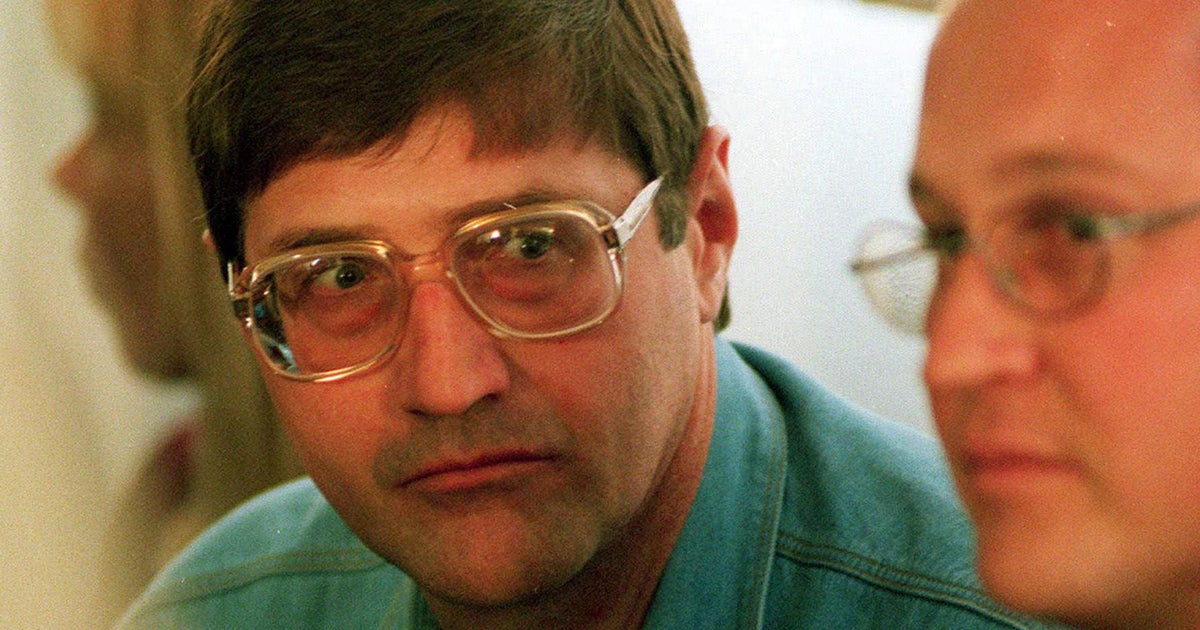
Notorious police commander dubbed "Prime Evil" testifies at South African hearing on apartheid killings
CBSN
One of South Africa's most notorious apartheid police commanders testified on Monday at an inquiry into the killing of four activists in 1985 as part of the country's renewed focus on atrocities committed by security forces during decades of forced racial segregation that went unpunished. In:
One of South Africa's most notorious apartheid police commanders testified on Monday at an inquiry into the killing of four activists in 1985 as part of the country's renewed focus on atrocities committed by security forces during decades of forced racial segregation that went unpunished.
Eugene de Kock, dubbed "Prime Evil" for his role in killing anti-apartheid activists, denied involvement in the prominent case of the Cradock Four - but said police at the time had photos of around 6,000 anti-apartheid activists described as "known terrorists" who should be tracked and killed if an arrest was not possible.
The Cradock Four were not among them, he said. Matthew Goniwe, Fort Calata, Sicelo Mhlauli and Sparrow Mkonto, three of them teachers, were abducted by police at a roadblock and killed. Their bodies were found burned, in one of the apartheid era's most shocking cases.
De Kock testified that one of the police officers implicated in the killings had asked him to help assist with a cover-up.
"He wanted to know if I could get another firearm," de Kock said, adding that he was asked "if we could interfere with the ballistics."


Polymarket is moving to quash insider trading as prediction markets face scrutiny over whether some users draw on classified or other closely held information to gain an edge in betting on events. Edited by Alain Sherter In:

Washington — Senate talks aimed at ending the 38-day shutdown of the Department of Homeland Security hit a new roadblock on Monday after President Trump called on Republicans to hold out for passage of an elections bill that Democrats strongly oppose. Nikole Killion contributed to this report.

Pope Leo XIV put the Rev. Edward Joseph Flanagan a step closer to possible sainthood Monday as he proclaimed the "heroic virtues" of the founder of Boys Town, a Nebraska home for at-risk youths that gained national renown and inspired an Oscar-winning biopic performance. In:

Washington — Amid Trump administration demands for Tehran to keep the free flow of commerce in the Strait of Hormuz, U.S. officials have told CBS News that there are at least a dozen underwater mines through the vital passageway, according to current American intelligence assessments. Arden Farhi, Kathryn Watson, Caroline Linton, Aimee Picchi and Layla Ferris contributed to this report.

Elon Musk, famously a man with big ideas, is building a semiconductor plant vast enough to power those ambitions. Edited by Alain Sherter In:

The Justice Department has quietly gutted a more than 60-year-old program created to ensure that low-income and indigent immigrants can receive competent and affordable legal representation, multiple sources with direct knowledge of the matter tell CBS News. In:

Kyiv — The White House wants Congress to provide at least $200 billion more in funding for the war in Iran, and President Trump says that's partly due to aid for Ukraine having depleted U.S. weapons stockpiles as it fends off Russia's ongoing full-scale invasion. In:

A statue of Christopher Columbus has been placed on the grounds of the Eisenhower Executive Office Building adjacent to the White House — the latest effort by the Trump administration to honor the explorer whose legacy has drawn increasing criticism in recent years. In:

OnlyFans owner Leonid Radvinsky, a reclusive billionaire who transformed a little-known adult-content site into a cultural touchstone, has died of cancer, the company said Monday. Radvinsky was 43. Edited by Alain Sherter

Washington — President Trump said early Monday that he is postponing airstrikes on Iran's power plants after "very good and productive conversations" over the last two days about reopening the Strait of Hormuz. However, Iran's foreign ministry denied any such talks. Claire Day contributed to this report. In:

Immigration and Customs Enforcement agents began deploying to some U.S. airports on Monday as a partial government shutdown causes shortages of Transportation Security Administration officers who have resigned or called out of work. Skyler Henry contributed to this report. In:

London — Police in London are investigating a suspected antisemitic hate crime after vehicles belonging to a Jewish ambulance service were set on fire early Monday morning. In:

Washington — The Supreme Court is considering Monday a major elections dispute involving whether federal law bars states from counting mail ballots that are postmarked by, but received after Election Day.